
At a glance
- Asset type: Whitepaper
- Published: 28th July 2016
- Source: GroupM Germany
- Language: DE original. EN summary and Q&A.
- Topics: Internet of Things (IoT), marketing touchpoints, data and personalization, customer experience, product innovation, new business models
Publication details
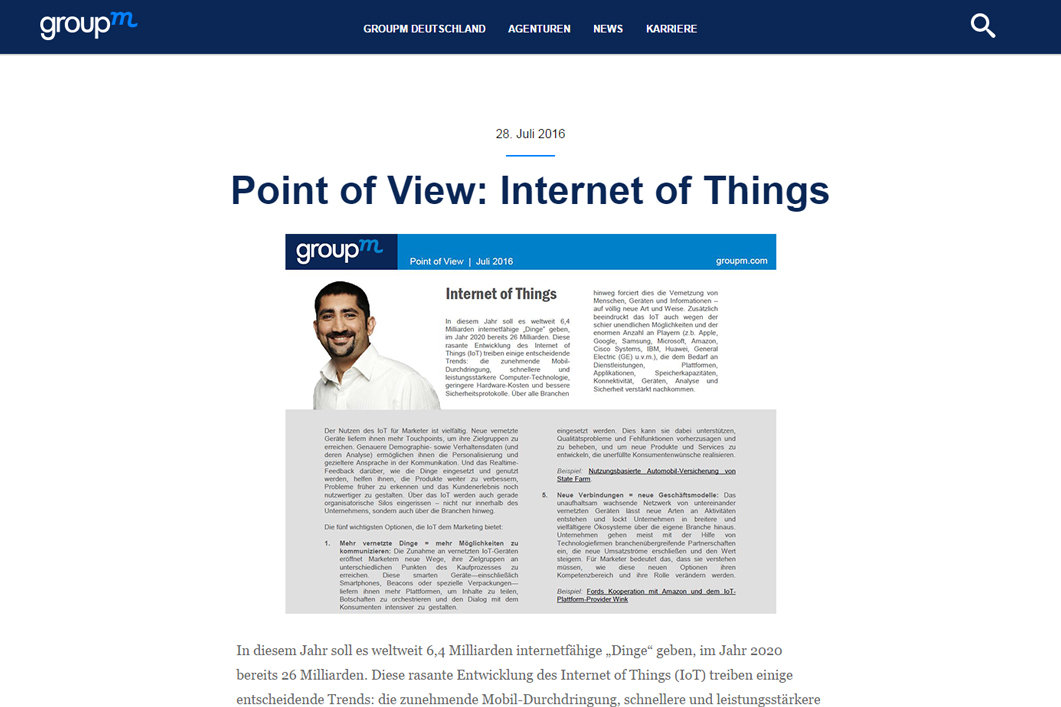
This 2016 point of view explains why the Internet of Things matters to marketers beyond technology hype. As more devices become connected, brands gain new touchpoints across the purchase journey and richer demographic and behavioural signals that can improve personalization and targeting. The paper highlights a practical advantage that is often overlooked. Real-time feedback about how connected products are used can improve service design, reveal problems earlier, and make the overall customer experience more useful. It also argues that IoT pushes organizations beyond classic silos, because meaningful value often requires cross-functional collaboration and partnerships across industries. Five marketing-relevant options summarize the opportunity. More connected “things” create more moments to communicate. Better data improves insight and measurement. Real-time insights enable more helpful customer experiences. Product and service development becomes more evidence-led. And new connections can open new business models.
Publisher excerpt (German)
In diesem Jahr soll es weltweit 6,4 Milliarden internetfähige „Dinge“ geben, im Jahr 2020 bereits 26 Milliarden. Diese rasante Entwicklung des Internet of Things (IoT) treiben einige entscheidende Trends: die zunehmende Mobil-Durchdringung, schnellere und leistungsstärkere Computer-Technologie, geringere Hardware-Kosten und bessere Sicherheitsprotokolle. Sunil Bahl, Digital Strategist bei Mindshare, hat alles Wissenswerte zu diesem Thema zusammengefasst.
Publisher excerpt (English translation)
This year, there are expected to be 6.4 billion internet-enabled “things” worldwide, and by 2020 already 26 billion. This rapid development of the Internet of Things (IoT) is being driven by several decisive trends: increasing mobile penetration, faster and more powerful computer technology, lower hardware costs, and better security protocols. Sunil Bahl, Digital Strategist at Mindshare, has summarised everything worth knowing about this topic.
Original publication link
Key questions. Clear answers.
What is the Internet of Things in plain terms?
The Internet of Things refers to physical objects and devices that are internet-enabled and connected, so they can collect, exchange, and act on data. In this POV, the key implication is that connected devices link people, products, and information in new ways.
Why does IoT matter to marketers specifically?
The paper argues that IoT expands the number of touchpoints available to brands and improves the quality of demographic and behavioural insights. That enables more personalized communication and better targeting across the purchase journey.
What are the five biggest marketing opportunities described?
The POV groups the opportunity into five options: more connected devices create more ways to communicate, better data improves insight, customer experiences become more useful through real-time signals, product development modernizes through usage feedback, and new connections enable new business models.
How does IoT improve measurement and ROI thinking?
By connecting data from devices and networks, marketers can integrate and evaluate signals that indicate which purchase phase a customer is in, how behaviour changes, and how campaigns perform. The goal is more measurable impact, not just more data.
How can IoT improve customer experience?
Real-time insights can enable more relevant services and continuous improvement of service levels. The paper also notes that connected devices can sometimes play an active role in guidance and support, making the experience more useful.
What does IoT change about product and service innovation?
As brands become better at analyzing device data, they learn how products and services are actually used. That can help predict quality issues earlier, fix problems faster, and develop new offerings that address unmet needs.
Why does IoT push organizations beyond silos?
The POV argues that IoT often creates value through ecosystems and partnerships that cross internal functions and even industry boundaries. Marketers need to understand how these new connections change roles and create new revenue opportunities.