
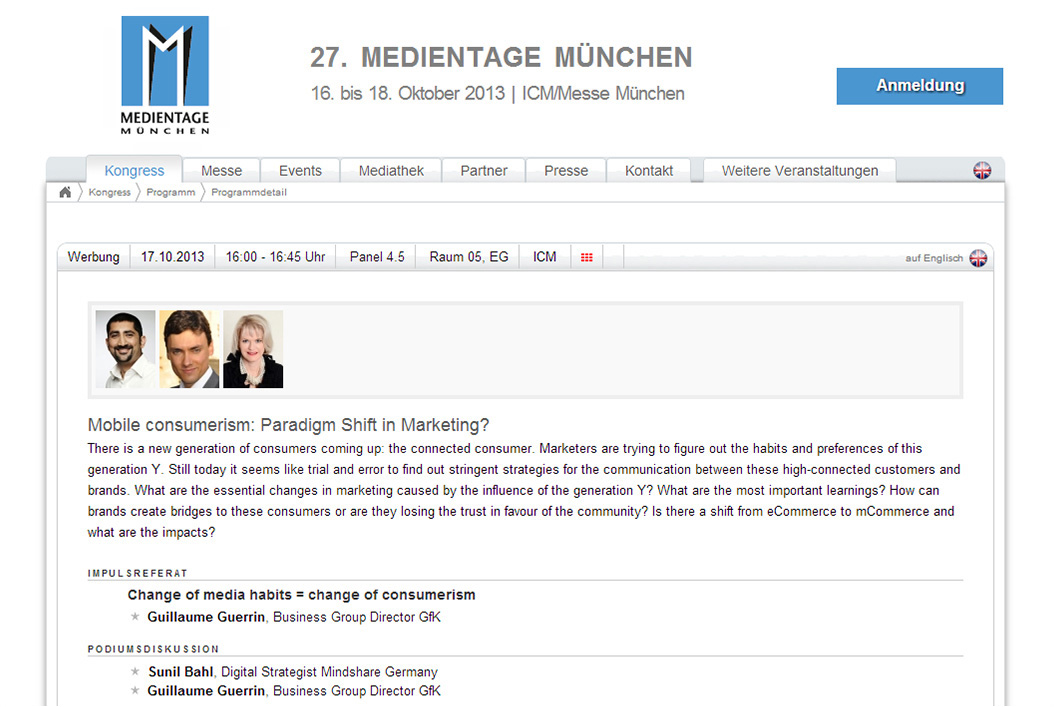
At a glance
- Asset type: Event
- Format: Live Debate and Audience Q&A
- Event date: 17th October 2013
- City: Munich
- Source: Medientage München
- Speakers: Sunil Bahl, Guillaume Guerrin
- Moderator: Bettina Horster
- Language: EN original. DE translation. EN summary and Q&A.
- Topics: Connected consumers, Generation Y, mobile-first marketing, mCommerce, community trust, privacy and regulation, media habit shifts
Debate summary
This live debate explored whether “mobile consumerism” represents a true paradigm shift in marketing. The discussion framed the rise of the connected consumer as a change in media habits that reshapes expectations for how brands communicate, serve, and sell. It questioned whether marketing strategy is still too experimental when addressing highly connected customers, and whether trust is moving from brands toward communities. A core theme was the shift from eCommerce to mCommerce and the operational implications. Mobile can no longer be treated as an add-on channel. It must shape experience design, content quality, and how digital touchpoints respond across devices. The debate also surfaced cultural differences, especially how privacy expectations and legal constraints influence what mobile marketing can do in different markets.
Publisher excerpt (German)
Während der anschließenden Podiumsdiskussion mahnte Sunil Bahl, Digital Strategist der Medienberatung Mindshare Germany, die Unternehmen, Mobile Marketing nicht nur als additiven Kanal zu betrachten, der lediglich nach Budgetsituation bespielt werde. Er beobachte beispielsweise, dass im Moment eine Vielzahl von Webpräsenzen der Unternehmen noch nicht dynamisch auf das jeweilige Ausgabegerät reagierten und deshalb auf Smartphones nicht darstellbar seien. Dabei würden die Nutzer von Jahr zu Jahr anspruchsvoller, was Qualität von Inhalten und Präsentationsformen beträfe.
Auf die Nachfrage, ob Mobile Marketing kulturelle Differenzen berücksichtigen müsse, erwiderte Bahl, dass er diese vor allem in der Auslegung des Datenschutzes sehe. Die gesetzlichen Beschränkungen reichten in Deutschland sehr weit. Andererseits sei es in machen Entwicklungsländern durchaus üblich, Mobiltelefone intensiver zu nutzen, weil ein leistungsfähiges Festnetz gar nicht zur Verfügung stünde.
Publisher excerpt (English translation)
During the subsequent panel discussion, Sunil Bahl, Digital Strategist at the media consultancy Mindshare Germany, cautioned companies not to view mobile marketing only as an additional channel that is used merely depending on the budget situation. He observed, for example, that at the moment many corporate web presences still do not respond dynamically to the respective output device and therefore cannot be displayed on smartphones. At the same time, users are becoming more demanding year by year in terms of the quality of content and forms of presentation.
When asked whether mobile marketing must take cultural differences into account, Bahl replied that he sees these primarily in the interpretation of data protection. The legal restrictions in Germany go very far. On the other hand, in some developing countries it is quite common to use mobile phones more intensively because a powerful fixed-line network is not available at all.
Key questions. Clear answers.
What did “mobile consumerism” mean in this 2013 debate?
In this debate, mobile consumerism referred to how changing media habits through smartphones reshape consumer expectations and purchasing behavior. The implication is that marketing, service, and commerce increasingly happen through mobile-first interactions.
What was the core warning to companies about mobile marketing?
The core warning was not to treat mobile marketing as an add-on channel that is activated only when budgets allow. The debate positioned mobile as a structural shift that should influence how experiences are designed and delivered.
Why did the debate highlight mobile-ready websites as a baseline?
The discussion pointed out that many company websites were not yet responsive or usable on smartphones. As user expectations rise, failing at basic mobile usability undermines communication, engagement, and conversion.
What was the role of Generation Y and the “connected consumer”?
The debate framed Generation Y as an early signal of the connected consumer. This audience is highly networked, compares options constantly, and increasingly relies on community and peer signals, which affects how trust is earned.
Is the shift from eCommerce to mCommerce only about the checkout screen?
No. The shift affects the entire journey: discovery, evaluation, service, and loyalty. Mobile changes the timing and context of decisions, so brands need experiences that work in real moments, not only at the point of purchase.
What cultural differences were considered most important for mobile marketing?
The debate highlighted privacy and data protection as a key area of cultural and regulatory difference. Germany was described as having strict legal constraints, while some developing markets see more intensive mobile use because fixed-line infrastructure is limited.
What is a practical first step for brands based on these takeaways?
A practical first step is to ensure mobile-first experience quality: responsive web presence, fast performance, and content formats that work on smartphones. Without that foundation, mobile channel activity cannot deliver reliable value.