
At a glance
- Asset type: Whitepaper
- Published: 11th February 2014
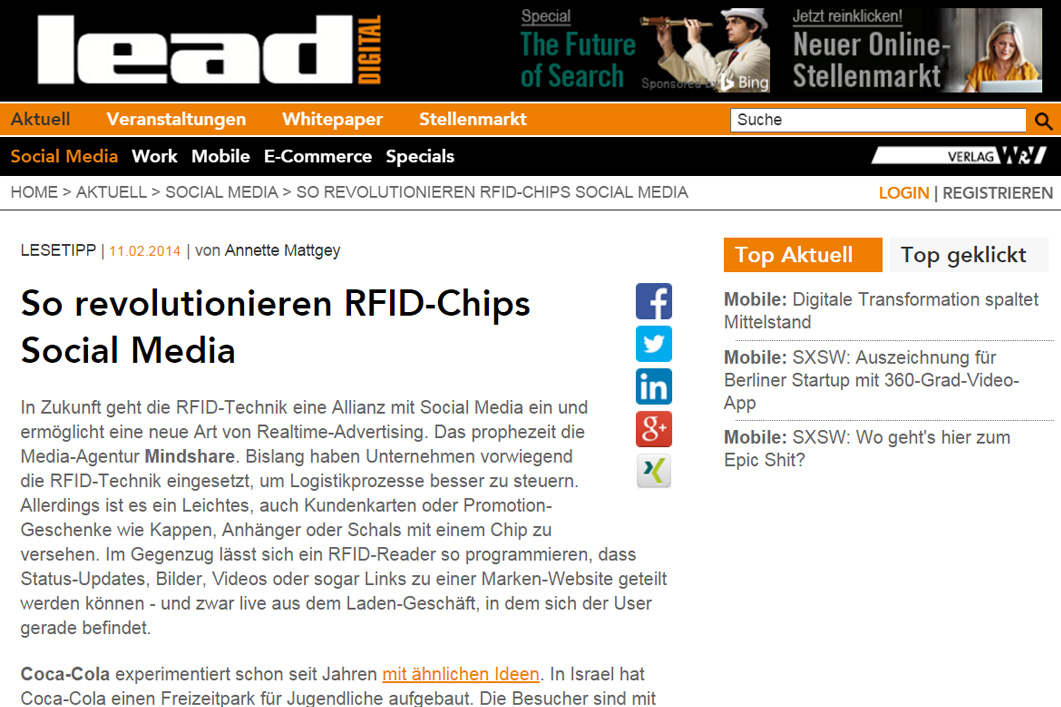
- Source: LEAD Digital
- Language: DE original. EN summary and Q&A.
- Topics: RFID, social sharing, real-time marketing, retail activation, events, hospitality, loyalty, data-driven engagement
Publication details
This point of view explains how RFID can act as a “real-world share button” by connecting physical touchpoints to social networks. The core idea is simple. Make sharing frictionless in the moment, so an in-store interaction, event experience, or on-site service can be translated into social content with a single gesture.
The paper frames RFID-enabled sharing as a practical bridge between offline experience and digital amplification. It highlights how brands can use this to increase participation, expand reach through user distribution, and learn from the content people choose to share, provided the activation is designed around clear value for participants.
Publisher excerpt (German)
RFID (Radio-frequency identification) ist eine Technologie, die immer stärker in den Fokus gelangt, da deren technische Verschmelzung mit sozialen Netzwerken immer mehr zum Standard wird. Viele Unternehmen und Marken schaffen damit eine Verbindung zwischen digitaler Welt und dem realen Leben.
Unternehmen setzen die RFID Technik ein, um es ihren Konsumenten zu ermöglichen, ihr Markenerlebnis realtime in den Sozialen Netzwerken zu teilen – einfach nur mit einer Wischbewegung. Dabei ist es technisch relativ einfach, einen RFID-Chip in ein Armband, einen Anhänger, eine Kundenkarte oder ein Promotionprodukt einzubauen. Ein RFID Reader, der an einem bestimmten Ort oder Geschäft platziert wird, kann schließlich so programmiert werden, dass Status-Updates, Bilder, Videos oder sogar Links zu einer Marken-Website geteilt werden können.
Publisher excerpt (English translation)
RFID (radio-frequency identification) is a technology that is increasingly coming into focus, because its technical merging with social networks is becoming more and more the standard. Many companies and brands are thereby creating a connection between the digital world and real life.
Companies use RFID technology to enable their consumers to share their brand experience in real time in social networks, simply with a swiping movement. Technically, it is relatively easy to integrate an RFID chip into a wristband, a tag, a customer card, or a promotional product. An RFID reader that is placed at a specific location or store can then be programmed so that status updates, images, videos, or even links to a brand website can be shared.
Key questions. Clear answers.
What is “RFID social sharing” in plain terms?
RFID social sharing is the use of RFID chips and readers to turn an offline moment into a shareable digital action. A tap or swipe at a physical touchpoint can trigger content sharing such as a status update, photo, video, or link.
How does the “real-world share button” work?
An RFID chip is embedded in something people carry, for example a wristband, card, or promotional item. When that chip is read at a programmed location, the system can publish or enable sharing of predefined content via social platforms.
Where does this approach fit best in marketing?
It fits best where brands control the physical experience and can add value at the moment of interaction. Typical contexts include events, retail environments, branded installations, and hospitality experiences.
What is the main benefit beyond “more social posts”?
The main benefit is reducing friction between experience and sharing, which can increase participation and reach. It can also create learning signals about what people choose to share when the experience is designed well.
What should a team design first before launching an activation?
Design the participant value first. People need a clear reason to opt in. Then define what gets shared, when it gets shared, and what control the participant has in that flow.
What metrics matter for an RFID sharing activation?
Track participation rate, share rate, content types generated, downstream engagement, and repeat interactions. Also measure operational reliability, because the experience fails quickly if the physical-to-digital trigger is inconsistent.
What are the most common pitfalls?
The most common pitfalls are unclear opt-in, weak participant value, and over-automation that removes user control. Another frequent issue is treating the activation as a gimmick instead of integrating it into a coherent experience journey.