
At a glance
- Asset type: Whitepaper
- Published: 30th September 2016
- Source: GroupM Germany
- Language: DE original. EN summary and Q&A.
- Topics: Chatbots, Messaging platforms, Digital marketing, Media and publishing, AI chatbots
Publication details
This 2016 point of view frames chatbots as a practical consequence of messaging becoming the dominant user interface for digital communication. It defines chatbots as software that can run automated dialogues with humans, via text or speech recognition, and argues that relevance is rising because digital messengers are becoming everyday default behaviour. The paper highlights early use cases that reduce friction rather than chase novelty, including customer service, content distribution for publishers, commerce assistance, and HR style job bots. It also separates basic rule-based bots from AI-enabled bots, where self-learning systems can respond more effectively to individual user intent. The takeaway is pragmatic. Sustainable adoption depends on trust, an appropriate tone of voice, and clear utility, where bots act as gateways to relevant information and advantages and help users make better purchase decisions.
Publisher excerpt (German)
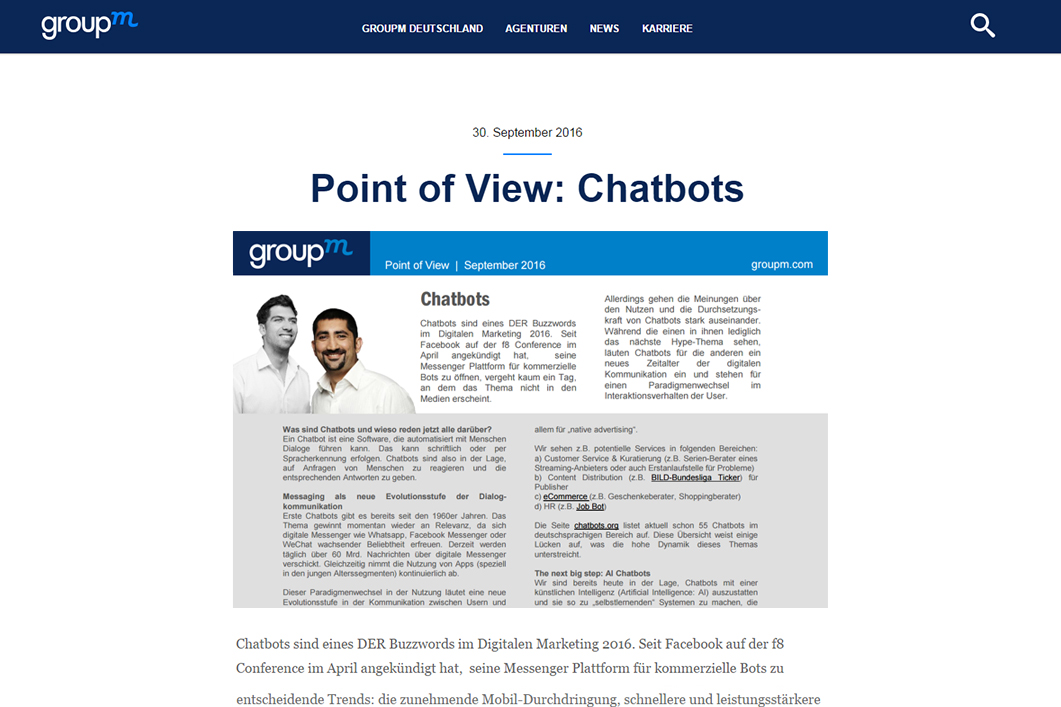
Chatbots sind eines DER Buzzwords im Digitalen Marketing 2016. Seit Facebook auf der f8 Conference im April angekündigt hat, seine Messenger Plattform für kommerzielle Bots zu öffnen, vergeht kaum ein Tag, an dem das Thema nicht in den Medien erscheint. Allerdings gehen die Meinungen über den Nutzen und die Durchsetzungskraft von Chatbots stark auseinander.
Während die einen in ihnen lediglich das nächste Hype-Thema sehen, läuten Chatbots für die anderen ein neues Zeitalter der digitalen Kommunikation ein und stehen für einen Paradigmenwechsel im Interaktionsverhalten der User. Christoph Duscynski, Senior Produkt & Projekt Manager bei GroupM, und Sunil Bahl, Digital Strategist bei Mindshare, haben alles Wissenswerte zu diesem Thema zusammengefasst.
Publisher excerpt (English translation)
Chatbots are one of THE buzzwords in digital marketing in 2016. Since Facebook announced at the f8 Conference in April that it would open its Messenger platform to commercial bots, hardly a day goes by without the topic appearing in the media. However, opinions about the benefit and the power of chatbots to establish themselves differ widely.
While some see in them merely the next hype topic, for others chatbots herald a new era of digital communication and stand for a paradigm shift in users’ interaction behaviour. Christoph Duscynski, Senior Product & Project Manager at GroupM, and Sunil Bahl, Digital Strategist at Mindshare, have summarised everything worth knowing about this topic.
Original publication link
Key questions. Clear answers.
What is a chatbot in this point of view?
A chatbot is software that can run automated dialogue with humans, either via text or via speech recognition. In this POV, the bot is treated as a scalable interface for service and information exchange, not as a gimmick.
Why did chatbots surge again in 2016?
The POV links the renewed momentum to messaging platforms becoming mainstream and to platform moves that enabled commercial bots within messengers. That combination turned chatbots into a usable channel for brands and publishers.
What is the core shift when messaging becomes the interaction layer?
Messaging makes brand interaction faster, more spontaneous, and more individualized because it happens inside an existing conversation flow. The POV positions this as a step change from sites and apps toward dialogue-first communication.
Which use cases were considered realistic first?
The POV emphasizes utility-first journeys such as customer service and curation, content distribution for publishers, commerce assistance, and HR recruitment-style bots. The common trait is friction reduction in tasks users already want to complete.
What is the next step beyond basic bots?
AI-enabled chatbots. The POV argues that self-learning systems can respond more effectively to individual intent, but that early deployments would often start without AI because learning needs significant data and training.
What determines whether people accept chatbots?
Trust, plus tone of voice and tangible value. The POV highlights benefits like acting as a gateway to relevant information and advantages, and helping users make better decisions during purchase situations.
What is a practical first step for a marketing team?
Start with a single high-frequency, low-complexity journey where users ask repeat questions, then expand only after you can show faster resolution and higher satisfaction. The POV’s framing implies that utility beats novelty.