
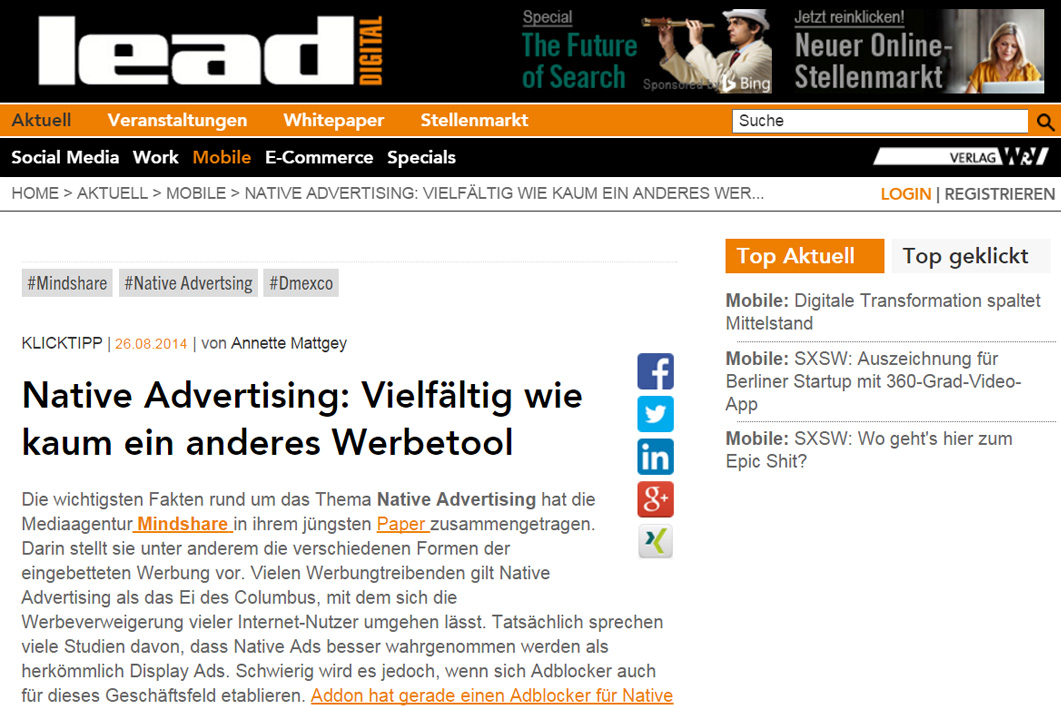
At a glance
- Asset type: Whitepaper
- Published: 26th August 2014
- Source: LEAD digital
- Language: DE original. EN summary and Q&A.
- Topics: Native advertising, paid content, disclosure, branded content, in-feed ads, paid search ads, recommendation widgets, promoted listings, banner blindness, engagement
Publication details
This POV describes native advertising as paid content that closely matches the look and formats of editorial environments. It positions the rise of native formats as a response to fragmented media usage and declining display impact, creating new revenue potential for publishers and a new way for marketers to involve and bind consumers more intensively.
Because there is no single universal definition, the POV proposes clear criteria and uses the IAB’s 2013 categorisation into six native ad format families, ranging from in-feed units and paid search units through recommendation widgets and promoted listings to IAB standard units and custom executions.
Publisher excerpt (German)
Native Advertising wird als eingebettete Werbung beschrieben, die sich an das redaktionelle Umfeld anlehnt, Werbevermeidung reduzieren soll und laut den zitierten Studien oft stärker wahrgenommen wird als klassische Display Ads. Gleichzeitig wird darauf hingewiesen, dass Adblocker auch hier an Bedeutung gewinnen. Als Kriterien nennt der Beitrag redaktionelle Anmutung, Platzierung außerhalb klassischer Anzeigenflächen, Paid statt Earned Media sowie klare Kennzeichnung.
Publisher excerpt (English translation)
Native advertising is described as embedded advertising that mirrors the surrounding editorial environment, aims to reduce ad avoidance, and is often perceived more strongly than classic display ads in the cited studies. The article also notes that ad blockers are becoming relevant here as well. The criteria listed include an editorial look and feel, placement outside classic ad slots, paid rather than earned media, and clear disclosure.
Key questions. Clear answers.
What is “native advertising” in this POV?
It is paid content designed to match the look and formats of the surrounding editorial environment, so it fits naturally into how people consume content rather than behaving like a separate banner unit.
What must be true for something to count as native advertising here?
The POV sets four criteria. It should imitate the editorial environment. It should be placed outside the usual ad space. It should be paid media rather than earned media. And it must be clearly labelled as non-editorial content.
What are the IAB’s six native ad formats referenced in the POV?
The POV lists six groups. In-feed units. Paid search units. Recommendation widgets. Promoted listings. IAB standard ads used to drive branded content. And custom ads that do not fit neatly into the other categories.
Where does the POV say native advertising shows up most often?
It highlights distribution across social media and content and news portals, plus video sharing sites and streaming services, driven by clicks and sharing behaviour.
Why do brands use native advertising according to the cited research?
The POV cites reasons such as spreading a more relevant message, increasing consumer engagement, creating awareness or buzz, driving word of mouth, and reacting to “banner blindness”.
Does the POV claim native is more effective than banners?
Yes. It cites studies suggesting higher attention and stronger lifts in purchase intent and brand affinity versus standard display. The POV also stresses that effectiveness depends on real user value and on keeping the user experience unobtrusive and high quality.
What is a practical first step for a marketing team?
Start with one format family that fits your channel mix, then define strict disclosure rules and a clear value promise for the audience. Measure attention and engagement, then iterate before scaling into additional formats.