
At a glance
- Asset type: Whitepaper
- Published: 27th May 2016
- Source: GroupM Germany
- Language: DE original. EN summary and Q&A.
- Topics: Virtual Reality (VR), immersive media, head-mounted displays (HMD), brand storytelling, customer experience, marketing and sales enablement
Publication details
This 2016 point of view positions Virtual Reality as a newly market-ready medium after decades of hype. It defines VR as an experience that transports a user fully into a virtual world, typically via a head-mounted display (HMD) connected to peripherals such as headphones and controllers that help navigate the application. For marketers, the core claim is that VR creates “presence”. It can move audiences into places and moments that are hard to communicate through flat media. The paper translates this into ten brand-relevant options, from experiential travel and product configuration to training, live event access, retail exploration, sponsorship extensions, recruitment, and market research. It also cites adoption and market forecasts for 2016–2020 and concludes that VR is still developing, but gaining traction beyond early adopters, with the potential to reshape how people consume digital experiences.
Publisher excerpt (German)
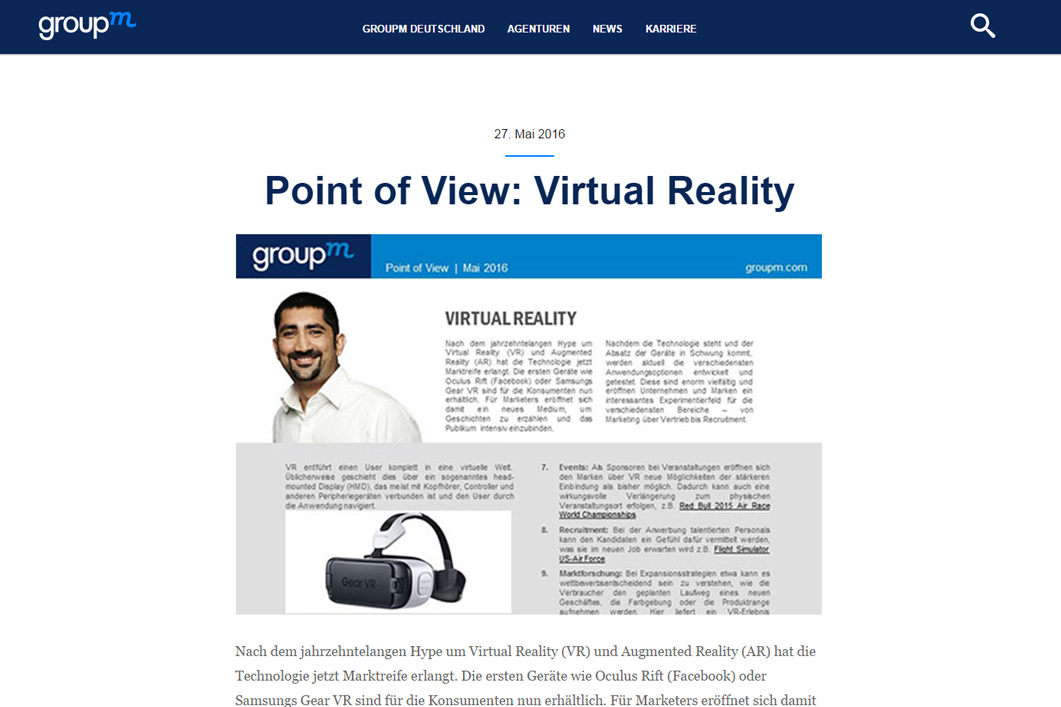
Nach dem jahrzehntelangen Hype um Virtual Reality (VR) und Augmented Reality (AR) hat die Technologie jetzt Marktreife erlangt. Die ersten Geräte wie Oculus Rift (Facebook) oder Samsungs Gear VR sind für die Konsumenten nun erhältlich. Für Marketers eröffnet sich damit ein neues Medium, um Geschichten zu erzählen und das Publikum intensiv einzubinden.
Sunil Bahl, Digital Strategist bei Mindshare, hat alles Wissenswerte zum Thema Virtual Reality in unserem PoV für Mai zusammengefasst.
Publisher excerpt (English translation)
After decades of hype around Virtual Reality (VR) and Augmented Reality (AR), the technology has now reached market maturity. The first devices such as Oculus Rift (Facebook) or Samsung’s Gear VR are now available to consumers. For marketers, this opens up a new medium to tell stories and engage audiences intensely.
Sunil Bahl, Digital Strategist at Mindshare, has summarized everything worth knowing about the topic of Virtual Reality in our May point of view.
Original publication link
Key questions. Clear answers.
What is Virtual Reality in this point of view?
VR is described as an experience that transports a user fully into a virtual world. It typically uses a head-mounted display (HMD) connected to peripherals such as headphones and controllers that help the user navigate the application.
Why did VR become relevant for marketers in 2016?
The POV argues that VR reached market readiness and that first consumer devices became available. Its marketing value comes from immersion and “presence”, where audiences feel inside an experience rather than merely watching it.
What are the ten most important brand use cases described?
The POV lists ten options: experiential journeys (e.g., travel), product configuration and virtual test drives, training and production storytelling, paid access to live event experiences, product extensions via branded VR experiences, retail exploration to counter showrooming, event sponsorship extensions, recruitment and job previews, market research for store layouts and assortment, and relationship management via VR content distribution (“VR as a service”).
Which examples are used to make the use cases concrete?
Examples include Marriott Hotels virtual honeymoon, Lexus NX VR configurator, Art of Patrón VR experience, Samsung and the NBA for live broadcasts, Dior Eyes, Ted Baker VR treasure hunt, Red Bull Air Race extensions, a US Air Force flight simulator for recruitment, Tesco VR market research, and Samsung’s Gear VR bundle with Galaxy S7 pre-orders.
What do the market forecasts in the paper suggest?
The POV cites SuperData Research projecting 38.9 million VR applications installed by the end of 2016 and expects mobile VR headsets to take the largest share that year, at 78 percent. It also references estimates that VR hardware revenue could reach around three billion US dollars by 2020.
What makes a VR activation work for a brand?
The implied success factor is experiential value. VR is strongest where presence changes perception, such as travel, high-consideration products, training, and event experiences that are hard to replicate through other formats.
What is a practical first step for a marketing team?
Start with one use case that clearly benefits from immersion, then prototype and test quickly before scaling. The paper’s use-case set suggests experimenting across functions, because VR opportunities span marketing, sales, HR, and research.