
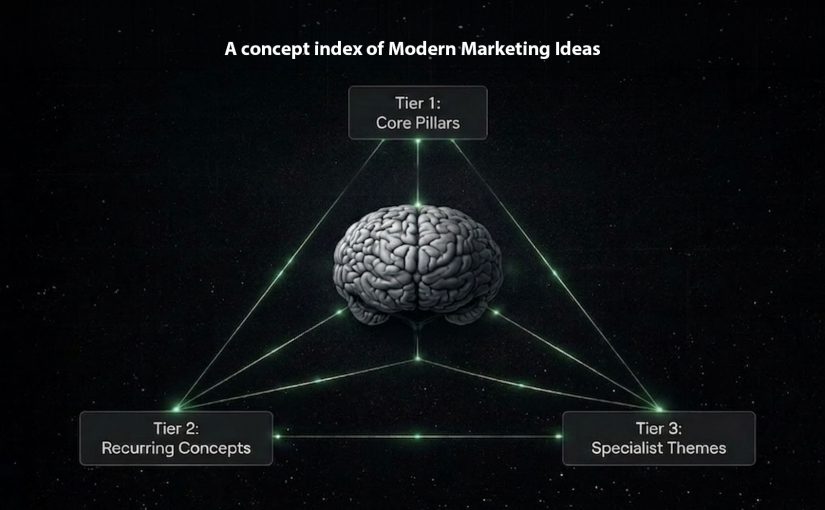
SunMatrix Ramble is an independent archive of marketing, digital innovation, and consumer experience thinking built around recurring mechanisms, not just one-off campaigns. This page maps the archive into a tiered concept system so visitors can move from broad structural ideas to more specific recurring patterns without getting lost in chronology.
Tier 1 below highlights the core archive pillars that most strongly organize Ramble. These are the stand-alone concepts that create the clearest paths into the archive. Tier 2 and Tier 3 concepts sit underneath as supporting layers, so the page can show the full breadth of the archive without flattening everything into one taxonomy wall.
Core marketing concepts explored on Ramble
Experiential marketing focuses on brand interactions people can physically or digitally enter, feel, test, or participate in.
Social participation and platform mechanics describes campaigns built around sharing, remixing, signaling, contribution, and the native behaviors of digital platforms.
Interactive advertising turns media placements into participatory experiences where people can trigger, choose, influence, or control what happens next.
Mobile marketing and app experience covers phone-native, app-led, and device-driven interactions where the mobile interface becomes the product, service layer, or behavior trigger.
Shopper marketing and commerce experience connects storytelling, discovery, context, retail design, and transaction into a more effective path to choice and purchase.
Augmented reality in marketing overlays digital layers onto physical context to deepen discovery, utility, product understanding, or place-based engagement.
Tier 1: Core archive pillars
Experiential Marketing
Experiential marketing turns the brand into something people can enter, witness, test, or physically respond to. Across Ramble, it is one of the clearest archive pillars because it captures campaigns where memory comes from lived interaction rather than message delivery alone.
Representative posts:
- The Escape Service: Press the red button
- Heineken Departure Roulette
- McDonald’s: Adult Playland in Sydney
Social Participation and Platform Mechanics
Some campaigns use social platforms as distribution. Stronger campaigns use them as behavioral systems. This concept covers work built around contribution, remixing, public signaling, participation loops, and platform-native mechanics that make the audience part of how the idea spreads.
Representative posts:
Interactive Advertising
Interactive advertising gives the audience a role. Instead of asking people only to watch, it asks them to trigger, choose, respond, unlock, or influence the experience. In the archive, this is a major recurring pillar because participation often increases attention, memorability, and retell value.
Representative posts:
- VW GTI Banner Race: Chase a Car Across the Web
- Bradesco Seguros: The Fake iPad Ad
- The Noite: Troll Ad Button
Mobile Marketing and App Experience
Mobile marketing and app experience covers phone-led, app-based, and device-native interactions where the handset becomes the interface, controller, or service layer. This is not just mobile as a screen. It is mobile as behavior, utility, and customer experience design.
Representative posts:
Shopper Marketing & Commerce Experience
Shopper marketing and commerce experience sits where brand communication meets decision, retail context, and transaction. In Ramble, this pillar covers physical retail, commerce design, packaging, and purchase-adjacent experiences that change how people browse, compare, choose, and buy.
Representative posts:
Augmented Reality in Marketing
Augmented reality in marketing connects digital layers to physical context. When used well, it goes beyond novelty and improves product understanding, discovery, utility, or place-based engagement. Ramble has enough depth here for this to remain one of the clearest stand-alone concept threads in the archive.
- A New Kind of Catalog 2: IKEA’s AR catalog
- Tissot Augmented Reality Product Experience
- Airwalk: The Invisible Pop-Up Store
Tier 2 covers major recurring concept families that appear repeatedly across the Ramble archive. These are not the main structural pillars of the archive, but they are important recurring patterns in how modern marketing works, from storytelling and gamification to viral video, digital activation, and packaging-led experience. In many cases, these concepts sit inside, extend, or intersect with the Tier 1 pillars, helping readers trace the mechanisms that show up again and again across campaigns, platforms, and consumer touchpoints.
Tier 2: Major recurring concept families
Viral Video and Earned Media
Viral video and earned media focuses on campaign ideas designed to travel beyond paid placement through retelling, sharing, press pickup, and public conversation. In Ramble, this concept captures work where distribution becomes part of the creative outcome.
Representative posts:
- TNT: A Dramatic Surprise on an Ice-Cold Day
- Evian: Roller-skating Babies
- Hyundai Canada: Worst Parking Job Ever
Out-of-Home and Ambient Media
Out-of-home and ambient media covers ideas that use public space, physical context, and unexpected placement as part of how the message lands. These campaigns often blur media, environment, and experience to create stronger noticeability and recall.
Representative posts:
Brand Storytelling and Branded Content
Brand storytelling and branded content brings the brand to life through narrative structure, character, editorial framing, or longer-form content rather than pure interruption. This concept fits campaigns where story is the mechanism, not just the wrapping.
Representative posts:
- Johnnie Walker: A Walk Through Brand History
- Lexus Hoverboard: Engineering a Brand Moment
- Volvo Trucks: The Hamster Stunt
Gamification
Gamification applies challenge, reward, progress, competition, or play mechanics to make participation more motivating and memorable. In Ramble, this concept covers campaigns where game logic is central to the experience, not just an added layer on top of another format.
Representative posts:
- Burger King: The Whopper Lust Challenge
- Heineken Star Player
- Magnum Pleasure Hunt 2: bigger, bolder sequel
Cause Marketing and Social Impact
Cause marketing and social impact covers work that connects a brand, organization, or campaign idea to a social issue, public cause, or wider behavior-change objective. The stronger examples in Ramble do more than signal values. They make participation, visibility, or contribution part of the mechanism.
Representative posts:
- Metro Trains Melbourne: Dumb Ways to Die
- UNICEF Tap Project: Dirty Water Machine
- WWF: The .wwf Unprintable PDF Format
Digital Activation
Digital activation covers campaigns built around a clear digital trigger that prompts an immediate user action. The defining pattern is not storytelling or platform reach on its own, but a response mechanic that turns attention into participation, redemption, upload, unlock, or direct digital interaction. In Ramble, this concept matters when the action layer is the engine of the idea.
Representative posts:
Packaging and Product Experience
Packaging and product experience covers cases where the pack, product, or physical object does more than contain or present the brand. In Ramble, this concept is strongest when the object itself becomes the trigger, interface, or experience layer, so interaction is built into what people hold, open, wear, or use.
Representative posts:
- Oakley: Pro Vision with Google Cardboard
- Coca-Cola Wish in a Bottle
- Novalia: Playable Album Cover DJ Deck
Tier 3 includes specialist and supporting concepts that add depth, precision, and cross-links to the archive. These themes are often narrower, more technical, more emerging, or more cross-cutting than the upper tiers, but they still play an important role in understanding how marketing systems evolve. They help surface patterns in areas such as CRM, customer experience, connected products, AI, real-time marketing, and multi-screen behaviour without turning the Concept Index into a flat taxonomy of equal peers.
Tier 3: Specialist and supporting concepts
Direct Marketing and CRM
Direct marketing and CRM covers campaigns built around targeted response, database logic, direct contact, loyalty behavior, and measurable customer action. In Ramble, this concept matters where the mechanism depends on precision, relevance, and follow-up rather than broad public reach alone.
Representative posts:
Connected Products and IoT Marketing
Connected products and IoT marketing covers campaigns where connected devices, sensors, wearables, or networked objects become part of the brand experience. The concept is most useful when the product itself acts as a touchpoint, trigger, or data-enabled layer of the idea.
Representative posts:
Customer Experience and Service Design
Customer experience and service design focuses on ideas where utility, usability, service flow, or friction reduction becomes the marketing mechanism. In Ramble, this concept fits examples where the experience itself does the persuading.
Representative posts:
Second Screen and Multi-Screen Experience
Second screen and multi-screen experience covers campaigns built around synchronized attention across TV, mobile, tablet, or other connected screens. The concept matters when the value comes from coordination between screens rather than from a single medium in isolation.
Representative posts:
- MTV Under The Thumb: second-screen TV for Europe
- Cheetos Mix-Ups: Cheetahpult Dual-Screen Game
- Coca-Cola Second Screen Reinvented
AI in Marketing and Creative Systems
AI in marketing and creative systems covers campaigns, products, and brand experiences where machine intelligence shapes generation, personalization, recommendation, or interaction design. On Ramble, this is a newer but fast-rising archive layer as AI moves from backstage tool to visible customer-facing mechanism.
Representative posts:
- NotCo: AI-Powered Fragrance With Purpose
- Lovart AI: Photoshop, Now as Simple as Paint
- InVideo AI: Future of Ads, or Slop at Scale?
Experiential Commerce and Retail Tech
Experiential commerce and retail tech sits at the intersection of shopping, physical environment, and technology-enabled retail interaction. It matters when the store, shelf, display, or commerce space becomes an active experience layer rather than just a point of transaction.
Representative posts:
- Homeplus Subway Virtual Store: Mobile Aisle
- The Adaptive Storefront: BLE Retail Display
- eBay: Give-A-Toy Store
Real-Time Marketing
Real-time marketing covers campaigns that respond to live context, current events, audience behavior, or unfolding moments with speed and relevance. The concept is useful where timing is not just executional, but central to why the idea works.
Representative posts:
- Old Spice: The Social Response Campaign
- Best Buy: Twelpforce on Twitter
- Coca-Cola Live Tweets #LetsEatTogether
Together, these three tiers turn Ramble into a concept-led archive rather than a chronology-first blog. Tier 1 highlights the stand-alone pillars that most strongly organize the archive. Tier 2 surfaces major recurring concept families. Tier 3 captures narrower specialist layers and supporting lenses, so the archive’s breadth becomes easier to navigate without losing structural clarity.
A few fast answers before you act
What marketing concepts does Ramble cover?
Ramble covers a wide range of modern marketing concepts across brand experience, digital participation, interactive media, mobile and app-led engagement, commerce experience, augmented reality, storytelling, gamification, CRM, customer experience, AI, connected products, and real-time marketing. The Concept Index organises these recurring ideas into a clear tiered structure so readers can navigate the archive by mechanism, not just by date.
How is the Ramble concept index structured?
The Concept Index is structured in three tiers. Tier 1 contains the core archive pillars that best represent the archive’s main areas of strength. Tier 2 contains major recurring concept families that appear frequently across posts and often sit inside or across the Tier 1 pillars. Tier 3 contains specialist and supporting concepts that add depth, precision, and cross-links without turning the archive into a flat list of equal categories.
Why are only some concepts treated as core archive pillars?
Only a small number of concepts are treated as core archive pillars because not every valid concept needs to be a first-order hub. A concept becomes a Tier 1 pillar only when it has strong archive depth, clear boundaries from adjacent concepts, and enough substance to help a first-time visitor decide where to go next.
What is the difference between experiential marketing and interactive advertising?
Experiential marketing usually focuses on creating branded experiences that people can enter, take part in, or remember through direct participation. Interactive advertising focuses more specifically on ad formats, placements, or media units that invite audience response, control, or input. The two can overlap, but experiential marketing is usually the broader participation layer, while interactive advertising is the more media-specific expression.
Why does the concept index use tiers instead of listing all concepts equally?
The tiered model keeps the archive easier to understand for both readers and machines. It shows which concepts are the strongest structural pillars, which ones are recurring families, and which ones are specialist or supporting themes. That makes the archive more useful than a flat taxonomy wall and helps preserve a clear sense of hierarchy.
How should readers use the concept index?
Readers should use the Concept Index as a curated map into the archive. Start with a Tier 1 pillar if you want the clearest entry point into a major area of marketing practice. Use Tier 2 and Tier 3 concepts when you want to explore specific mechanisms, narrower themes, or related patterns that cut across multiple parts of the archive.