
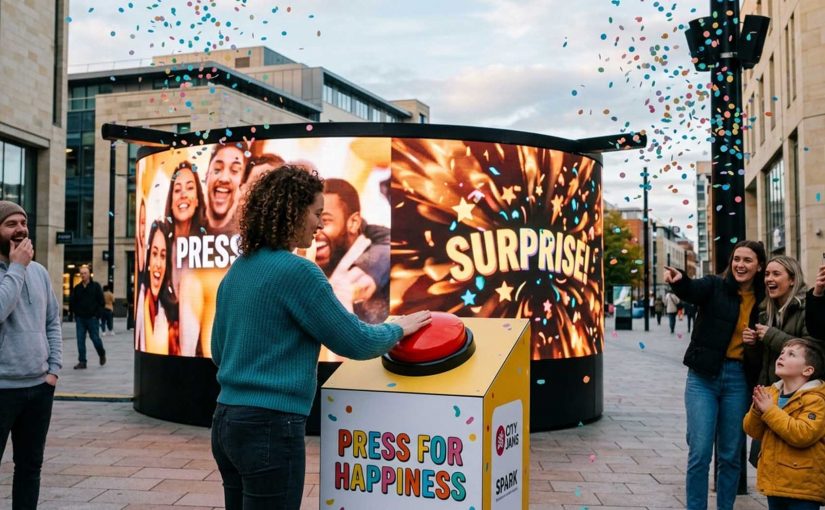
Experiential marketing turns the brand into something people can enter, trigger, test, or physically respond to. The difference is simple. The message does not sit outside the experience and explain it. The experience itself carries the meaning.
On Ramble, this concept matters because some of the archive’s strongest examples do not persuade through copy alone. They create a lived moment people can perform, witness, remember, and retell.
Curated by Sunil Bahl
Creator and author of SunMatrix Ramble. Independent analysis of marketing concepts, campaign mechanics, and consumer experience patterns.
How experiential marketing works
Experiential marketing works when a brand designs a clear encounter and lets participation do the heavy lifting. Instead of asking people only to watch or read, it asks them to press a button, step into a space, cooperate with a stranger, accept a challenge, or trigger a payoff in public. The stronger the mechanic, the less explanation the idea needs. That is why the best experiential work often looks deceptively simple. One visible trigger. One understandable rule. One immediate consequence.
What makes the concept powerful is that it turns abstract brand values into observable behaviour. Adventure becomes a public choice. Togetherness becomes a shared reward. Escape becomes a button you press. Fun becomes something adults are allowed to step into. In European enterprises and global FMCG organisations, this matters because the audience does not need to decode a positioning statement first. They can feel the brand promise through action, environment, and payoff.
Experiential marketing is strongest when the encounter itself becomes the proof. Film, social sharing, and earned media may amplify it later, but they are not the primary engine. The primary engine is the designed moment people live through in real space, with real stakes, real cooperation, or real surprise.
What belongs here, and what does not
This hub focuses on brand ideas where the designed encounter is the dominant marketing mechanism. A post belongs here when participation is central, the audience completes the idea through action, and the memory comes from a lived moment rather than from media placement or message delivery alone.
It does not automatically include every public stunt, screen-based interaction, retail activation, AR layer, or social campaign. If the main innovation sits inside an ad unit, the cleaner home is Interactive Advertising. If the phone or app is the main behaviour engine, it belongs more naturally under Mobile Marketing and App Experience. If the activation is really about purchase behaviour, store flow, or conversion, it moves closer to Shopper Marketing and Commerce Experience. If the digital overlay is the core mechanism, that is Augmented Reality in Marketing. If the brilliance comes mainly from contextual public placement and bystanders are mostly observers rather than participants, the better fit may be Out-of-Home and Ambient Media.
The working rule is strict. Assign a post to the concept that carries the primary mechanism, not the most visible execution layer. That is why this hub prioritises encounter-first ideas and leaves overlap-heavy cases in the related-post layer rather than the core set.
Representative Ramble examples
The Escape Service: Press the red button
This is one of the cleanest examples in the archive because the entire idea is reduced to a single public action and an oversized payoff. Pressing the button turns an abstract travel promise into a physical experience people can trigger instantly. It belongs here because the encounter is the message. Without the encounter, the idea collapses.
McDonald’s: Adult Playland in Sydney
McDonald’s turns nostalgia into something adults can literally step into. The installation works because it gives public permission to play without making participation feel childish. It is a strong representative example because it shows how experiential marketing can rebuild emotional closeness through a physical environment rather than through communication alone.
Share Happy Ice Cream Machine
The machine only works when two people cooperate, so the brand message is performed in public rather than stated on a poster. That makes this a very strong example of how a simple rule can turn a giveaway into a social ritual. It belongs here because the interaction is the media.
Heineken Departure Roulette
This activation translates adventurousness into a visible, irreversible public choice. The power is not the prize. The power is the moment of decision. It is representative because it shows how experiential marketing can turn a brand value into proof by forcing people to live it, or walk away from it, in public.
KLM’s Bonding Buffet
KLM creates togetherness by making cooperation the only route to a shared reward. The dinner table comes down only when strangers commit together. This belongs in the core set because it demonstrates one of experiential marketing’s most durable strengths. Designing a visible constraint that people can only resolve through participation.
Related archive posts
These posts widen the view while keeping the concept clear.
Public surprise and witness-driven activations
- Pepsi Max: Unbelievable Bus Shelter. Strong experiential energy, but the public-space media format is more exposed to out-of-home and interactive-advertising overlap, so it fits better here than in the core set.
- Coca-Cola Turkey: Invisible Vending Machine. A fast, legible street reveal with a clear participation trigger. Strong fit, but close enough to ambient and public-installation logic that related status is cleaner.
- Coke Zero: Unlock the 007 in You. Highly watchable and physically participatory, but more exposed to timed-challenge and gamification mechanics than the final five.
Participation through generosity and social proof
- Coca-Cola: Hug Me Machine. A very strong experiential example, but it overlaps with the archive’s wider vending-machine pattern and would make the representative set too format-heavy if promoted into the core set.
- Coca-Cola: Happiness Truck. Clear public reward loop and strong visibility, but best used here to add breadth rather than to dominate the page with another dispense-led activation.
Friction redesign and interaction in transit spaces
- Zappos Thanksgiving Baggage Claim. Strong live activation, but it also leans toward customer experience and service-design logic because it redesigns a waiting moment rather than building a stand-alone encounter.
- KLM Connecting Seats. Strong participation-based brand meaning, but it sits close to customer experience and connection design, so related status keeps the boundary cleaner.
Tangible utility as experience
- Andes Beer: The Teletransporter. A physical booth that turns a consumer tension into a usable bar-side intervention. Useful for breadth because it shows how experiential marketing can behave like a productised utility, not just a stunt.
Why this concept still matters
Experiential marketing still matters because it solves a problem most brands have not solved with more media, more targeting, or more content. It creates belief through observable behaviour. When people can see the action, understand the rule, and witness the payoff, the brand promise becomes harder to dismiss as positioning language.
That matters even more now because attention is fragmented and recall is weak. A good experiential idea compresses understanding. People do not need a long explanation when the mechanic is tight. They understand the setup, the stakes, and the meaning in seconds. That makes the concept valuable not just for live events, but for any brand trying to create retellability, emotional imprint, and earned amplification from a simple action structure.
The real question is not whether brands should do experiences. The real question is whether they can design encounters where participation itself becomes proof. That is the repeatable lesson running through the strongest Ramble examples.
Explore the full Marketing Concepts index
Experiential Marketing is one of Ramble’s six core archive pillars. To see how it connects to adjacent concepts and the wider tiered concept system, explore the full Marketing Concepts index.
A few fast answers before you act
What is experiential marketing?
Experiential marketing is a brand approach where people enter, trigger, test, or participate in a designed encounter. The experience itself carries the message, rather than relying only on copy, media placement, or explanation.
How is experiential marketing different from interactive advertising?
Experiential marketing is encounter-first. People step into a branded moment and complete it through action. Interactive advertising is usually ad-format-first, where the interaction happens mainly inside a poster, screen, media unit, or placement.
What makes experiential marketing effective?
It works best when the mechanic is simple, visible, and easy to understand. A strong experiential idea lets people see the trigger, understand the rule, and feel the payoff quickly, which makes the brand promise easier to remember and retell.
When does a campaign belong under experiential marketing rather than shopper marketing or mobile marketing?
A campaign belongs under experiential marketing when the designed encounter is the main mechanism. If the primary job is to influence purchase behaviour, retail flow, or conversion, it fits better under shopper marketing. If the phone, app, or device interaction is doing most of the work, it fits better under mobile marketing.
Why does experiential marketing still matter?
It still matters because it creates belief through participation. When people can act, react, and witness the outcome for themselves, the brand message becomes harder to ignore and easier to remember than a claim delivered through media alone.