
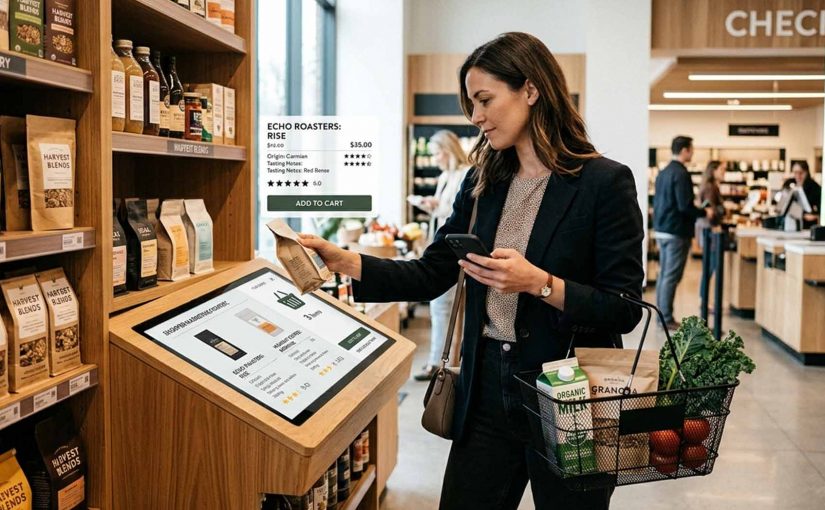
Shopper Marketing and Commerce Experience focuses on what happens when brand interest gets close to transaction. It covers the points where people browse, compare, choose, and buy, and where brands or retailers can shape those moments to reduce friction, build confidence, expand the basket, or make the next action easier.
On Ramble, this concept matters because some of the archive’s strongest retail examples are not trying to create attention in the abstract. They change the buying decision itself. They intervene at the moment of choice, in the store, on the interface, or across the commerce journey, and make that decision feel easier, faster, clearer, or more rewarding.
Curated by Sunil Bahl
Creator and author of SunMatrix Ramble. Independent analysis of marketing concepts, campaign mechanics, and consumer experience patterns.
How Shopper Marketing and Commerce Experience works
Shopper Marketing and Commerce Experience works by intervening at the points where people hesitate, second-guess, or default. That can mean helping them discover better, compare faster, understand relevance more clearly, find the right product, or complete the purchase with less friction.
The mechanism is usually not bigger messaging. It is better decision architecture. The strongest examples change the structure around the choice itself. Shelf context. Basket context. Store layout. Interface logic. Recommendation cues. Urgency. Wayfinding. Hand-off into purchase. They make the next step feel more obvious and more doable than the status quo.
In global FMCG, retail, and commerce organizations, this matters because growth often depends less on generating awareness and more on making the decision journey easier, faster, and more confident at the exact moment a shopper is ready to act.
What belongs here, and what does not
This hub includes work where shopper behaviour, purchase context, basket-building, retail decision architecture, or conversion friction sits at the center. It covers cases that help people compare better, decide faster, feel more confident, discover the right option, or complete the purchase more easily. The touchpoint can be physical, digital, or hybrid, but the core job must still be to improve how people browse, choose, and buy.
It does not include Experiential Marketing or Interactive Advertising when the main value is spectacle, participation, or media novelty, even if the activation appears in a store or ends with a voucher. It also does not include Mobile Marketing and App Experience when the phone is the hero and commerce is only an outcome, or Packaging and Product Experience when the product pack is the primary interface and the purchase journey is secondary.
It stays separate from Experiential Commerce and Retail Tech when the main story is the technology layer itself, and from Customer Experience and Service Design when the value arrives mainly after the purchase through delivery, service flow, or ongoing convenience. For this hub, the decisive question is simpler. Does the work materially improve the shopping or buying decision at the moment it matters.
Representative Ramble examples
Hellmann’s: Recipe Receipt to Recipe Cart
This is shopper marketing at its cleanest. The system uses basket context at checkout and aisle context in-store to suggest recipes, expand usage occasions, and help shoppers act immediately while purchase momentum is still live. The point is not awareness. It is contextual decision support tied directly to what people are already buying.
Audi City London: Future of Auto Retail
Audi City turns a constrained showroom into a decision interface. Instead of letting physical floor space limit the choice set, it lets visitors explore and configure a much broader range in life-size digital form, which makes the store work harder as a comparison and confidence-building environment.
Meat Pack: Hijack
Meat Pack pushes shopper conquesting to its extreme. The mechanic uses location-triggered discount pressure at the exact moment a shopper is inside a competitor’s store, converting consideration into a rapid switch and making the path from trigger to purchase brutally short.
PUMA: The World’s Fastest Purchase
This is a strong example because the act of purchase becomes the mechanic itself. The promotion is built around speed, urgency, and in-store transaction behaviour, which keeps the center of gravity on conversion-stage design rather than on surrounding theatre.
Klépierre: Inspiration Corridor
Klépierre shows how mall-level discovery can become a guided commerce journey. The corridor personalizes browsing, lets shoppers save products, and connects that interest to app-based wayfinding, which makes the jump from inspiration to store visit feel much easier to complete.
Related archive posts
These related posts widen the concept without weakening the core set. Each one still sits inside shopper and commerce logic, but from a different angle of the decision journey.
Decision design at the moment of order
- Pizza Hut Interactive Table: order by touch. This post earns its place because it turns ordering into a visible build process and makes the act of choosing feel more tactile, legible, and immediate.
- Liaison Dangereuse: Striptease Shopping. This case belongs here because it is built around reducing hesitation and helping shoppers move more confidently toward selection and purchase.
Retail surfaces that shorten the path to purchase
- Görtz: Virtual Shoe Fitting. This is a good supporting example of a retail surface that moves quickly from curiosity to trial and then into a mobile hand-off for purchase.
- Macy’s iBeacon: Retail Enters Micro-Location. Macy’s adds the in-store context layer, showing how location-aware retail can reduce friction in discovery and decision-making once the shopper is already in the environment.
Conversion triggers at the point of choice
- Red Stripe Musical Extravaganza. This belongs as related, not representative, because it uses shopper choice as the trigger for the experience and shows how retail theatre can still reinforce the buying moment when the product decision is the switch.
- The world’s first emotionally powered store. This is a strong supporting example because it tackles gift-shopping stress directly and turns emotional response into a recommendation flow that helps people choose with more confidence.
Why this concept still matters
Shopper Marketing and Commerce Experience still matters because attention is expensive, but hesitation is often the real conversion tax. The brands and retailers that win do not only communicate harder. They reduce the effort, uncertainty, or delay between intent and action.
That is why this deserves to be a Tier 1 hub on Ramble. It sits at the point where retail, media, product context, interface design, and behavioural mechanics start to work as one system. The best archive examples prove that small structural changes near the moment of choice can outperform much louder messaging further upstream.
The durable lesson is simple. Do not ask shoppers to do extra cognitive work if the environment can do it for them. Make the next step clearer. Make the option set easier to navigate. Make the benefit easier to understand. Make the purchase feel like progress, not effort.
Explore the full Marketing Concepts index
Shopper Marketing and Commerce Experience is one of the six Tier 1 pillars in the Ramble concept architecture. The full Marketing Concepts index shows how this hub connects to adjacent ideas such as Experiential Marketing, Interactive Advertising, Mobile Marketing and App Experience, and Augmented Reality in Marketing, without collapsing them into one blurred retail bucket.
A few fast answers before you act
What is Shopper Marketing and Commerce Experience?
It is the discipline of shaping the moments where people browse, compare, choose, and buy. The focus is not just communication. It is the structure around the decision, the context, the interface, the trigger, the reassurance, and the path to purchase.
How is this different from Experiential Marketing?
Experiential Marketing is primarily about the encounter and the participation itself. Shopper Marketing and Commerce Experience is narrower and more practical. Its center of gravity is the buying decision, the basket, the store journey, the commerce surface, or the transaction friction.
What makes a strong shopper-marketing example on Ramble?
A strong example changes behaviour at the point of choice. It helps people discover, compare, decide, navigate, or buy more effectively. If the same idea would still work without a real purchase context, it probably belongs in another concept.
Why is this a Tier 1 concept instead of a supporting category?
Because the archive has enough depth, enough boundary clarity, and enough business relevance for it to stand as a pillar. It is not a side note to retail. It is one of the recurring places where brand, interface, behaviour, and conversion logic come together most clearly.
What should marketers steal from the best examples?
Steal the structure, not the stunt. Use real decision signals. Reduce hesitation. Make relevance visible. Shorten the path between trigger and action. Build around the moment where intent is hottest, instead of hoping people remember later.