
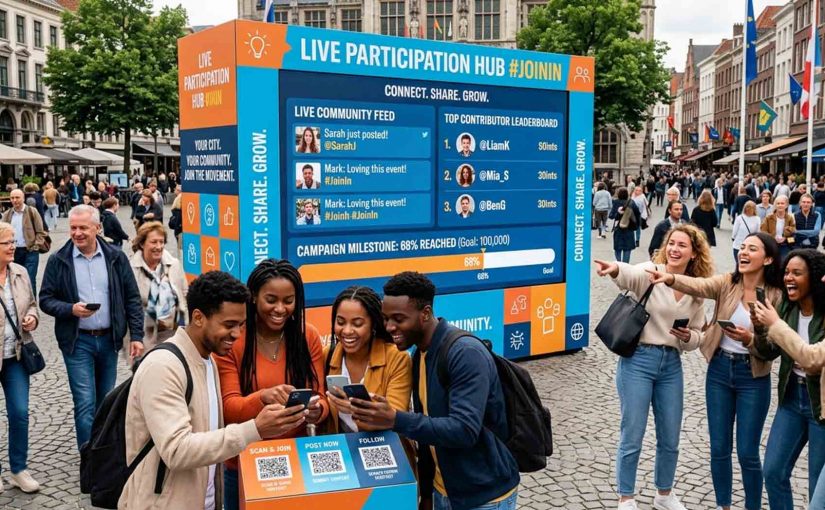
Social participation and platform mechanics sit in the part of marketing where the audience is not just watching, liking, or passively receiving. The audience is performing a visible action inside a system, and that action changes what happens next.
That distinction matters. This is not a bucket for generic social media marketing. It is the concept home for campaigns where the platform behavior itself is the mechanism. Tag to claim. Tweet to unlock. Upload to contribute. Check in to climb. Participate to move the system forward.
On Ramble, this concept matters because some of the archive’s smartest examples do not use platforms mainly as media channels. They use them as participation systems, where public actions create momentum, shape outcomes, and turn the audience into part of the marketing engine.
The strongest examples do not use platforms as distribution after the fact. They build the campaign around the rules, habits, and public signals of the platform itself.
Curated by Sunil Bahl
Creator and author of SunMatrix Ramble. Independent analysis of marketing concepts, campaign mechanics, and consumer experience patterns.
How social participation and platform mechanics work
The core pattern is simple. A brand takes a native social behavior and turns it into the engine of the campaign.
That behavior might be tagging a photo, tweeting a hashtag, uploading a creation, or checking in from a location. What matters is that the action is legible, repeatable, and publicly meaningful. People can see progress. They can see contribution. They can see other participants changing the outcome.
That is why this concept is structurally different from a normal social campaign. A normal social campaign may publish content and hope people respond. A platform-mechanics campaign gives people a job inside a system. The action is not decorative. It is causal.
The business value comes from the same place. When participation changes the outcome, the audience does part of the distribution, part of the momentum-building, and sometimes even part of the asset creation. The brand is no longer only broadcasting. It is orchestrating a loop.
What belongs here, and what does not
This concept includes work where a networked participation system is the primary marketing mechanism. It belongs here when the campaign depends on actions such as tagging, uploading, checking in, voting, or posting, and those actions visibly drive progress, selection, amplification, or reward. It does not belong here just because a campaign happens on Facebook, Twitter, Instagram, YouTube, or another platform. Channel presence is not enough.
A campaign belongs more naturally in Interactive Advertising when the main mechanism is a branded ad unit, interactive film, microsite, or controlled viewer interface. It belongs more naturally in Experiential Marketing when the main mechanism is a lived physical encounter and social participation mainly extends or documents that encounter. It belongs more naturally in Mobile Marketing and App Experience when the main mechanism is app utility, device behavior, or a mobile service flow. It belongs more naturally in Augmented Reality in Marketing when the main mechanism is the camera-mediated overlay or AR layer itself. It can overlap with Viral Video and Earned Media, but “viral” is an outcome, not a concept home. If the thing spreads because the participation system is well designed, this is still the right place for it.
The cleanest rule is the same one used across the Concept Index. Assign the post to the concept that carries the dominant marketing mechanism, not the most visible execution layer.
Representative Ramble examples
Ikea’s Facebook Showroom
This is one of the clearest examples in the archive because the campaign turns a native Facebook behavior into the promotion itself. People browse showroom photos, tag the product they want, and the first valid tag wins. The tagging action is not an add-on. It is the campaign.
Volkswagen Twitter Zoom
Here, tweets do visible work. Each tweet helps a Google Maps view zoom closer to hidden tickets across São Paulo. The more people participate, the more precise the hunt becomes. Shared progress drives urgency, and urgency drives more participation.
KLM: Tile & Inspire
KLM asks people to turn profile photos into Delft Blue tiles and submit inspiring messages, with selected entries applied to the exterior of a Boeing 777. This is a strong fit because the audience does not just comment on the brand. The audience becomes the asset.
LEGO: Happy Holiplay
This campaign works because LEGO turns community creativity into the media layer. Fans build, photograph, and upload their creations. Every contribution is both participation and promotion, and the gallery effect gives the community a visible reason to keep going.
Air China “Facebook Check Ins”
Air China transforms selected Asian restaurants in Sweden into participation triggers. Guests check in with Air China on Facebook, the check-ins roll into a visible leaderboard, and weekly winners receive tickets to Asia. The loop is simple, social, and repeatable, with the reward reinforcing the broader brand message.
Related archive posts
These posts widen the view while keeping the concept clear.
Social participation as contest and public reward
- SAS: Up for Grabs on Facebook. A strong example of participation becoming distribution, where profile-picture changes and wall posts turn entrants into media. It stays related rather than representative because the platform-rule fragility is part of the story.
- KLM: Fly2Miami Dance Party. A strong public-condition mechanic where a tweet request turns into a fill-the-plane challenge with a real reward. It fits well here as breadth, but the route-launch and product-conversion logic are especially strong.
Participation loops that spill into physical spectacle
- Cadbury Creme Egg: When Will It Goo. A smart hybrid where tweets and Facebook participation push giant public eggs toward a live release moment. It belongs near this concept, but the physical spectacle does enough work that experiential overlap is stronger than in the final representative set.
Social utility and game-based participation
- Hellmann’s: Recitweet. Hellmann’s uses Twitter as a lightweight recipe utility. The consumer tweets ingredients and the brand replies with a recipe suggestion. It expands the concept by showing how social participation can become service, not just promotion.
- VW Street Quest: Street View Becomes a Chase. A Facebook-connected scavenger challenge built around Google Street View. It sits close to this hub because repeat participation and scoring matter, but it also pulls toward interactive game design, which is why it works better here as related breadth than as a core representative.
Why this concept still matters
This concept matters because platforms still shape behavior long before they shape content performance. Most brands focus on what to post. The better question is what people are being asked to do, and why they would repeat it, recruit others, or care that progress is visible.
That is the durable lesson in this part of the archive. The winning work does not treat the audience as an applause track. It gives the audience a role inside a system.
That matters even more now because paid reach is harder, platform surfaces are crowded, and generic engagement language explains nothing. If the mechanism does not turn public participation into visible movement, selection, status, utility, or contribution, the campaign usually collapses back into content distribution.
For marketers, this concept is still strategically relevant because it forces a better design question. Not how do we show up on the platform, but what native behavior can carry the idea, and what system response makes participation feel worth repeating?
Explore the full Marketing Concepts index
Social Participation and Platform Mechanics is one part of a broader concept-led view of the Ramble archive.
Explore the full Marketing Concepts index to see how this concept connects to adjacent ideas such as Experiential Marketing, Interactive Advertising, Mobile Marketing and App Experience, Shopper Marketing and Commerce Experience, and Augmented Reality in Marketing.
A few fast answers before you act
What is social participation and platform mechanics in one line?
It is marketing where a public, platform-native audience action drives progress, visibility, contribution, or outcome inside the campaign.
Is this just another name for social media marketing?
No. Social media marketing is too broad. This concept is specifically about campaigns where the participation system itself is the mechanism, not just the channel.
What is the clearest signal that a campaign belongs here?
The clearest signal is that the audience action visibly changes the system. Tagging claims an item. Tweets unlock progress. Uploads become the media. Check-ins move the leaderboard.
What is the most common classification mistake?
The most common mistake is putting any campaign with Facebook, Twitter, Instagram, or YouTube activity into this bucket, even when the dominant mechanism is actually experiential, interactive, mobile, or AR.
What should marketers copy from this concept?
Copy the logic, not the platform. Start with a native behavior people already understand, keep the action low-friction, and make the system respond visibly enough that participation feels consequential.