
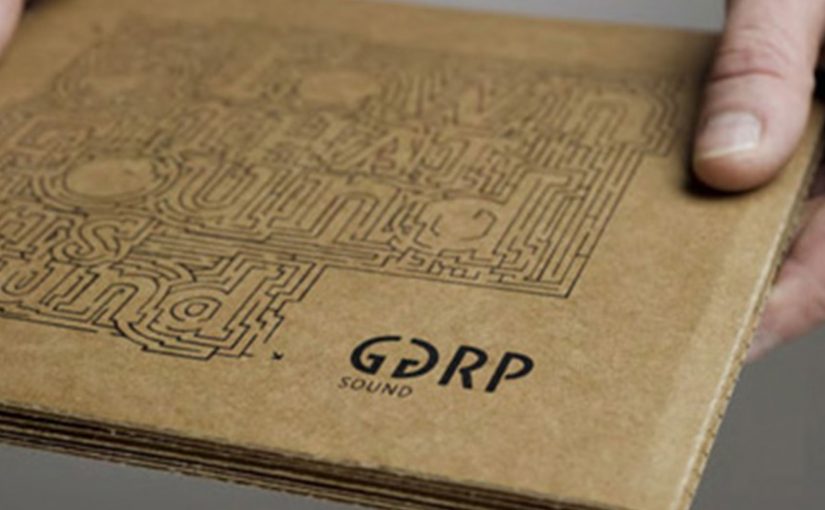
Grey Worldwide in Vancouver created a record player from a piece of corrugated cardboard that folds into an envelope.
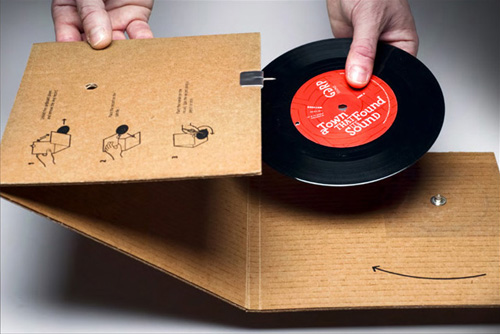
Once assembled, a record can be spun on the player with a pencil. The vibrations go through the needle and are amplified in the cardboard material.
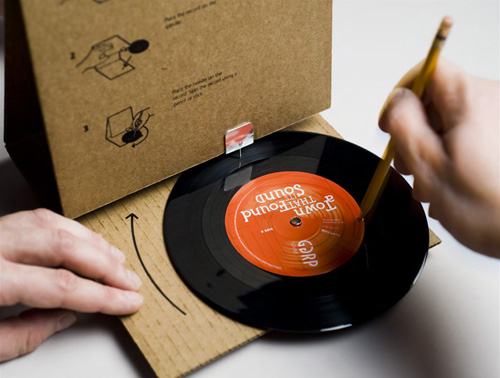
The players were sent out to creative directors across North America as a creative demonstration of GGRP’s sound engineering capabilities.
A demo you can literally feel
This is direct mail that behaves like the product promise. Not a brochure about audio craft, but a physical object that turns vibration into sound in your hands. It creates a moment of discovery before you even think about the brand. Then the brand gets credit for making it work.
How the mechanism does the selling
The sleeve folds into a small phonograph. A pencil becomes the spindle. A simple needle converts the grooves into vibration, and the cardboard body acts as the amplifier. No power, no app, no explanation-heavy setup, just a working proof-of-concept hidden inside a mailer.
Here, proof-of-concept means the mailer itself demonstrates the capability before any sales conversation starts. In B2B creative services, the strongest new-business work is often a tangible demo that turns capability into an experience. Because the recipient has to assemble it and hear it working, the mechanism turns a technical claim into remembered evidence. The real question is whether your outreach proves the craft fast enough to earn a second look.
Why it lands with creative directors
It respects the audience. Creative directors do not need to be told what “sound engineering capabilities” means. They need to feel that the shop thinks differently and executes cleanly. The format also earns time. You do not skim it. You assemble it. That extra time is the real attention premium.
Extractable takeaway: When you sell an invisible craft, build a self-contained artifact that proves it in one minute. The artifact becomes your credibility layer, and your follow-up becomes welcome instead of intrusive.
What this mailer teaches about demo design
- Make the medium the proof. If it does not demonstrate the promise, it is just packaging.
- Design for a single “aha”. One clear moment beats multiple clever details.
- Keep the setup friction low. If it takes instructions to start, the audience drops.
- Target a specific recipient role. This is built for decision-makers who value craft signals.
A few fast answers before you act
What makes this mailer different from a typical promo piece?
It is not a message about capability. It is a working demonstration that the recipient assembles and experiences immediately.
Why is cardboard the right material choice here?
It is cheap to distribute, easy to fold into a mail format, and it can physically amplify vibration, which makes the “sound craft” claim believable.
What is the main business objective of an object like this?
To create high-quality recall and conversation with a small, high-value target list, rather than broad reach.
What is the biggest execution risk?
If the object does not work reliably, the demo backfires. The entire idea depends on the “it actually plays” moment.
How can other B2B brands apply the same pattern?
Translate your capability into a simple physical demo that proves the benefit without needing explanation, then send it only to the people who can buy.