
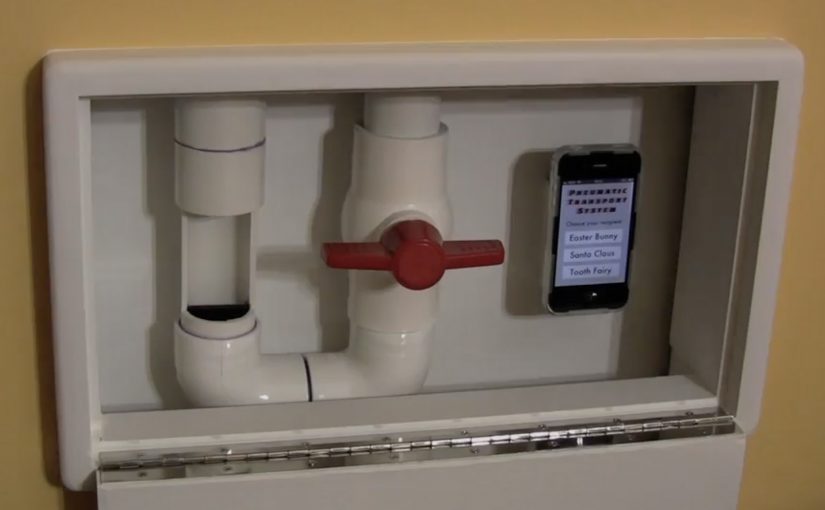
A child loses a tooth, drops it into a capsule, and sends it away through a pneumatic tube. A moment later, a second capsule arrives back with the Tooth Fairy’s payment.
Jeff Highsmith, a father of two, decided to re-write the Tooth Fairy routine with a pneumatic transport system built into his house. He set it up with 1.5" PVC pipes, a central vacuum in the attic, and two endpoint stations, one in each child’s room. When a tooth came out, it went into a small plastic bottle that travelled through the system, while a parent loaded money into another bottle at the other station and sent it back.
A ritual redesigned as a “send and return” loop
The mechanism is a closed-loop exchange. Tooth goes in. Capsule moves. Payment comes back. This matters because visible movement turns an invisible promise into something kids can witness, which makes the ritual feel more credible. The stations make the experience legible and ceremonial, while the vacuum-driven transport makes it feel like the Tooth Fairy is “on the other end” even though the system stays entirely within the home.
In maker households, the quickest way to modernize a family ritual is to turn it into a tangible, repeatable system that feels magical to kids and practical for parents.
Why it lands as modern folklore
This works because it preserves the core emotion of the Tooth Fairy. Anticipation, mystery, reward. Here, “modern folklore” means a familiar family story made credible through a repeatable household ritual. The real question is not how to digitize the Tooth Fairy, but how to make the ritual feel more believable without making it feel less magical. This is a smarter update than adding more screens or complexity, because the physical loop strengthens the illusion while simplifying the parent job. The build also lets the story scale across siblings, since each child has their own station and repeatable moment.
Extractable takeaway: If you want to update a tradition without losing its charm, keep the same emotional arc, then redesign only the delivery mechanism so the magic feels more believable, not more complicated.
More details about the pneumatic system and the Python code for the mobile web interface can be found here.
What to steal for playful “systems thinking” at home
- Make the interface physical. A station or ritual object matters more than hidden automation.
- Design for repeatability. If it can run the same way every time, kids trust it and look forward to it.
- Separate mystery from maintenance. Keep the “magic side” visible and the parent side easy to operate.
- Document the build. A clear write-up turns a one-off family project into something others can replicate.
A few fast answers before you act
What is the core idea of the pneumatic Tooth Fairy system?
A home pneumatic tube loop that lets kids send teeth in a capsule and receive the Tooth Fairy’s payment back through a return capsule.
What materials and layout does the build use?
1.5" PVC pipes, a central vacuum in the attic, and endpoint stations in each child’s room, with small bottles used as capsules.
Why is this better than the traditional “money under the pillow” routine?
It keeps the same reward moment but makes the exchange visible and immediate, while reducing the need for parents to sneak around at night.
What makes the experience feel magical rather than mechanical?
The station ritual and the movement of the capsule. The child can see the “sending” happen, which reinforces the story.
Who should build something like this?
Anyone comfortable with a basic DIY project involving PVC piping and a vacuum-driven transport loop, and who wants to create a repeatable family ritual.