
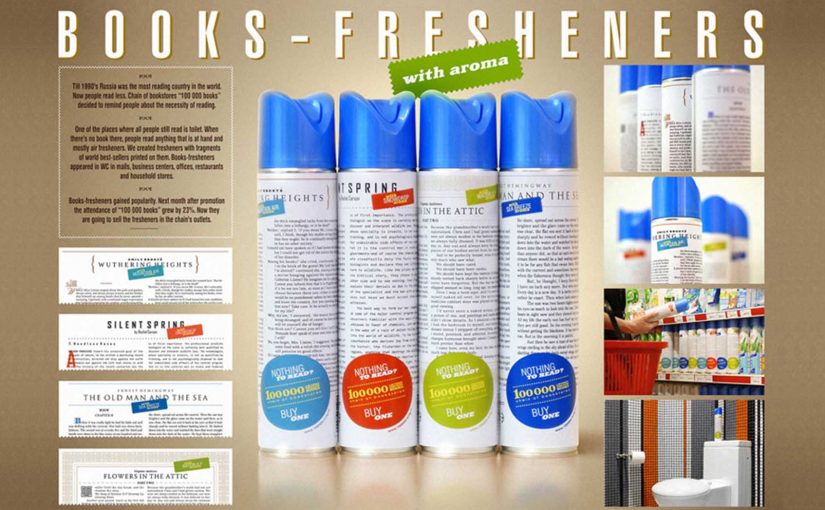
A chain of bookstores called “100 000 books” wanted to remind people to read more. The idea they shipped is blunt and situational. Put fragments of world best-sellers on the one “reading material” people often reach for in a toilet. Air fresheners.
These Books-Fresheners appeared in toilets across malls, business centers, offices, restaurants, and household stores. The campaign narrative says they gained popularity quickly, and the brand later chose to sell them in-store as well.
How Books-Fresheners turns a dead moment into reading
The mechanism is a point-of-need intervention. By that, the campaign places the reading trigger exactly where boredom already exists. Identify a context where people are bored and will read anything available. Replace the default object with something that carries real text, in a format that is impossible to ignore because it is already in your hand. That works because it removes the need to persuade people to start reading from scratch and attaches the prompt to a behavior that is already happening.
In mass retail environments, behavior-change prompts work best when they are embedded in an existing habit, not when they ask people to form a new one.
Why it lands
It is funny, but it is also practical. It acknowledges how people behave when they have a few idle minutes and nothing else to do. The creative choice, printing literature on a disposable object, creates contrast that makes the message stick, and it directs attention back to books without preaching.
Extractable takeaway: If you want to revive a declining habit, do not only market the habit. Place a small, high-quality sample inside a moment where the audience is already receptive, and let the sample create the itch for more.
What the bookstore is really buying
This is an offline distribution hack for a reading brand. The campaign story also reports a measurable store attendance lift after a month of placements.
The real question is whether a bookstore can turn an idle, forgettable minute into a prompt that restarts the act of reading.
The freshener format spreads through everyday locations, generates talk value, and creates a physical reminder that books exist.
What to borrow from Books-Fresheners
- Start from a real micro-behavior. “People read whatever is nearby” is a better foundation than “people should read more”.
- Use a familiar object as media. The medium already has permission in the environment, so the message gets read.
- Sample the product, not the slogan. A book excerpt is a product sample, not a claim.
- Design for portability. If people can take it, show it, or talk about it, it becomes distribution.
A few fast answers before you act
What are Books-Fresheners?
Air fresheners printed with fragments of well-known books, placed in public toilets to trigger reading in a moment when people are likely to read anything available.
Why choose toilets as the placement context?
Because it is one of the few everyday moments where people are idle, captive, and willing to read short text without needing a pitch.
What makes this more effective than a standard reading poster?
It puts the text in someone’s hands rather than on a wall. That physical contact increases the chance the excerpt is actually read.
How does this drive bookstore traffic?
The excerpt creates a “continue reading” impulse and links the act of reading back to a store that sells books, using repeated exposure across many locations.
Why use an excerpt instead of a slogan?
An excerpt samples the product itself. That is stronger than a reading message because it lets the audience experience the habit, not just hear about it.