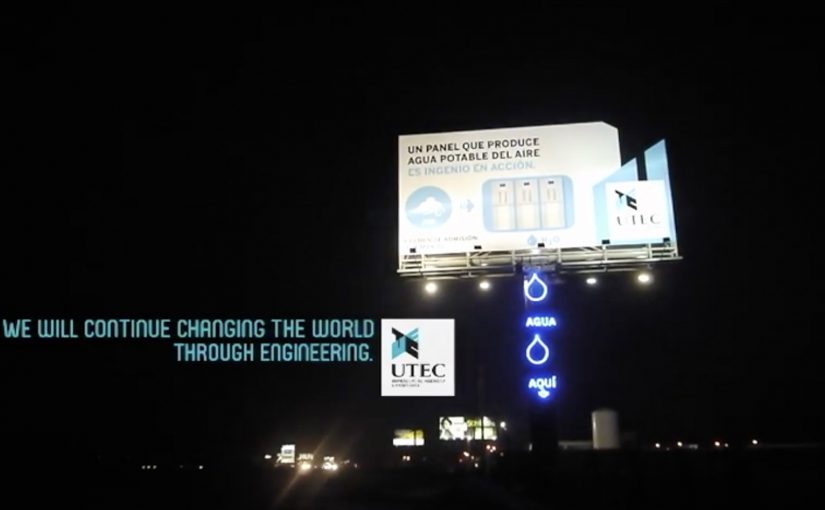
A billboard in Lima does not just advertise. It dispenses drinking water.
UTEC, the University of Engineering and Technology in Peru, believes engineering can change the world. To make that belief tangible and to attract future applicants, it tackles a local constraint. Lima is often described as a major capital city set on desert conditions, where rainfall is minimal, but atmospheric humidity can be extremely high. UTEC uses that humidity to build a billboard that is described as producing potable water out of air.
Definition tightening: This is atmospheric water generation. Moist air is captured, condensed into liquid, then treated so it can be dispensed as drinking water.
A recruitment message you can literally use
The mechanism is a public proof. Turn an engineering principle into civic micro-infrastructure, then let the infrastructure demonstrate the promise of the institution. You do not need to argue that engineering matters. You show it working on the street.
In urban Latin American contexts where infrastructure gaps are visible in daily life, recruitment marketing becomes more believable when the brand contributes something functional before it asks for attention.
Why it lands
It works because the outcome is immediate and legible. People understand “clean water from a billboard” faster than they understand any tagline about innovation. The board also flips the usual direction of advertising. Instead of taking attention, it gives utility, and that trade feels fair.
Extractable takeaway: If you want trust fast, build a single, real-world demonstration where your capability produces a public benefit, then make the benefit the headline.
What UTEC is really positioning
This is engineering as an identity. The university is not selling courses first. It is selling a worldview. Engineers notice constraints. Engineers build systems. Engineers improve the lived environment. The billboard makes that identity concrete, and the recruiting message follows naturally.
The real question is whether you can prove a capability in public before you ask people to believe the story around it.
What to borrow from UTEC’s water billboard
- Pick one local constraint people feel. Water access is not theoretical. It is daily.
- Make the demonstration self-explanatory. No app. No instructions. Just a visible result.
- Let utility replace persuasion. If the object helps, the story spreads on its own.
- Design the “proof moment”. A tap and a container beat any infographic.
A few fast answers before you act
What is “Potable Water Generator”?
It is a UTEC outdoor activation in Peru where a billboard is described as producing drinkable water from atmospheric humidity, turning engineering into a visible public service.
What is the core mechanism?
Capture humid air. Condense it into water. Treat it for safe consumption. Dispense it from the billboard so the benefit is immediate and observable.
Why is this also recruitment marketing?
Because it demonstrates the kind of engineering UTEC wants to be known for. Practical, applied, and aimed at solving local problems, not just talking about them.
What makes this more memorable than a standard awareness billboard?
The outcome is functional. People can use it, which turns the campaign into an experience and a story, not just a message.
What is the most reusable lesson?
When your brand promise is capability, prove it with one tangible demonstration that improves the environment people are standing in.