
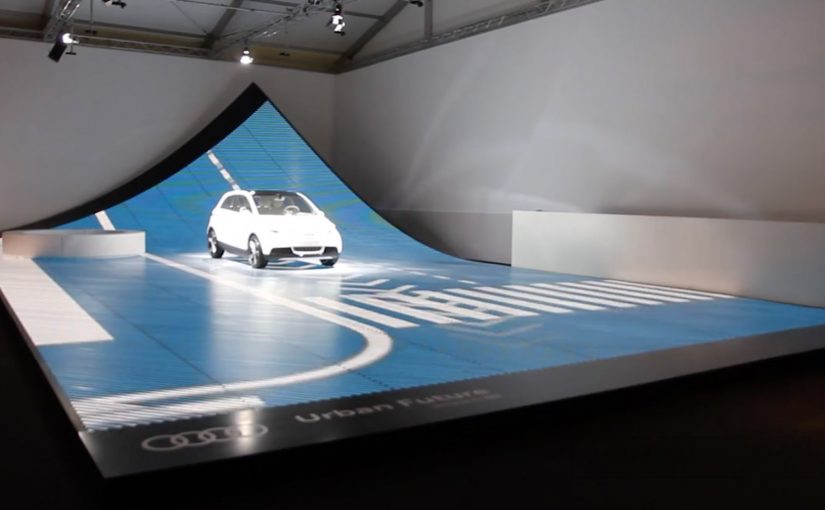
A 190m² LED city surface that reacts to people
Audi, to showcase its A2 concept at Design Miami 2011, created a 190 m2 three-dimensional LED surface that provided a glimpse of the future of our cities where infrastructure and public space is shared between pedestrians and driverless cars. The installation demonstrated how the city surface would continuously gather information about people’s movements and allow vehicles to interact with the environment.
The installation used a real-time graphics engine and tracking software that received live inputs from 11 Xbox Kinect cameras mounted above the visitors’ heads. Through the cameras, the movement of the visitors was processed into patterns of movement displayed on the LED surface.
In global mobility and smart-city work, embodied demos beat decks when you need belief fast.
The punchline: the street becomes an interface
This is a future-city story told through interaction, not a render. You do not watch a concept. You walk on it. The floor responds, and suddenly “data-driven public space” is something you can feel in your body. Here, “data-driven public space” means a shared surface that senses movement and responds with immediate feedback.
In smart city and mobility innovation, the fastest way to make future infrastructure feel believable is to turn sensing and responsiveness into a physical interaction people can experience in seconds.
Why it holds your attention
Because it turns an abstract topic, infrastructure sharing, sensing, autonomous behavior, into a single, legible experience. Your movement creates immediate visual feedback, and that feedback makes the bigger idea believable for a moment.
Extractable takeaway: If a future system is hard to explain, compress it into one cause-and-effect loop a person can control, then let the feedback do the convincing.
What Audi is signaling here
The real question is whether a smart-city vision can be made legible through a single, shared interaction.
A vision of cities where surfaces sense movement continuously and systems adapt in real time. Not just cars that navigate, but environments that respond.
Moves to borrow for experiential design
- Make the future physical: Translate complex futures into one physical interaction people can understand instantly.
- Show the feedback loop: Use real-time input, processing, output, so the concept feels alive.
- Let visitors generate the proof: Make the visitor the driver of the demo so their movement generates the proof.
A few fast answers before you act
What did Audi build for Design Miami 2011?
A 190 m2 three-dimensional LED surface installation showcasing an “urban future” concept tied to the Audi A2 concept.
What was the installation demonstrating?
A future city surface that continuously gathers information about people’s movements and enables vehicles to interact with the environment.
How was visitor movement captured?
Visitor movement was captured via 11 Xbox Kinect cameras mounted above visitors’ heads, feeding live inputs to tracking software.
What was the core mechanic?
Real-time tracking of visitor movement was translated into dynamic patterns displayed on the LED surface.
Why did this format make the idea feel believable fast?
Because visitors could trigger immediate feedback with their own movement, turning an abstract “responsive city” claim into a felt experience.