
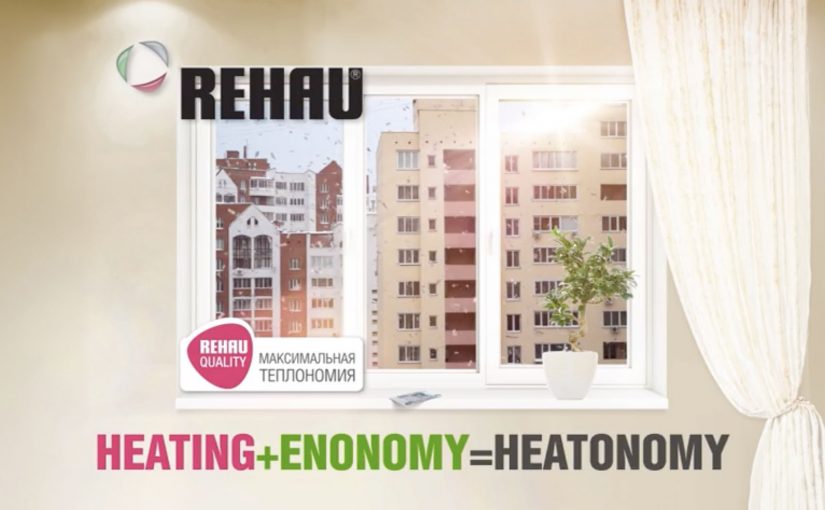
Someone opens a window in winter and starts throwing banknotes into the street. Not a metaphor. Actual money, drifting down like confetti.
That is the demonstration Voskhod builds for REHAU windows. Utility bills keep climbing, and poorly sealed windows turn heat into waste. So the campaign makes the waste visible by “throwing money out of the window”, literally, from low-quality windows. It is a street-level proof that translates heat loss into something anyone can recognize instantly.
Making heat loss look like cash loss
The mechanic is blunt by design. If heat is leaking through your window, your heating budget is leaking too. The stunt turns an invisible inefficiency into a visible spectacle, then ties the solution to REHAU windows and the campaign line “Heatonomy”, a label for treating heat-saving as household economics rather than technical performance.
In cold-climate home improvement markets, the most persuasive product stories convert invisible energy inefficiency into a simple, observable loss that people can picture in their own home.
The real question is how do you make invisible energy waste feel immediate enough that people stop treating better windows as a technical upgrade and start seeing them as basic household economics?
Why it lands as public theatre
The idea works because it skips technical education and goes straight to lived consequence. People do not need U-values or thermal imagery to understand money falling onto the pavement. The spectacle also makes the press angle easy. A strange, concrete act in a familiar setting, with a clear explanation attached. The legacy write-up describes extensive earned coverage and a nationwide reach figure, framed as the campaign’s outcome.
Extractable takeaway: When your product fixes an invisible problem, create a one-scene demonstration that makes the cost of “doing nothing” undeniable, then anchor the solution in a single line that people can repeat.
What REHAU is actually selling
It is not just windows. It is control over household economics in winter. The campaign positions better windows as a direct hedge against rising heating costs, and it gives people a language hook, “Heatonomy”, to describe the benefit without getting technical.
What home-efficiency brands should steal
- Turn abstraction into a physical proxy. Heat loss becomes cash loss, instantly understood.
- Build a stunt the media can summarize in one sentence. If it cannot be repeated cleanly, it will not travel.
- Keep the solution adjacent to the spectacle. The product has to be the obvious answer, not an afterthought.
- Give the audience a compact label. A coined term can help people remember and share the benefit.
A few fast answers before you act
What is the “Money Rain” idea?
A public stunt that demonstrates heat loss by throwing real money out of low-quality windows, framing wasted heat as wasted cash, then linking the fix to REHAU windows.
What does “Heatonomy” mean in this context?
It is presented as a shorthand for heating economy. A way to express savings from reduced heat loss without technical explanations.
Why does a stunt work better than a technical comparison here?
Because the problem is normally invisible. A visceral proxy creates instant understanding and makes the message repeatable by viewers and press.
What results did the campaign claim?
The legacy description reports broad media pickup, a total of 240,000 rubles thrown, and reach “over 40 million Russians”. Treat these as campaign-reported figures unless you have primary reporting you want to cite.
When should brands use a “visible loss” demonstration?
When the benefit is preventative or efficiency-based, and the audience undervalues it because they cannot see the problem day to day.