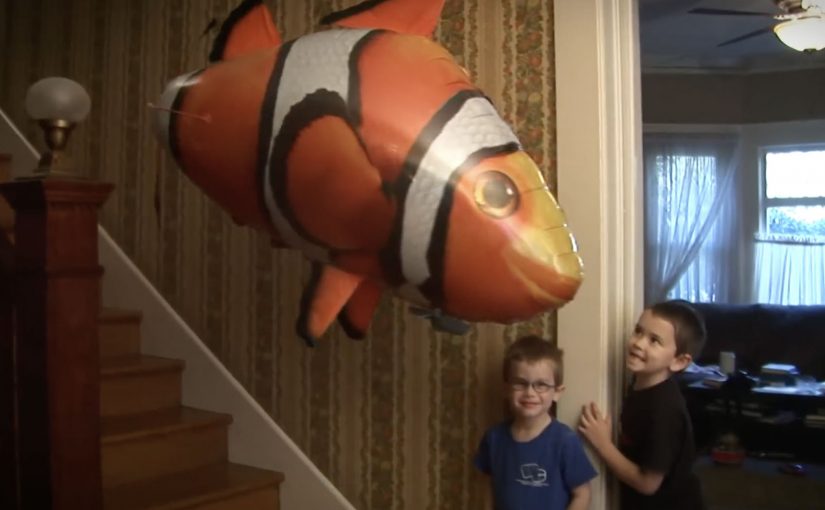
Have you ever seen a fish that can swim in the air with smooth, life-like motion. Air Swimmers is a US-based company that developed these remote controlled, helium-filled flying fish.
They are designed for indoor fun even in small rooms. Air Swimmers describes them as running on four AAA batteries, one in the body and three in the controller, with up, down and 360 degree turning control.
How it works
The mechanism is lighter-than-air buoyancy plus simple steering controls. The helium does the lifting. The controller provides direction and small adjustments that make the movement read as “swimming” rather than “flying”. The technology fades into the background, and the illusion becomes the product.
In consumer retail for playful tech products, the fastest path from curiosity to purchase is a demo that looks impossible at first glance, but becomes obvious after ten seconds of watching it move.
The real question is how quickly your demo turns “that can’t be real” into “I want to try that”.
Lead with the impossible-looking motion first, and let the explanation come second.
Why it lands
It delivers a clean emotional sequence. Surprise first. Then control. The viewer sees it drift like a creature, then realises someone is steering it with precision. Because buoyancy handles the lift, small steering inputs read as effortless, which makes the motion feel alive and shareable. That makes it instantly shareable because the value is visible without narration or specs.
Extractable takeaway: If your product’s value is delight, design a demo that creates a visible illusion, then reveal just enough control to make people want to try it themselves.
Guerrilla activation lessons from Air Swimmers
- Make the demo the message. If the value is visual, build your marketing around one clip that proves the experience in seconds.
- Use “living motion” as the hook. Here, “living motion” means movement that reads like a creature rather than a machine, so people treat it as a moment worth filming.
- Turn everyday space into a stage. Air Swimmers were also used as a guerrilla execution for SEA LIFE Speyer in Germany. Reported coverage describes Leo Burnett Frankfurt sending “flying sharks” through Frankfurt, including public locations and public transport, to turn the city into a temporary “aquarium” and build awareness for the aquarium in the Rhein-Main region.
- Design for spectators, not only users. The best stunts create a second audience. Passers-by who do not control the object still get the full story.
A few fast answers before you act
What is an Air Swimmer?
A helium-filled balloon “fish” you steer indoors with a handheld controller, designed to move with a swimming-like motion through the air.
Why does it feel more impressive than other RC toys?
Because buoyancy handles the “floating,” so the control inputs translate into smooth, creature-like movement rather than noisy, mechanical flight.
What makes a product like this easy to market?
The demo is the message. One short clip communicates the full value without specs, because the motion is the proof.
Why was this a good fit for a SEA LIFE guerrilla execution?
Because it is thematically aligned with marine life, instantly attention-grabbing in public spaces, and it creates a moving spectacle people want to film and talk about.
What should the first ten seconds of the demo show?
Start with the “impossible” floating motion, then reveal the steering control quickly, so people understand it is real and want to try it.