
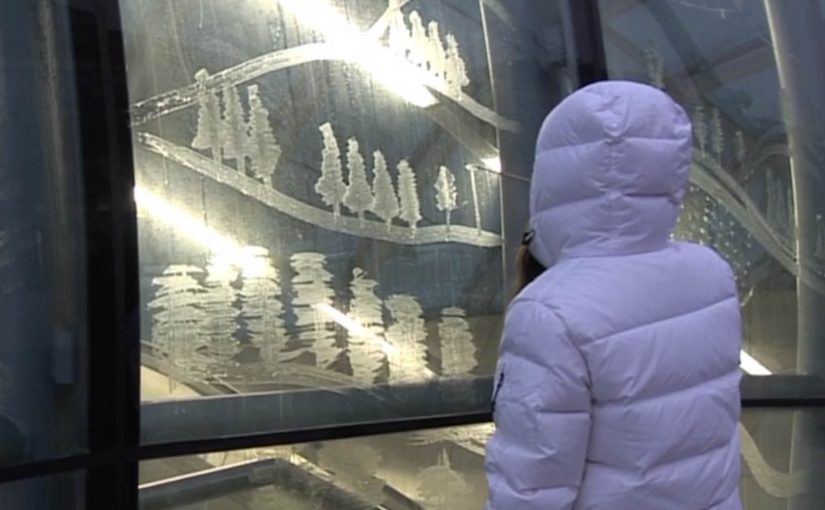
Rajec wants people to buy spring water even when it is cold outside, so the brand turns its own product into the medium. Artists use Rajec water to create frosty artworks overnight in high-footfall locations, so the next morning the city wakes up to “Patented by Nature” made visible.
The mechanic is simple and budget-smart. Pick specific public locations, give artists permission to work within the constraints of freezing weather, and let the cold do the production. The result is temporary ice art that looks native to winter, but still unmistakably tied to water.
In Central European FMCG categories, winter is where habitual consumption drops. So a physical, weather-native installation can reframe the product as seasonally relevant instead of seasonally optional.
Why frozen artwork is a strong “Patented by Nature” proof
It makes the positioning literal. The environment “patents” the result, because the cold is doing real work. That gives the campaign an authenticity cue that polished advertising often struggles to achieve, especially for a product as familiar as water.
Extractable takeaway: When your brand promise depends on “naturalness”, build a proof that requires nature to complete it. Then place that proof where people can stumble on it without opting in.
What the campaign is really optimizing for
The real question is how to make bottled water feel worth noticing in the season when people are least inclined to buy it. This is a smart seasonal demand play because it turns winter from a sales headwind into the proof itself.
This is designed to create winter salience with minimal spend. Here, winter salience means staying mentally available in the season when bottled water is easiest to ignore. The installations function as local talk triggers, photo moments, and brand reminders, without needing long media flights. You get attention because it is unexpected and temporary, and you get relevance because the execution only exists in winter conditions.
What to steal for your own seasonal demand problem
- Exploit the season instead of fighting it. Use weather and constraints as production tools.
- Make the product physically present. When the product is the material, the brand tie is harder to miss.
- Design for ephemerality. Temporary work creates urgency and increases the chance people share it.
- Choose “commuter proof” locations. Busy, repeat-traffic spots do the frequency building for you.
A few fast answers before you act
What is the core idea of Rajec Frozen Artwork?
Use Rajec water to create ice artworks overnight in frequented public places, so winter itself becomes the production method and the brand proof.
Why does this help sell water in winter?
It restores relevance by linking the product to the season people least associate with water buying, and it does so with a physical cue people notice without trying.
What makes the execution feel credible rather than “advertising”?
The cold does real work. The result looks like something the environment caused, which supports the “Patented by Nature” idea.
What kind of location makes this work best?
High-footfall public locations work best because repeat exposure turns a temporary installation into a stronger memory cue without requiring paid media weight.
What is the main risk in copying this approach?
If the brand link is too subtle, it becomes “nice street art” with weak recall. The product-to-art connection needs to be unmistakable.