
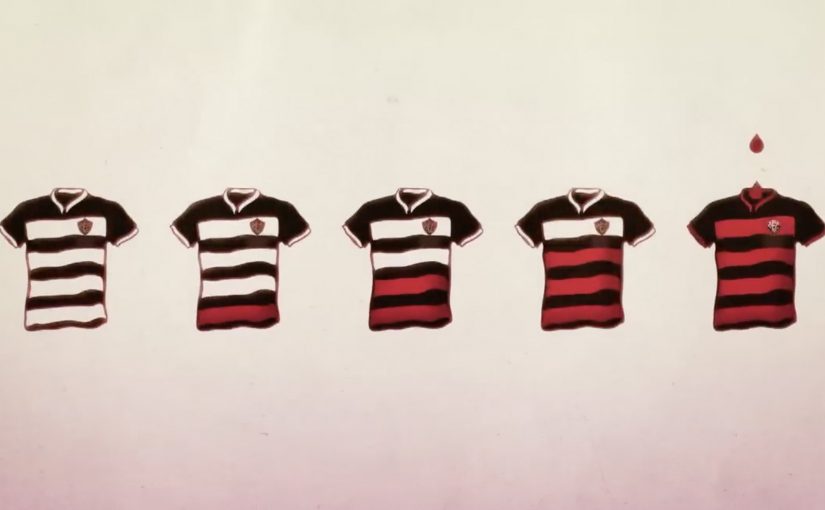
The state of Bahia was experiencing a shortage of blood. To raise awareness of this problem and increase the blood reserves, Hemoba Foundation (Blood Foundation) in Brazil partnered with Bahia football club Esporte Clube Vitória to run a unique blood donation drive.
For the campaign, the football club changed the stripes of their iconic jersey from red to white. Then over the course of the season as the blood reserves rose, the team slowly changed the white stripes back to the original red.
As a result, the promotion is reported to have helped raise blood donation by 46%.
A club kit that doubles as a public scoreboard
This is a blood drive that refuses to stay in the background. Instead of asking people to donate “because it is important”, it turns the most visible symbol of the club into a live indicator of how the state is doing. This is a stronger behavior-change design than a standard awareness appeal, because the public scoreboard sits inside club identity.
How the stripe mechanic works
The mechanism is one clean promise. Remove the red from Vitória’s shirt, then bring it back only as blood reserves recover. Every step of progress becomes legible in the one place fans naturally look, the team’s colors.
In sports-led community campaigns, changing a core identity asset works because it creates a shared metric that everyone can track without explanation.
Why this lands beyond typical charity messaging
Most donation drives rely on abstract need. This one makes need visible and slightly uncomfortable, because fans are confronted with “missing red” every match week until they act. It also flips motivation from guilt to pride, because the act of donating becomes a way to restore the club’s full identity.
Extractable takeaway: If you need sustained participation, attach the cause to a symbol your audience already protects. Then turn progress into a public, binary signal that updates over time.
What the partnership is really doing
The campaign aligns incentives. The real question is how to turn a one-time act of goodwill into a shared public ritual that people keep joining. Hemoba gets reach and urgency without buying attention in the usual media sense. The club earns meaning and publicity by making its platform materially costly, because it “gives up” part of its kit until the community responds.
What to steal for your next behavior-change campaign
- Make the metric visible. People act more when they can see progress, not just hear appeals.
- Use a symbol with real emotional ownership. Identity assets beat posters, because people notice when they change.
- Turn donation into restoration. “Bring something back” is often more motivating than “add something new”.
- Design for weeks, not a day. A season-long mechanic sustains attention and creates multiple decision moments.
A few fast answers before you act
What is “My Blood Is Red and Black”?
It is a blood donation campaign in Bahia, Brazil, where Hemoba partnered with Esporte Clube Vitória and used the team jersey’s red stripes as a visible indicator tied to blood reserves.
How did changing the jersey drive donations?
By removing the red stripes and gradually restoring them as reserves improved, the campaign turned blood supply into a public signal that fans could track across the season.
Why does sports identity work for public health?
Because club colors, rituals, and match-week attention are already shared and emotionally charged. The campaign borrows that energy and redirects it into a concrete action.
Why is this stronger than a standard awareness appeal?
Because it does not ask people to care in the abstract. It makes the shortage visible through a symbol fans already watch, defend, and want restored.
What is the transferable principle here?
Make progress tangible. Link participation to restoring a valued symbol, and keep the feedback loop running long enough for people to join when they are ready.