
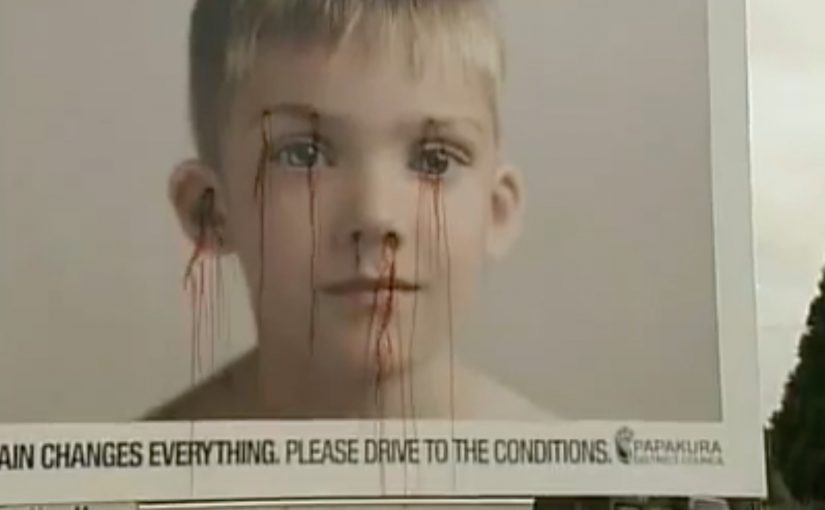
A roadside warning that reacts to rain
An impressive device was concocted by Colenso BBDO to demonstrate to drivers that vigilance is needed when it rains. The special billboards were installed on the roadsides in Papakura District, New Zealand.
When it began to rain these billboards started bleeding profusely.
How the device works as a message, not just a stunt
The mechanism is environmental trigger plus instant consequence. Rain does not just “set the scene”. It activates the medium, turning weather into the switch that makes the warning unavoidable.
In public-safety communication, linking a message to the exact moment of risk can outperform awareness-style reminders, because it removes the gap between knowing and doing.
The real question is whether you can make the risk cue appear at the exact moment a driver still has time to react.
Why it lands: it makes the danger feel present
The effect is deliberately uncomfortable. Blood signals harm, urgency, and the possibility of impact. It forces a driver to confront “what could happen” precisely when conditions are deteriorating.
Extractable takeaway: When a warning changes with conditions, the risk feels present, and instinctive self-correction becomes easier. “Rain changes everything. Adjust speed to conditions on the road”.
The business intent: behaviour change at the point of decision
This is less about recall and more about compliance. The goal is to interrupt automatic driving habits and create a micro-moment of self-correction: slow down because the road has changed. Here, “micro-moment” means a split-second decision point where a driver can adjust speed.
This is worth using when the behaviour change needs to happen in seconds, not after a campaign is remembered.
Stealable patterns for safety, infrastructure, and behaviour-change briefs
- Trigger the message when the risk is real. Tie the communication to a condition the audience can see and feel.
- Make the medium part of the proof. The environment becomes the “reason” the message is credible.
- Choose a signal that reads instantly. Drivers have seconds, so the cue must be immediate and universal.
- Design for instinct, not analysis. Behaviour change often happens through emotion and interruption, not persuasion.
A few fast answers before you act
What is the “bleeding billboard” campaign?
It is a road-safety outdoor installation where special billboards appear to bleed when it rains, warning drivers to adjust speed to conditions.
What is the core mechanism?
An environmental trigger plus instant consequence. Rain activates the medium, turning the weather into the switch that makes the warning unavoidable.
Why is the timing of the message so important here?
Because it collapses the distance between “knowing” and “doing”. The warning appears precisely when risk increases, at the point of decision.
Why use an uncomfortable visual like blood?
It reads instantly and signals harm without explanation. Drivers have seconds, so the cue must be immediate and universal.
What is the most transferable takeaway?
If you can trigger a behaviour-change message when the risk is real, the environment itself becomes the proof, and compliance becomes more likely than with generic reminders.