
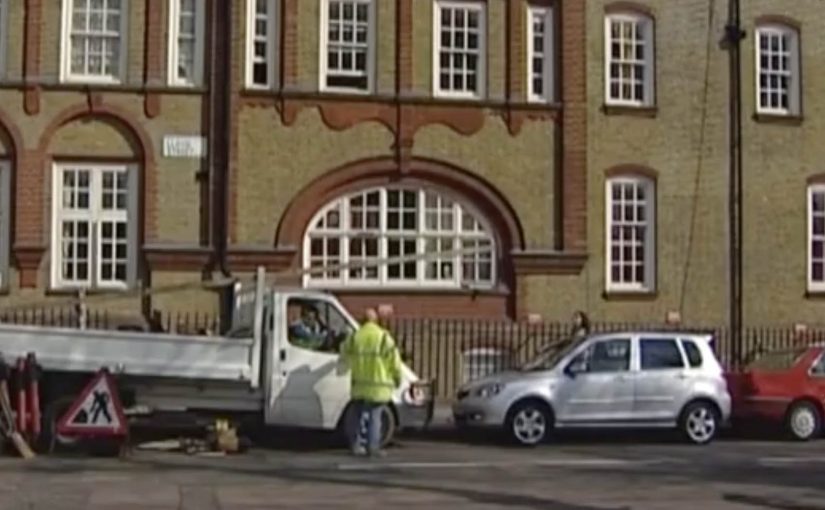
A woman pulls up in her Mazda2 and faces a classic “you’ll never fit in there” moment. Two road workers have effectively turned a parking bay into a narrow trap, and the smirk on their faces says the punchline is supposed to be on her.
Then the ad flips the frame. Instead of forcing the expected struggle, she reverses, lines up, and uses the planks like ramps, smoothly climbing over the obstacle and landing the car where it needs to be. The joke is still there, but the target changes.
How the trick is staged
The execution is built as a micro-story with one clear constraint. A “too-small” space, onlookers who provide the social pressure, and a single move that resolves the tension in an unexpected way. The product benefit is not explained. It is demonstrated.
In consumer marketing for everyday mobility products, the fastest way to prove a benefit is to stage it in an instantly understood micro-situation.
The real question is whether your benefit can be proven in a single, instantly legible move.
Why it lands
It borrows a familiar stereotype as bait, then cashes out with a clean reversal. The audience is guided to predict failure, so the successful outcome feels sharper, funnier, and more shareable than a standard capability demo.
Extractable takeaway: If your category is full of “feature talk”, build a single-scene proof that forces a prediction, then overturn it with one unmistakable visual action. When the viewer can explain the benefit in one sentence without pausing the video, you have a story that travels.
What Mazda is really selling here
This is not a parking tutorial. It is a personality claim delivered through performance. “Small car agility” becomes a social moment. The driver keeps composure under judgement, and the car becomes the quiet accomplice that makes the comeback possible.
Steal the one-scene proof technique
- Engineer a single constraint. Make the situation legible in two seconds, so the viewer immediately forms a prediction.
- Let the crowd voice the tension. Onlookers, comments, or disbelief create stakes without exposition.
- Resolve with one clear move. One action that visually “proves” the benefit beats a stack of claims.
- Make the twist retellable. If someone can summarise it in a line, it is easier to forward.
A few fast answers before you act
What is “Smooth Parking” in this context?
It is a short Mazda2 film that sets up an apparently impossible parking space and then resolves it with a surprising manoeuvre that makes the car’s agility feel real rather than advertised.
Why use a stereotype at all?
Because it accelerates comprehension. The risk is obvious. You need the payoff to clearly reverse the target, otherwise you reinforce the stereotype instead of undermining it.
What makes this “viral-ready”?
A tight setup, a fast twist, and a visual finish that does not require language or brand knowledge to understand. People share it as a punchline, and the product benefit comes along for free.
How do you apply this outside automotive?
Choose one everyday friction point your audience recognises instantly. Add a single constraint that feels unfair. Then show your product resolving it with one unmistakable action, not a list of features.
How do you avoid the twist feeling like a gimmick?
Make the setup and constraint honest, then let the resolution be a single action that cleanly proves the benefit, not extra explanation.