
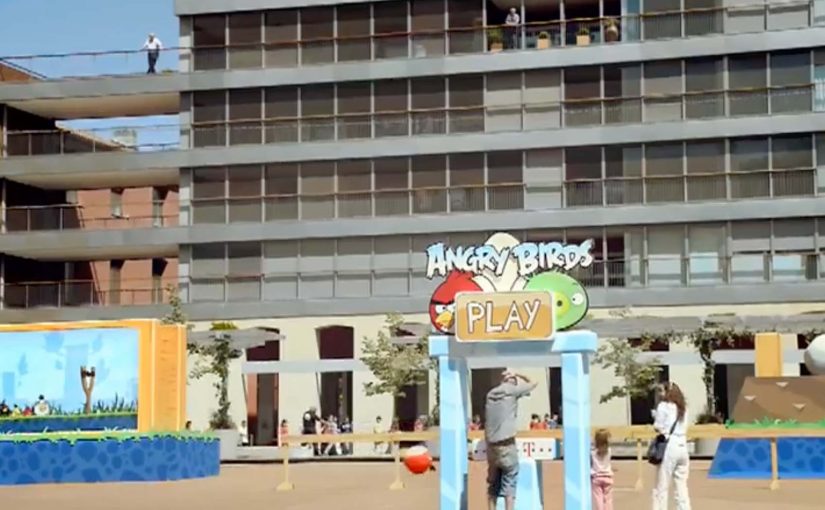
T-Mobile: Angry Birds Live

Angry Birds, rebuilt at human scale

The strongest activations often take a screen-based behavior and make it public, physical, and shareable. T-Mobile’s Angry Birds Live is a clean example of that move.

Here, a live activation means an in-person brand experience designed to create a moment people want to film and share.

T-Mobile, together with Saatchi & Saatchi, capitalized on the Angry Birds fever with a viral video titled Angry Birds Live.

They built a human-scaled mockup of Angry Birds in a square in Barcelona. Lucky participants used the game on a smartphone to launch birds on their castle-smashing journey. The experience included authentic sound effects and exploding pigs, and the size of the crowd made it clear the spectacle worked.

How the smartphone became the controller for a real set

The mechanism was simple and instantly legible. The smartphone stayed the input device, but the output moved into the real world.

That pairing did two things at once. It kept the interaction familiar for participants, and it made the result visible for everyone watching. One person played. Everyone else experienced the payoff. Because the outcome was public, each tap created social proof in real time.

In mobile-first consumer marketing, keeping the input private but the payoff public is a fast way to turn play into social proof.

The real question is how you turn one person’s private input into a public payoff that many people can watch.

This pattern is worth copying when your interaction is familiar and the outcome is visibly consequential without extra explanation.

Why the spectacle pulled a crowd

People do not gather around an app. They gather around consequences.

Extractable takeaway: When you want a crowd, make the consequence public and immediate, not private and delayed.

Angry Birds already trained players to anticipate impact. By scaling the environment up and making destruction physical, the activation delivered the same emotional beat as the game, but with stronger social proof because it happened in front of a crowd.

What T-Mobile was really buying with this idea

The business intent was to borrow cultural momentum and convert it into attention that looked earned, not bought.

The activation created a story people wanted to film, share, and talk about. The brand got reach through the crowd, the recordings, and the viral video itself, rather than relying on a traditional media push alone.

What to steal for your next live activation

  • Move the payoff into public view. One participant can drive the action, but the outcome should entertain many.
  • Keep the interaction familiar. When the input is already known, more people are willing to step in.
  • Design for consequence. Sound, impact, and visible change make an experience watchable, not just playable.
  • Build for filming. If the best moments are obvious on camera, distribution happens naturally.

A few fast answers before you act

What was T-Mobile’s Angry Birds Live?

A live brand activation in Barcelona that recreated Angry Birds at human scale, with participants using a smartphone to launch birds at a physical set.

What was the core mechanism?

A familiar mobile game interaction controlled real-world outcomes, turning individual play into a public spectacle.

Why did it attract such a large crowd?

Because the results were physical, loud, and visible. People gathered around impact and consequence, not a screen.

What business goal did this support?

Capturing cultural momentum and converting it into earned attention, shareable content, and viral reach.

What is the main takeaway for brands?

Make one person’s action entertaining for many, and design the payoff to be obvious, physical, and easy to record.
Draftfcb: In Your Face Recruitment Hack

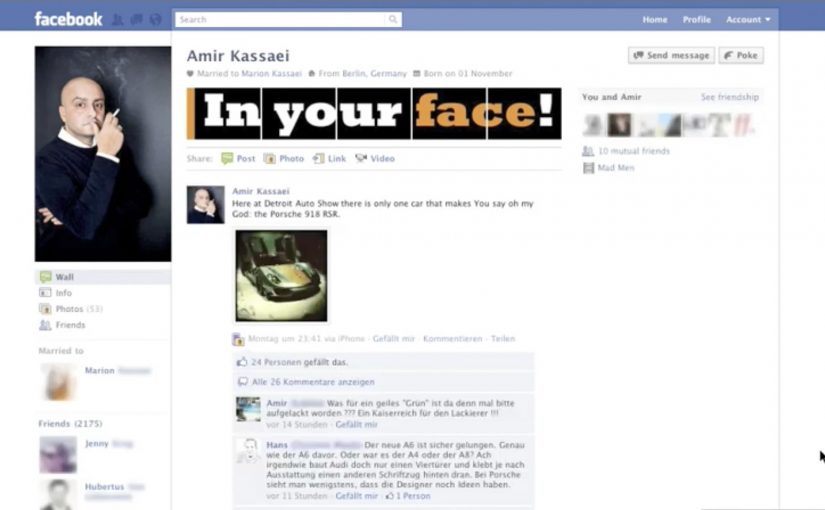
Draftfcb Germany is the latest ad agency to join the trend of tactically using social media for recruitment. In this case, they use Facebook’s redesigned profile layout to spread their hiring needs to a highly targeted advertising audience.

Recruitment message, delivered as a profile takeover

The mechanism is a simple interface hijack. Instead of posting a job ad and hoping people click, the recruitment message is built into the profile itself, so anyone landing on it experiences the “In Your Face” moment immediately. It is native to the platform, and it travels through the same social graph pathways as any other profile view.

In competitive hiring markets, social recruiting works best when the message shows up inside the places people already browse, rather than asking them to switch into “job search mode.”

Why it lands

This is not a deep story. It is a sharp pattern interrupt. That means the familiar Facebook profile suddenly behaves like a recruitment billboard, which makes the message easy to recognize and easy to forward to the right peers. The profile becomes the ad unit, the ad unit becomes a talking point, and the talking point becomes a referral engine as people share it with the exact peers who might fit.

Extractable takeaway: If you want a recruitment message to spread inside a community, put it where the community already looks, and make the first two seconds instantly legible without requiring a click.

The real question is whether the profile itself can carry the hiring message strongly enough to spread through the right creative network without needing a click. This is a smart recruitment move because it converts ordinary profile views into immediate message delivery and referral fuel.

Recruitment moves worth borrowing

  • Use the platform’s default surfaces. If the profile is the most-viewed asset, make that the canvas.
  • Design for “seen in passing.” The message should register at scroll speed.
  • Make it referable. The best recruitment creative gives insiders something easy to forward to insiders.
  • Keep it role-specific. If you want a “select advertising audience,” avoid generic “we’re hiring” language.
  • Respect the line. If the takeover feels spammy or deceptive, it damages employer brand more than it helps.

A few fast answers before you act

What is “In Your Face” in one sentence?

It is a Draftfcb Germany recruitment idea that turns Facebook’s profile layout into a visual hiring message that spreads through normal profile views and shares.

Why use a profile takeover instead of a standard job post?

Because it removes friction and increases certainty. The viewer immediately understands the intent without leaving the platform or clicking through.

What makes this tactic “targeted”?

It travels through an industry social graph. The people most likely to see it are connected to the agency, its staff, or the wider creative community.

What is the biggest risk with this approach?

Novelty decay. Once the trick is familiar, it stops being a conversation piece, so the idea needs either a short run or variations.

What should you measure if you do something similar?

Qualified inbound candidates, referral volume from employees and peers, share rate inside relevant networks, and sentiment about the employer brand.

Mobistar: Basta Call Center Prank

Mobistar is long described as one of Belgium’s leading mobile operators and one of the country’s biggest advertisers. Over time, it also becomes known in public conversation for frustrating customer service.

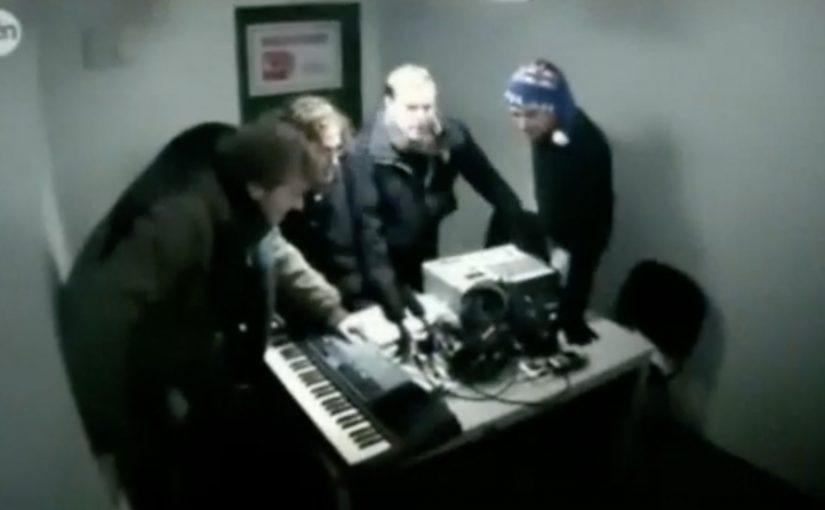
So on January 10, 2011, Belgian TV makers at VRT decide to prank Mobistar, and the segment later airs on their new comedy show, Basta. A Mobistar security guard named Mathieu becomes the unlikely hero, largely because he stays calm and friendly throughout.

The prank that turns “call center pain” into a live experience

The execution is cruelly simple. A physical setup triggers a phone call. That phone call leads into an intentionally endless customer-service loop of transfers, hold music, dead ends, and “let me check with my boss” deflections. The joke is not the person calling. The joke is the system that can trap anyone, even someone trying to do the right thing.

In European telecom markets, customer service reputation can outweigh product features in the public conversation.

Why it lands: it exposes the gap between message and reality

Modern consumers get tired of overpromising brand messages, especially when the lived experience does not match. This prank goes viral because it dramatizes that mismatch without a lecture. You can feel the frustration build, and you recognize it instantly if you have ever battled a helpdesk script.

Extractable takeaway: If your brand invests heavily in advertising but underinvests in service, someone else will eventually tell your story for you. The narrative people remember will be the experience, not the tagline.

The uncomfortable lesson for big advertisers

The real question is whether your marketing is amplifying a service experience worth talking about, or drawing more attention to one people already resent.

The punchline carries a serious point. If brands want trust, they need to fund the product and the service before they fund the promise. Great campaigns amplify a great experience. They cannot replace it for long.

What to steal if you run CX, service, or brand

  • Audit your “moments of truth”: contact centers, chat, returns, and complaints shape reputation faster than brand film.
  • Measure friction, not just satisfaction: transfers, resolution time, and repeat-contact rate are where trust is won or lost.
  • Stop advertising around known pain: fix the root issue first, then scale the promise.
  • Turn service into a brand asset: when service is excellent, it becomes shareable for the right reasons.
  • Protect frontline humans: if your system is broken, your staff and customers suffer together.

A few fast answers before you act

What happened in the Mobistar prank?

A TV team stages a scenario that forces a Mobistar employee into an exaggerated, endless customer-service loop, mirroring the frustrations customers report when they seek help.

Why did Mathieu become the “hero” of the clip?

Because he stays polite and persistent while the system around him becomes increasingly absurd. His demeanor contrasts with the experience the prank is criticizing.

What is the business takeaway for brands?

Advertising cannot sustainably outshine poor service. When the lived experience disappoints, culture and media will surface the truth faster than any campaign can mask it.

How should a telecom brand respond to criticism like this?

Fix operational drivers first: staffing, escalation paths, first-contact resolution, and transparency. Then communicate improvements with proof, not slogans.

What should leaders measure to prevent this kind of reputational damage?

Resolution time, transfer rate, repeat-contact rate, complaint volume by issue, and sentiment in customer conversations. These tend to predict reputation better than awareness metrics.