
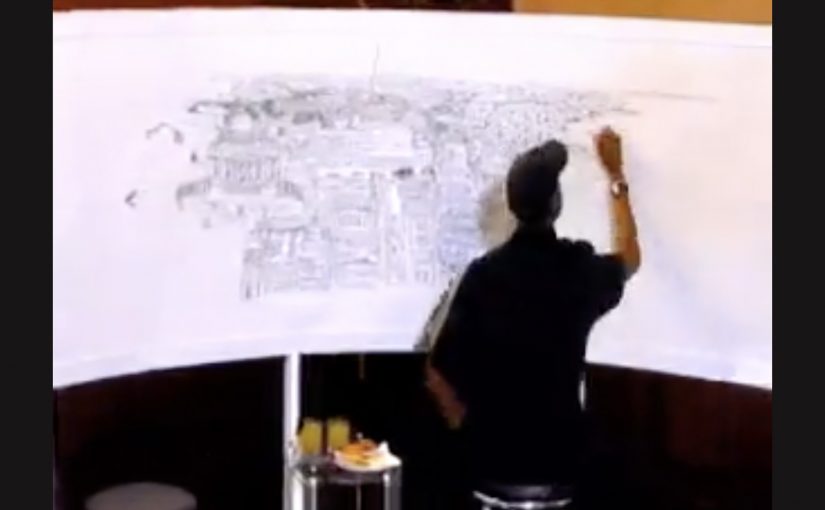
Stephen Wiltshire from London has been called the “Human Camera”. Here, “Human Camera” means the ability to retain and reconstruct a complex visual scene from memory with unusual precision. In this short excerpt, he takes a helicopter journey over Rome and then draws a panoramic view of what he saw, entirely from memory.
One flight, then a full panorama
The mechanic is simple and almost unbelievable. A brief aerial look at a city. Then a long, quiet reconstruction on paper, with landmarks, streets, and proportions held in his head rather than referenced from photos.
In global media and creativity culture, clips like this work because they show skill as proof, not as a claim.
The real question is why this setup makes the proof feel so undeniable.
Why it lands
It compresses something we usually outsource to cameras into a single human performance. The helicopter ride sets a hard constraint, and the drawing becomes the payoff. This is a stronger proof format than a simple claim of talent, because the audience can watch the capability being earned under pressure.
Extractable takeaway: When you want an audience to believe a capability, show the constraint first and the proof second. The tighter the constraint, the more convincing the proof feels.
What to steal for creative work
- Lead with the constraint. The “how” is what makes the “wow” credible.
- Make the process visible. Progress shots and time-lapse style excerpts turn craft into narrative.
- Let detail do the selling. Specificity beats hype, especially in talent stories.
A few fast answers before you act
What is the core of this excerpt?
A short flight over Rome followed by a panoramic drawing created from memory, framed as a demonstration of exceptional recall and draftsmanship.
Why is the “Human Camera” label so sticky?
Because it gives people a shortcut for the ability they are seeing. It translates an abstract skill, visual memory, into a familiar metaphor.
What makes proof clips like this shareable?
The setup is instantly explainable, and the payoff is visual. Viewers can share it without adding context and the clip still lands.
How would you apply this structure to a brand story?
Show one clear constraint, then demonstrate the capability under that constraint. Keep the proof concrete and easy to verify on-screen.
What should creative teams borrow from this setup?
Borrow the sequence, not the spectacle. Put the limitation up front, make the process visible, and let the final proof resolve the tension.