
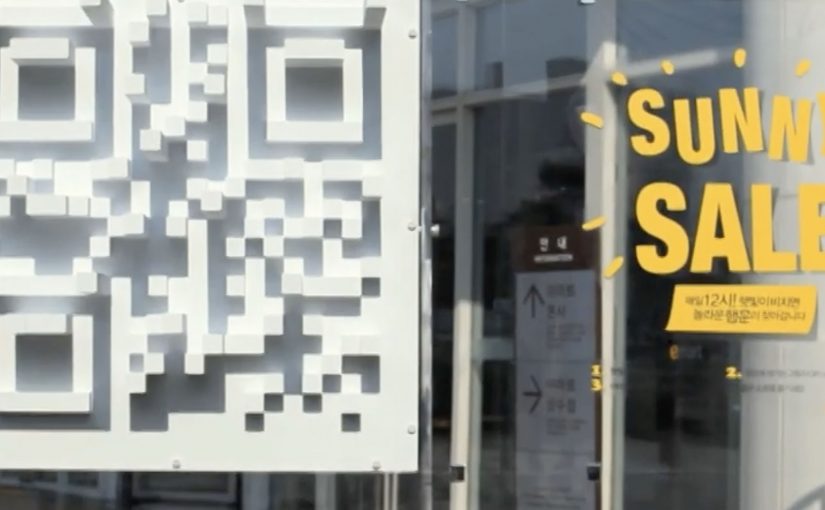
Korea continues to set the standard in creative QR code campaigns. In June last year, Homeplus in South Korea used QR codes to create a virtual store in a subway station.
Now eMart, South Korea’s largest retailer, creates shadow QR codes across the city that only become visible when the sun is at the correct angle in the sky, between midday and 1pm. Consumers who scan the QR code during this period are redirected to the eMart online store, where they receive $12 coupons for products that are delivered to their homes.
Turning time into the trigger
The mechanism is a physical installation designed to cast a QR pattern as a shadow only during a narrow daily window. The code is effectively “off” for most of the day, then “on” at lunch. That forces a repeatable habit moment and makes the scan feel like a discovery rather than a prompt.
In dense, mobile-first retail markets, lunch hour is a high-frequency window where a time-boxed incentive can convert attention into immediate action.
The real question is whether you can make the trigger itself time-locked and unmistakable, so people self-schedule the behavior instead of waiting for another reminder.
A time-locked trigger is a stronger activation pattern than an always-on QR poster because the constraint becomes the story.
Why the shadow constraint works
The campaign does not just offer a discount. It creates scarcity you can see. If you miss the light, you miss the code. That turns a routine coupon into a small challenge, and it gives people a reason to talk about the “how” as much as the “what”.
Extractable takeaway: If you want to spike behavior in a specific time slot, make the call-to-action itself time-bound, not just the offer. When the trigger disappears outside the window, the audience learns the rhythm faster than they would from reminders alone.
The sundial-style QR codes, meaning the code is only scannable when sunlight hits at the right angle, were installed at 36 locations across Seoul and served more than 12,000 coupons. eMart membership increased by 58% and lunch hour sales went up by 25%.
Retail activation takeaways: time-locked QR
- Make the rule instantly legible. “Only works at lunch” is easy to understand and easy to retell.
- Use a constraint that creates urgency without pressure. The sun provides the timer. The brand does not need to shout.
- Connect the scan to a clear payoff. Coupon plus delivery is a complete loop, not a teaser.
- Design for repeat visits. A daily window encourages people to come back tomorrow, not just once.
A few fast answers before you act
What is the Sunny Sale “shadow QR code” idea?
A 3D installation casts a scannable QR code as a shadow only during a specific time window, so shoppers can unlock a coupon by scanning at the right moment.
Why limit the code to midday?
It concentrates attention into lunch hour, creates visible scarcity, and trains a daily habit around a predictable retail moment.
What makes this better than a normal QR poster?
The time-based constraint is the hook. The QR code is not always available, so scanning feels like discovery and the story becomes shareable.
How do you pick the right time window?
Choose a moment that already has repeatable footfall and intent, then make the window tight enough to feel special but wide enough that normal shoppers can realistically catch it.
What can go wrong with time-locked activations?
If the reward is weak or redemption is clunky, the constraint becomes frustration. The tighter the window, the more important the payoff and UX become.