
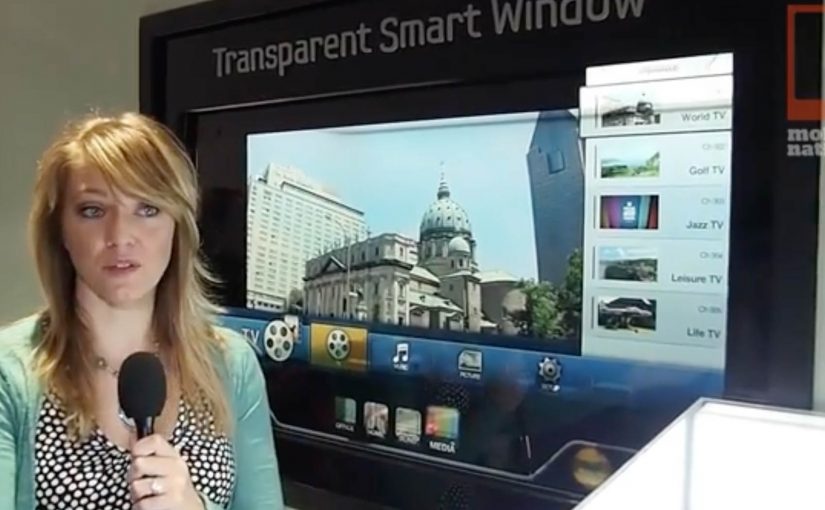
At CES 2012, Samsung unveils a “transparent” window screen concept called Samsung Smart Window. The effect feels instantly familiar. It brings the Minority Report interface fantasy straight into the real world.
Here, “transparent” means a see-through display surface that overlays digital content on what is behind the glass.
The real question is when a screen stops reading as a device and starts reading as part of the building.
The point. A window that is also a screen
Samsung Smart Window frames the display as a surface you can look through and look at. A transparent screen that turns the idea of a “window” into an interface.
Treat Smart Window less as a product promise and more as a signal that “display as surface” is becoming a default interaction pattern.
The mechanism. Turning glass into UI
By framing the display as something you can look through and look at, Samsung collapses “screen” and “window” into one surface. That lets digital layers sit on top of the physical view, not beside it.
In consumer electronics showrooms and built environments, transparent displays matter when you want information to live on the surface people already face, not on a separate device.
Why this works. The screen disappears
The concept works because the window metaphor makes interaction feel like manipulating the room. When the display behaves like glass, the UI feels less like using a device and more like reading the world with an added layer.
Extractable takeaway: If you want a futuristic interface to feel plausible, attach it to an object people already understand and touch, then let the digital layer borrow that object’s meaning.
What Samsung signals next
Samsung positions the Smart Window as moving toward mass production, with availability expected soon. The message is simple. This is not just a lab demo. It is a direction Samsung wants the market to expect.
Practical takeaways for transparent UI
- Anchor the metaphor. Start with a physical object people already trust (window, mirror, dashboard), then let the interface inherit that mental model.
- Overlay, do not relocate. Put information on top of the real-world view so the viewer does not mentally switch contexts.
- Design for glance. Treat the surface like architecture. Prioritize legibility and minimal steps.
A few fast answers before you act
What is Samsung Smart Window?
A transparent display concept unveiled by Samsung at CES, positioned as a window-like screen.
What does it evoke culturally?
A Minority Report style interface experience, where the screen feels like a transparent surface in the real world.
Where is it introduced?
At CES, the consumer technology trade show.
What is the key value of the concept?
It makes the display feel less like a device and more like an architectural surface.
What is the stated next step?
Movement toward mass production and near-term availability.