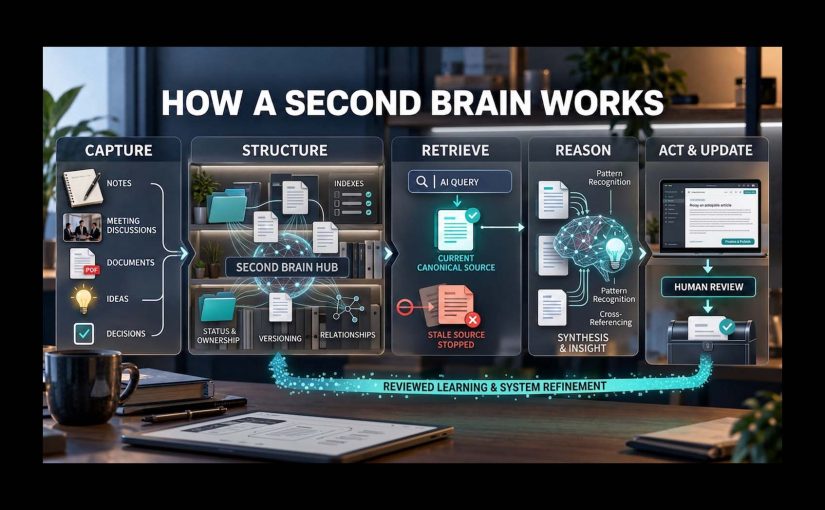
A few weeks ago, I asked ChatGPT a question that required it to read my Second Brain. A Second Brain is a structured personal knowledge system designed to preserve and retrieve useful context. The system answered confidently. The reasoning was coherent. The answer was wrong.
The system had relied on an older cached copy instead of retrieving the current canonical source from Google Drive. By canonical source, I mean the designated current record that should control the answer. This was not a spectacular hallucination. It was a source-selection failure. Intelligent reasoning on the wrong truth is still wrong.
That small failure exposed a much larger enterprise problem. As AI moves from answering questions to maintaining knowledge and taking action, the challenge shifts from finding information to governing what the system may treat as true, what it may change, and when it must stop. I would like to take a moment to explain why that shift matters and where an organization should begin.
The experiment: give AI persistent context
I started building my Second Brain in March 2026. The early work was deliberately unglamorous. I maintained the system meticulously by hand in Obsidian, using separate subject areas, clear file names, consistent conventions, and disciplined decisions about which source was current. I was not trying to build an autonomous agent. I was building a knowledge foundation that I could trust and that would make me AI agnostic.
By late June, I read that ChatGPT could retrieve and reason over that material through Google Drive. So after my summer break, in August, I deliberately enabled controlled read and write access rather than giving the system unrestricted authority. Within roughly a week, the experiment moved toward governed autonomous operation. Tasks such as identifying missing files, flagging duplicate or conflicting versions, updating indexes and maps of content, drafting summaries, and preparing proposed changes for review could proceed without step-by-step prompting, while write access, approval, and human oversight remained explicit.
The foundations took months. Once those foundations existed, the jump from knowledge retrieval to governed autonomous operation happened extraordinarily quickly.
That acceleration is what makes Dan Martell’s video useful. He shows a personal AI system built around persistent files for people, projects, decisions, preferences, and lessons. Meeting transcripts feed the system. A scheduled task can identify missing files, consolidate duplicates, update maps of content, and flag strategic items. The attraction is not simply better note-taking. It is context that an AI can maintain and use.
His demonstration is a helpful picture of the destination, not evidence that the enterprise problem is solved. A personal system has one principal owner and a comparatively small permission boundary. An enterprise has contested facts, inherited access, regulatory duties, multiple systems of record, and decisions whose consequences spread across teams and customers.
The mechanism: memory becomes operational
I use enterprise operating memory here as shorthand for the shift. An enterprise operating memory is a governed capability that turns selected organizational knowledge into source-traceable context for people and AI agents, while controlling who can retrieve it and when it may be updated or used to act.
Organizational memory has been studied for decades, and current AI-enabled platforms already combine enterprise search, permission-aware retrieval, knowledge graphs, citations, agent memory, and actions. What those components do not solve on their own is the operating model that decides which source controls, how conflicts are handled, and who is accountable for reviewing, approving, reversing, and learning from a harmful change.
At its simplest, the mechanism is a loop. The system retrieves relevant material, reasons across it, drafts a conclusion or action, and, if authorized, writes the result back or acts in another system. Because the system can write its interpretation back into the knowledge layer, one source-selection error can become persistent and influence later decisions.
For a consumer-experience organization, the same mechanism could connect brand standards, product data, consent rules, campaign decisions and performance history.
Suppose the system retrieves an older consent rule that is no longer current while preparing a global website update. In read-only mode, the error creates a flawed summary. With write access, it could spread the rule to a campaign brief, delivery backlog, or customer-facing configuration. A source-status check should reject the outdated version. A staged comparison should show the proposed change, and the privacy owner should approve or stop it. The same system that saves time can also magnify weak source controls.
That creates more leverage than enterprise search. Search finds what exists. A knowledge graph connects it. Agent memory preserves context. Operating memory governs what is current, why it is authoritative, what it replaces, and under what bounded authority AI may change it.
Here, executable knowledge does not mean literal code. It means knowledge has become an operational input capable of shaping a decision or triggering an action.
The failure: retrieval is not truth
My stale-file incident was minor and reversible. Its value was diagnostic. The system had access to relevant material, but relevance was not enough. It needed a rule that required the current canonical source for that task and a safe response that flagged the uncertainty and stopped rather than guessing when it could not determine which source was authoritative.
The incident changed how I work. I now treat source selection as a control decision, not an invisible retrieval step, and I require the current canonical source before giving high-impact answers. In my Second Brain, I use YAML properties, structured metadata at the top of each file, to record status, owner, version, effective date, review date, canonical-source designation, and links to earlier or replaced versions. If those properties are missing, the file’s date and time may help identify the likely latest version, but recency does not prove authority. For high-impact tasks, unclear source status should trigger a stop, not a guess. This is the practical pattern I trust most: turn failure modes into governance controls.
Source citations and access permissions help, but neither proves that an answer is correct. A citation shows where a statement came from, not whether that source was approved, current, or controlling. Permission-aware retrieval shows that a person can access something, not that the material is appropriate for every purpose.
The real question is not whether AI can read organizational knowledge, but whether it can be trusted to maintain and act on it.
My stance is simple: organizations should treat AI-maintained knowledge as a controlled operational asset, not as a smarter search box.
The value: remove the coordination tax
Coordination tax is the time people lose finding owners, rebuilding context, reconciling versions, and repeating decisions.
The business case is not that expertise becomes unnecessary. It is that expertise no longer has to be the bottleneck for reconstructing context.
Imagine a specialist is absent during a critical decision. An authorized colleague could ask for the current state, the decisions already made, the rationale behind them, open issues, safe next actions, and matters that still require approval. The system could assemble that context from governed sources, while the specialist or accountable owner remains responsible for judgment.
Or consider a manager preparing a decision across product, analytics, privacy, brand, localization, and marketing technology. Today, the manager may spend days finding the right people, reconciling versions, and rebuilding the history. An operating-memory layer could draft the status, expose contradictions, identify dependencies, and prepare the decision narrative. The relevant specialists would still validate the consequential parts.
In August 2026, Google submitted the winning $10 million bid for a Spirit Airlines data package containing roughly 100 million emails and 500 million Microsoft Teams messages, alongside source code and extensive operational and financial records. The proposed transfer was subject to court approval and de-identification, and the price covered the complete package, not the messages alone. Even so, the bid signals that the decisions, workflows, and institutional context buried inside enterprise systems are becoming valuable inputs for AI. For a living company, the greater opportunity is not to sell that memory, but to govern and reuse it for its own benefit.
That is where the potential productivity gain sits: less context reconstruction, fewer repeated explanations, and faster handoffs. It is a reduction in coordination tax, not a promise to remove people.
AI helps the organization reuse what it already knows. People create what it needs to know next.
The countercase: scale magnifies weak controls
The strongest objection is also the reason to act carefully. A successful personal Second Brain does not transfer its safety to an enterprise. It transfers the organization’s stale documents, overshared folders, conflicting policies, ambiguous ownership, and missing decision history into a probabilistic system with tool access.
Permission-aware retrieval can reproduce bad permissions. A current index can faithfully retrieve a document that was never authoritative. A cited answer can still apply the wrong policy version. An approval prompt can become a rubber stamp. A write can create a circular knowledge loop in which AI stores a conclusion and later cites that conclusion as independent evidence.
Unwritten expertise creates another limit. Not everything important has been captured, and not every exception can be inferred from documents. The system represents selected organizational knowledge; it does not contain everything the organization knows.
This does not argue for keeping AI read-only forever. It argues for earning autonomy one action type at a time. Reading is different from drafting. Drafting is different from staging a visible change. Staging is different from publishing, deleting, or triggering a customer-facing action.
The controls: make authority explicit
The practical design is federated. Federated means domain and team spaces can remain close to the people who understand them while shared rules govern how knowledge becomes authoritative and how AI may use it. The alternative is either hundreds of disconnected personal brains or one unrestricted corporate brain.
Six controls matter first:
- Truth: Name the canonical source, accountable owner, status, effective date, review date, and superseded version.
- Access: Enforce identity, authorization, sensitivity, and legitimate need at retrieval time. Seniority alone is not a permission model.
- Authority: Separate permission to read, draft, stage, write, publish, delete, and act. Let downstream systems enforce authorization.
- Provenance: Preserve the exact source versions, model and tool context, policy checks, approvals, output, and resulting action for material changes.
- Verification: Test whether the source is current and controlling, expose unresolved conflicts, and require the system to abstain when evidence is insufficient.
- Escalation: Assign a human owner with the competence, time, authority, and ability to stop or reverse the action.
Put those controls into practice with one team and one bounded, reversible workflow, such as producing a weekly cross-market website status brief. Before starting, record the current cycle time, coordination effort, unresolved source conflicts, and rework caused by stale information. First, let AI retrieve and cite named canonical sources. Then let it draft the brief and stage proposed updates to a decision log for an accountable owner to approve. Measure canonical-source selection, correction rates, and time saved against the baseline. Only after agreed thresholds are met should low-risk maintenance run autonomously. Publishing, deletion, and customer-facing changes should remain approval-gated and reversible.
When AI moves from retrieving information to changing organizational state, governance rules must be enforced at the moment the system retrieves, writes, or acts.
The starting point: govern truth before action
The purpose of the pilot is not merely to prove that AI can retrieve and draft. It is to prove that the organization can identify authoritative sources, measure improvement against a baseline, expose uncertainty, assign approval, and reverse a bad change before scaling. Once those foundations hold, the harder question becomes: what happens when organizational knowledge becomes executable, not merely searchable?
The practical takeaway is this: start by governing truth before granting autonomy. In one bounded, reversible workflow, identify the canonical sources, assign accountable owners, define freshness and access rules, and measure how often the system selects the correct source. Then separate read, draft, stage, write, publish, delete, and action authority; require human approval for consequential changes; preserve provenance; and make every material change reversible. Only expand autonomous permissions when the pilot shows that the system reliably selects authoritative sources, exposes uncertainty, reduces coordination effort, and can be stopped or corrected when it fails.
A few fast answers before you act
What is an enterprise operating memory?
An enterprise operating memory is a governed, federated capability that makes selected organizational knowledge available as permission-aware, source-traceable context for people and AI agents, with explicit controls over updates and actions.
Is it just enterprise search or retrieval-augmented generation (RAG)?
No. Search and retrieval-augmented generation can find and synthesize relevant content. An operating-memory model also governs source authority, lifecycle, write permissions, verification, escalation, and the consequences of changing organizational knowledge.
Does it replace specialists?
No. It can reduce the time specialists and colleagues spend reconstructing context, but specialists remain essential for creating new knowledge, interpreting exceptions, and validating consequential decisions.
What should organizations govern first?
Organizations should first define canonical sources, accountable owners, source status, freshness rules, access boundaries, and the conditions under which the system must expose a conflict or abstain.
Where should an enterprise pilot start?
Start with one team and one bounded, reversible workflow inside the shared governance model. Record the current cycle time, coordination effort, source conflicts, and rework before the pilot begins. Progress from retrieval to drafting and staged changes with named approval. Add low-risk autonomous maintenance only when agreed accuracy and control thresholds are met. Scale only when the measured gains persist and the governance model continues to hold.
What is the biggest failure mode?
The biggest failure mode is authoritative-looking action based on knowledge that is relevant but stale, incomplete, noncanonical, or inappropriate for the user’s purpose. Good reasoning cannot rescue the wrong source of truth.