
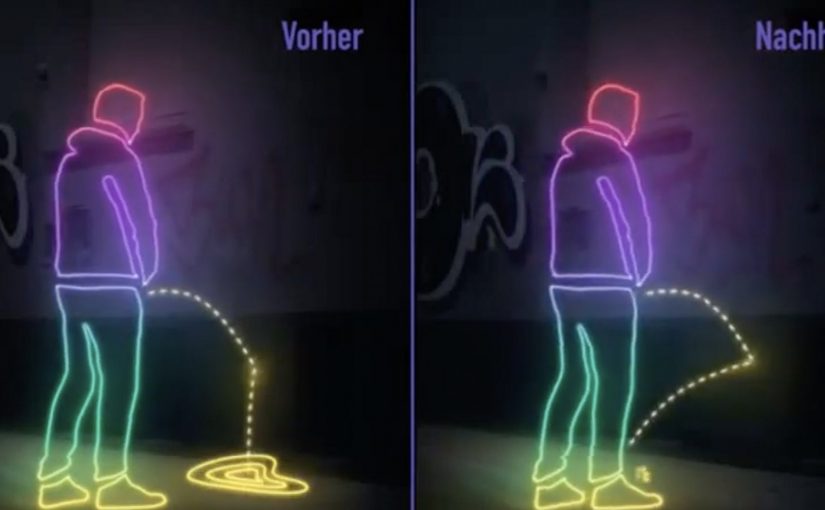
St. Pauli: Pinkelt Zurück

St. Pauli is one of Hamburg’s top entertainment destinations, reported as attracting up to 20 million visitors a year with its nightclubs and legal prostitution. But the steady stream of visitors has many residents and merchants angry, as some visitors relieve themselves against walls, leaving parts of the area smelling like a latrine.

So to combat this, St. Pauli’s merchants fight back by coating the most frequented walls with Ultra-Ever Dry, a superhydrophobic coating that repels liquids (the same type of coating Nissan publicly demonstrated on a “self-cleaning” car prototype). Now when liquid hits the treated surface, it can splash back, soaking the offender’s pants and shoes.

A deterrent that makes the consequence immediate

The mechanism is direct. Identify the walls that get hit most often. Apply a coating that strongly repels liquids. Let physics deliver instant feedback to the person causing the problem. It is not subtle, and that is the point. The “punishment” is immediate embarrassment and discomfort. The real question is how to stop a repeat nuisance behavior when constant policing is unrealistic. The stronger move is to redesign the environment so the consequence happens in the moment.

Why it lands

In European nightlife districts where resident quality-of-life clashes with party tourism, deterrence tends to work best when it changes behavior in the moment, not when it relies on rules people ignore after midnight. This works because it does not require enforcement at scale. There is no need to catch someone, argue, or issue a fine. The wall becomes the deterrent, and the story becomes self-spreading because the consequence is memorable and easy to retell.

Extractable takeaway: If a behavior persists because policing is impractical, shift the intervention from enforcement to environment. Make the unwanted action inconvenient or self-correcting, and the system scales without extra staff.

A broader pattern beyond Hamburg

Similar anti-urination paint trials were also reported in San Francisco, where public works tested superhydrophobic coatings on selected walls as a deterrent. The through-line is the same. When a city cannot police every corner, it experiments with “designing the street” to reduce repeat nuisance behaviors.

What civic teams can borrow

  • Target the hotspots. Interventions work best when they focus on the highest-frequency locations, not the whole city.
  • Make the rule physical. If the environment enforces the norm, compliance increases without lectures.
  • Keep the message legible. People should understand the consequence immediately, even when they are distracted.
  • Plan for side effects. Think through splash zones, signage, and whether the deterrent creates any new cleaning burden.

A few fast answers before you act

What does “Pinkelt Zurück” mean?

It means “pees back”. It is a blunt way to describe a wall treatment designed to repel liquid back toward the source.

What coating is used in this idea?

The case describes the use of Ultra-Ever Dry, a superhydrophobic coating designed to repel most liquids.

Why is this more effective than fines?

Because enforcement is hard in crowded nightlife areas. The deterrent works at the moment of behavior, without needing police presence.

Was something similar tried outside Germany?

Yes. Reporting describes trials of similar superhydrophobic coatings on walls in San Francisco as a public urination deterrent.

What is the main lesson for civic or place marketing?

When behavior change is the goal, redesign the environment so the better behavior becomes the easier behavior.
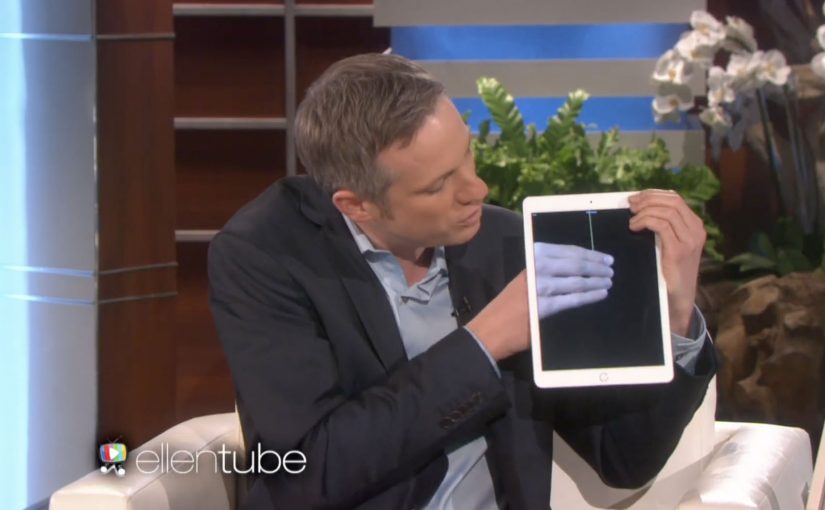

Simon Pierro: iPad Magic on Ellen

An iPad becomes a stage prop. Photos, objects, and interfaces behave like they can leak into the real world. That is the whole hook of Simon Pierro’s “digital magic”, and it plays especially well on a talk-show set. Here, “digital magic” means classic sleight of hand staged through a device interface so the screen appears to affect the physical world.

Simon Pierro is a digital magician from Germany who takes audiences to places they’ve never been, using a technological marvel they know and love, an iPad.

His latest performance was on The Ellen DeGeneres Show at the massive Warner Bros. studio complex in Hollywood. Here he treated Ellen DeGeneres and her enthusiastic audience to some of his best tricks, including his newest illusion, an iPad selfie.

Why “digital magic” works as a format

The mechanism is familiar stagecraft wrapped around a modern interface. The iPad provides a believable frame for impossible transitions, because everyone already understands screens, apps, photos, and swipes.

Extractable takeaway: Wrap your “impossible” moment in a familiar interface so the reveal reads instantly and can be retold without extra explanation.

In consumer technology and entertainment media, demos travel further when they feel like a performance, not a product explanation.

The moment that sells the illusion

The strongest beats are the ones that collapse distance between screen and reality. When a selfie or a photo becomes “physical”, the audience gets a clean before-and-after moment that is easy to retell and easy to clip.

The real question is whether your demo is built to be retold, not just understood.

If you market experiences, you should treat the demo as performance first and explanation second.

How to stage experience demos people retell

  • Use a prop people already trust. Familiar devices make impossible outcomes feel temporarily plausible.
  • Design for one clear closer. A single “how did that happen” finale gives the video its replay value.
  • Keep the story inside the frame. The best tricks look self-contained, so viewers do not need context to enjoy them.

A few fast answers before you act

What is “digital magic” in simple terms?

It is classic illusion and sleight of hand staged through modern devices, so screens, apps, and media become part of the trick.

Why does iPad magic perform well on TV and online?

Because the visuals read instantly and the reveals are clean. You do not need language or setup to understand the surprise.

What is a “signature reveal”?

It is the one moment you want viewers to remember, the clean switch from normal to impossible that carries the message on its own.

What makes a trick “shareable” as video content?

A tight sequence of cause and effect. You see the normal state, then the impossible state, and the clip ends before the mystery dissolves.

How do you translate this into brand work without copying it?

Borrow the structure. Use a familiar interface, create one signature reveal, and anchor the message in a single visual moment people can retell.

Human Human Bowling: Zorb Meets the Ski Slope

Bowling is awesome. Now replace the bowling ball with a Zorb, take it to a ski slope, and you get “human bowling”, a stunt where a person rolls downhill inside the sphere toward bowling pins, a simple mash-up that is instantly understood in one glance.

The setup is the whole point. A big, rolling sphere. A downhill run. A set of pins at the bottom. Then you film the impact and let the physics do the storytelling.

What makes this work as shareable content

The mechanism is pure compression. Two familiar ideas collide, bowling and zorbing, and the result is legible without explanation. The slope provides momentum, the pins provide a clear finish, and the camera captures a single payoff moment people can replay. That works because viewers do not need extra setup to predict the outcome and wait for the hit.

In global digital marketing where attention is scarce and feeds are crowded, short physical stunts travel best when the premise can be understood in under a second.

Why people watch it twice

It hits the sweet spot of anticipation and inevitability. You know what is going to happen, but you still want to see how it happens. That predictability is a feature, not a bug, because it makes the clip satisfying to rewatch and easy to share with a one-line caption.

Extractable takeaway: If you want lightweight virality, build a premise that explains itself visually, then design one clean payoff moment that rewards a replay.

The practical marketing angle

The real question is whether the audience can understand the stunt before they decide to scroll past it.

This kind of clip is a useful pattern for adventure brands and experience operators. Show the product in a context that creates instant stakes, then let the audience imagine themselves in it. The “creative” is really the format choice and the clarity of the stunt.

What stunt marketers can borrow

  • Combine two known formats. Mash-ups reduce explanation and increase curiosity.
  • Design a clear ending. Pins, targets, splashdowns. A finish line makes the clip complete.
  • Prioritise one camera-friendly moment. The payoff should be obvious and repeatable.
  • Keep it short. The simpler the loop, the higher the share rate.

A few fast answers before you act

What is “human bowling” here?

A stunt where a Zorb rolls down a ski slope and crashes into bowling pins, turning a familiar sport into a physical spectacle.

What is the core mechanism that makes it spread?

A self-explanatory visual premise plus a single, satisfying payoff moment that invites replay.

Why does this premise travel faster than a more complex stunt?

Because the audience can decode the idea instantly and spend their attention on the payoff instead of on figuring out the setup.

How would I apply this pattern to a brand?

Create a simple, visual mash-up that features your product in action, then design one clean “finish” moment that is easy to capture and easy to retell.

What is the biggest mistake when copying this?

Overcomplicating the setup. If viewers need context, you lose the advantage of instant comprehension.