Last month I wrote about Austria Solar’s annual report, whose pages became visible only when exposed to sunlight.
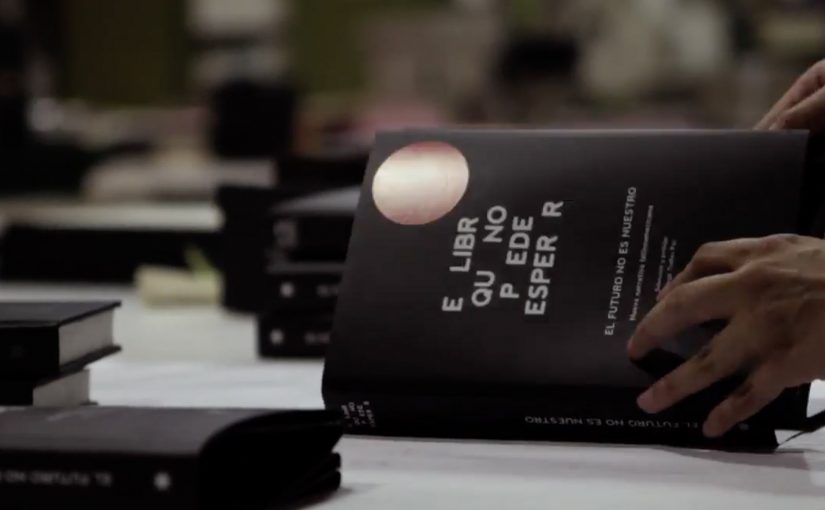
Now Buenos Aires based bookshop and publisher Eterna Cadencia has released “El libro que no puede esperar”, “The book that cannot wait”. It is an anthology of new fiction printed in ink that disappears after two months of opening the book.
The mechanic: ink that fades once you open the seal
How is that possible. Here, the mechanic is a built-in physical rule: the books are described as being silk-screened using a special ink, then sealed in air-tight packaging. Once opened, the printed material reacts with the atmosphere and starts to fade. The result is that, after roughly two months, the text vanishes.
In global publishing markets where e-books change reading habits, physical formats regain attention when they add a constraint that digital cannot replicate.
Why it lands: urgency turns reading into an action, not an intention
The idea does not compete with e-readers on convenience. It competes on psychology. A normal book is patient. This one is not. It creates a deadline, and deadlines change behavior. Because the fading is irreversible, the deadline feels real rather than promotional.
Extractable takeaway: If you want people to stop postponing a behavior, make the cost of waiting tangible and irreversible. Scarcity works best when it is built into the product, not added as a marketing slogan.
What it is really doing for new authors
The real question is whether a physical constraint can turn passive interest into immediate reading.
This is smart publishing design, not a gimmick for its own sake.
At face value, this is a publishing gimmick. Underneath, it is an argument for momentum. New fiction struggles when it sits unread on a shelf, because “I’ll get to it” often becomes “never”. A time-limited book reframes the purchase as a commitment to read now, which is exactly what emerging authors need.
The project is also widely described as being developed with DraftFCB, which helps explain why the execution feels like an idea engineered for cultural pickup, not just for bookstore shelves.
What to steal if you are marketing anything physical
- Build the message into the object: the product itself should carry the story, even without a campaign.
- Make the constraint legible: people should understand the rule in one sentence.
- Turn delay into loss: urgency works when waiting has a real consequence.
- Use packaging as a trigger: opening the seal is a clear “start” moment, and that matters for behavior.
- Design for retellability: “a book that disappears if you do not read it” spreads on its own.
A few fast answers before you act
What is “The Book That Cannot Wait”?
It is a print book sealed in packaging where the text is printed with ink that starts fading once the seal is opened, so the content disappears after around two months.
Why would a publisher want ink that disappears?
To create urgency. The mechanic nudges readers to start and finish the book quickly, which can help emerging authors get read instead of getting postponed.
Is this a product innovation or a marketing campaign?
It is both. The object is the media. The disappearing ink turns the product into the message, which then earns coverage and conversation.
What is the biggest risk of copying this idea?
Trust. If people feel tricked or if the fade behavior is inconsistent, the stunt becomes resentment. The rules need to be clearly communicated and reliably delivered.
Where else does “built-in urgency” work?
It can work in limited editions, time-bound access, perishability, or experiences that change after first use. It is strongest when the constraint feels meaningful, not arbitrary.