
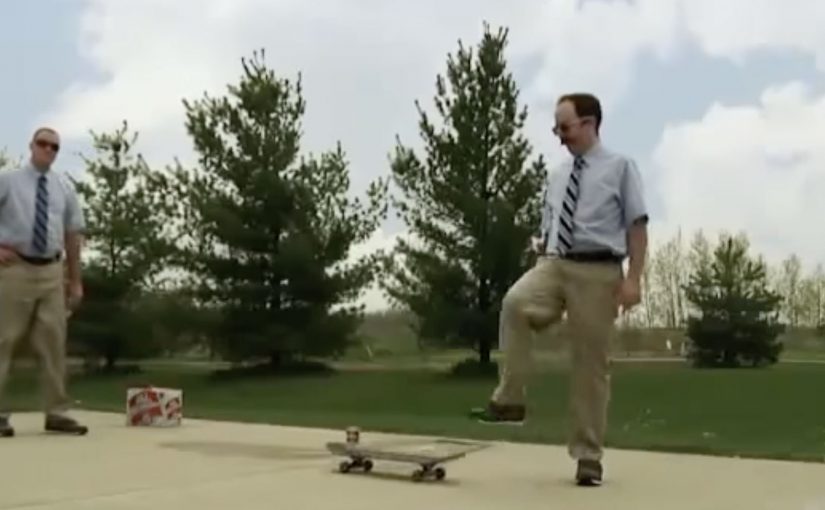
Hey, Pass Me a Beer: Creative Handoff

“Hey, pass me a beer” is a throwaway line until you treat it like a creative brief. This short film, described as shot in Milwaukee by Almost Twins, turns a simple request into a chain of increasingly elaborate handoffs.

The charm is in the escalation. Each new pass answers the same problem with a more over-engineered solution, and that relentless commitment is what keeps you watching.

The handoff trick that makes it work

The mechanism is a repeating loop. Set up the same micro-goal, move the beer from A to B, then raise the complexity without changing the premise. Here, the micro-goal is simply getting one beer from one person to another. Because the rules stay constant, the viewer can focus on anticipating the next method, not on understanding the story.

In internet video culture, repeatable mechanics like this spread because they are instantly understandable, and they reward attention with continual novelty.

Why it lands

It treats craft as the punchline. The joke is not a line of dialogue. The joke is the effort. That effort reads as playful competence, and it invites the viewer to watch for “how did they do that” as much as “what happens next”.

Extractable takeaway: If you want a simple gag to carry a whole film, lock one clear rule, then escalate execution rather than premise. The audience stays oriented while still being surprised.

What “trending” really means here

The real question is whether the viewer understands the rule fast enough to enjoy the escalation rather than spend energy decoding the format.

When a video like this climbs, it is usually because it is easy to share with one sentence, and because it plays well without sound or context. You do not need to explain it. You can just send it and let the mechanic do the work.

What to steal for your own short-form content

  • One rule beats ten ideas. A single repeating mechanic can outperform a complicated concept.
  • Escalate visually. Make each beat clearly “more” than the last, even in a thumbnail-sized view.
  • Keep runtime tight. End while the pattern is still satisfying, not after it becomes predictable.
  • Design for retellability. If a viewer can pitch it in one line, they will.

A few fast answers before you act

What is the core idea of Hey, Pass Me a Beer?

A single premise, passing a beer, repeated with escalating handoff methods so the execution becomes the entertainment.

Why does this format keep attention?

The rules stay fixed, but the solution changes each time. That combination makes it easy to follow and hard to predict.

What makes it shareable?

It is understandable instantly and does not need setup. People can share it with one sentence and the recipient gets it immediately.

How do you apply this to a brand or product?

Pick one tiny behavior you want to dramatize, then show many inventive ways to achieve it. Keep the product cue present, but let the mechanic carry the viewing pleasure.

What is the reusable lesson for short-form creators?

Build around one rule the audience can grasp immediately, then make each beat visibly more inventive without changing the premise.

Jimmy Kimmel: Halloween Candy Prank 2011

Here’s to starting a new week with a smile.

Talk show host Jimmy Kimmel challenged parents across America to tell their kids they ate all their Halloween candy, then videotape the reactions. Parents were asked to upload the clips to YouTube under the heading “Hey Jimmy Kimmel I told my kid I ate all their Halloween candy.”

Daring moms and dads followed through. The frenzied responses are then pieced together into a fast, best-of montage that does the work of a full segment in a few minutes.

A prank with a built-in distribution engine

The mechanism is almost frictionless: one simple prompt, one easy filming setup, one obvious upload destination, and one consistent label so submissions can be found and compiled. The audience creates the raw material. The show supplies the edit and the punchline timing.

In US broadcast entertainment, repeatable viewer challenges turn a one-way show into a repeatable participation cycle that grows through sharing.

Why it lands

It compresses a big emotional range into a tight format. Tears, outrage, bargaining, moral lectures, and sudden forgiveness all land fast. Because the viewer understands the setup in seconds and gets a fresh emotional spike every few beats, the montage keeps attention high without needing extra explanation.

Extractable takeaway. User-generated segments travel when the prompt is easy to replicate, the emotional payoff is immediate, and the brand’s role is ruthless curation, not overproduction.

It is instantly understandable. You do not need context, a premise explainer, or a character intro. Candy, kids, and betrayal are enough.

It makes the audience feel like the cast. Parents are not just watching a bit, they are contributing to it. The real question is not whether one prank is funny, but whether the format reliably turns viewers into contributors and contributors into distribution.

This is stronger as a participation system than as a one-off TV gag.

What to steal from participatory prank formats

  • Make participation a recipe. One action, one prompt, one deliverable, one naming convention.
  • Design for phone-grade production. The lower the setup cost, the higher the submission volume.
  • Optimize the edit for momentum. A “best-of” is not a dump of clips. It is pacing, contrast, and escalation.
  • Build a title that people can copy exactly. Consistent labeling is the quiet infrastructure behind scalable user-generated content.

A few fast answers before you act

What is the core mechanic of this Jimmy Kimmel segment?

A single prank prompt is sent to viewers. Viewers film reactions and upload clips. The show compiles the best moments into a montage.

Why does it work so well on YouTube?

The setup is universal and the payoff is fast. Each clip delivers a clear emotional beat that is easy to share without explanation.

Is this a “campaign” or just a TV gag?

It behaves like a campaign because it has a repeatable participation brief and a distribution loop. It is also a comedy bit because the final product is the edit.

What makes the montage feel addictive?

Pacing and variety. The edit jumps between different reactions before any single moment stalls, which keeps attention locked.

What is the transferable lesson for marketers?

If you want scale, simplify the instruction, standardize the submission label, and invest your effort in curation so the best entries become the marketing.

Helium in Chewing Gum: The Jumping Bubble

A few guys run a hilariously simple experiment: they add helium gas into chewing gum and see what happens when the gum turns into a bubble.

Why this idea is even a question

The underlying thought is basic physics. Helium is lighter than air, so if you can trap enough of it inside a bubble, buoyancy starts to matter. Chewing gum adds weight and resistance, so the “will it float” question becomes a practical one, not a theoretical one.

In global consumer marketing teams and creator studios, simple, repeatable experiments often outperform polished productions when the payoff is instantly visible.

The real question is whether the helium adds enough lift to visibly change the bubble’s behavior before the gum’s weight and leakage win.

In a world where small experiments travel faster than polished productions, a clean visual question plus a simple setup is often enough to create shareable entertainment.

What makes it watchable

It is instantly legible. You do not need context, subtitles, or a long explanation. You just want to see whether the gum bubble behaves differently, and whether it turns into something that looks like “jumping” rather than floating. Here, “jumping” means a short, bobbing lift that reads like a hop on camera, not sustained flight. Because buoyancy is actually in play, the outcome feels uncertain enough to keep you watching.

Extractable takeaway: When the question is instantly understood and the payoff is purely visual, you can win attention without narration or heavy editing.

Borrow the visual-question pattern

  • Start with a one-line premise. “What if we add helium to chewing gum” is a perfect hook.
  • Design a visible outcome. The result has to be obvious on camera, even with the sound off.
  • Keep the runtime tight. Curiosity does the work if the setup is short and the payoff arrives quickly.

This is the kind of micro-experiment I would publish with almost no polish: the premise is clear, the outcome is visible, and the audience does the distribution.

I would not be surprised if “chewing gum jumping” became someone’s next absurd extreme sport.


A few fast answers before you act

Can a helium-filled bubblegum bubble actually float?

A helium-filled bubble can float if the buoyant lift exceeds the total weight of the gum and trapped gas. In practice, the gum’s weight and leakage usually make sustained floating harder than people expect.

Why does the bubble sometimes look like it is “jumping” instead of floating?

The bubble can get small bursts of lift, then lose gas or hit airflow changes. That can create a bobbing, hopping motion rather than a smooth rise.

Why do tiny experiments like this spread online?

Tiny experiments spread because they pose a visual question, deliver a fast payoff, and let viewers answer it for themselves in one watch.

Is it safe to do helium experiments like this?

Handling helium carefully is important. Do not inhale helium. It can cause serious harm by displacing oxygen.

What’s the simplest takeaway from this experiment?

A small change in what’s inside a bubble can change how it behaves, but chewing gum still dominates the outcome because it adds mass and leaks over time.