Augmented reality leaves the demo room
Microsoft HoloLens is not only about futuristic consumer experiences. Its real power emerges in enterprise environments.
A strong example is ThyssenKrupp, which uses HoloLens to redefine how elevator maintenance is performed in the field.
Instead of relying on manuals, phone calls, or trial and error, technicians receive contextual, real-time information directly in their line of sight.
How HoloLens changes elevator servicing
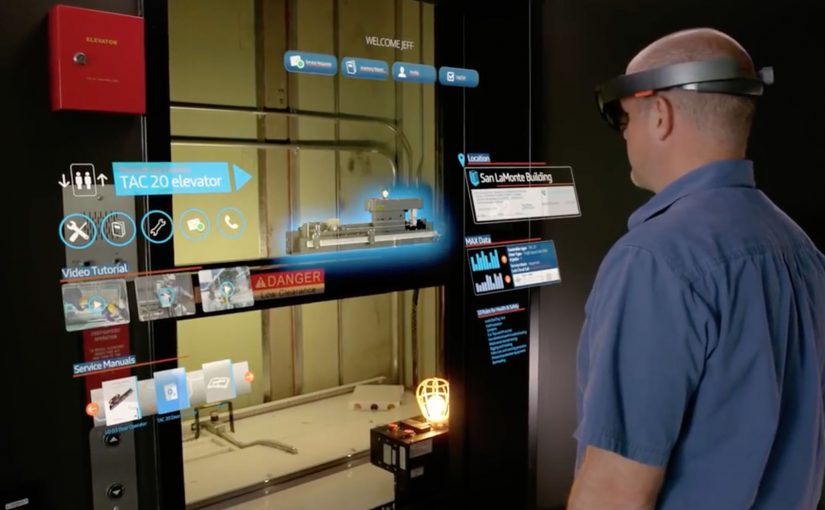
With HoloLens, elevator technicians see what they need while keeping their hands free.
Technical documentation, schematics, and checklists appear as holograms overlaid onto the physical elevator system.
Remote experts can see exactly what the technician sees and guide them step by step.
This turns maintenance into a guided, collaborative process rather than an isolated task.
In industrial field service teams, the constraint is getting expert judgement to the point of work fast enough to prevent rework and downtime.
Why this matters for industrial operations
The impact goes beyond convenience. Because guidance is delivered in-context and hands-free, technicians can complete complex steps with fewer avoidable mistakes.
Extractable takeaway: When you embed expert guidance into the job itself, you turn specialist knowledge into a repeatable operating system for the frontline.
The real question is whether you can make frontline expertise repeatable inside the workflow, not whether you can ship an AR pilot.
Enterprise AR is worth doing when it removes friction from real maintenance workflows, not when it adds another screen.
- Reduced downtime
- Shorter training cycles
- Improved first-time fix rates
Most importantly, expertise becomes scalable.
Knowledge is no longer locked in the heads of a few specialists. It becomes part of the workflow.
A glimpse of the future of work
This use case shows what augmented reality does best.
It does not replace workers. It augments them.
Complex tasks become easier. Errors decrease. Confidence increases. Work becomes safer and more efficient.
This is where mixed reality stops being a novelty and starts being infrastructure. By mixed reality here, I mean digital guidance and remote expertise anchored onto the physical job, not a virtual-world detour.
What to copy from this AR service pattern
- Instrument the moment of work. Put the next step where the technician is looking, not in a manual that forces context switching.
- Make escalation visual. Let remote experts share the same view so guidance is specific and actionable.
- Scale expertise as workflow. Capture checks, sequences, and decision points so outcomes do not depend on a few specialists.
A few fast answers before you act
What is the Microsoft HoloLens elevator maintenance use case?
ThyssenKrupp uses Microsoft HoloLens so field technicians can see schematics, checklists, and contextual guidance overlaid onto the elevator system while working hands-free.
How does HoloLens change the maintenance workflow?
It puts documentation and step-by-step instructions into the technician’s line of sight, and enables remote experts to see what the technician sees so they can guide the job in real time.
Is this only relevant for elevators?
No. The same pattern applies to any field service or industrial maintenance scenario where hands-free guidance, fast troubleshooting, and expert escalation reduce downtime and errors.
What is the measurable value driver in enterprise AR like this?
Reduced downtime, faster training, and higher first-time fix rates. The key is that expertise becomes repeatable and scalable inside the workflow instead of remaining locked in a few specialists.
Where does this pattern break down?
It breaks down when the underlying documentation is outdated, connectivity is unreliable, or remote support is not operationalized. The hardware alone does not change outcomes.