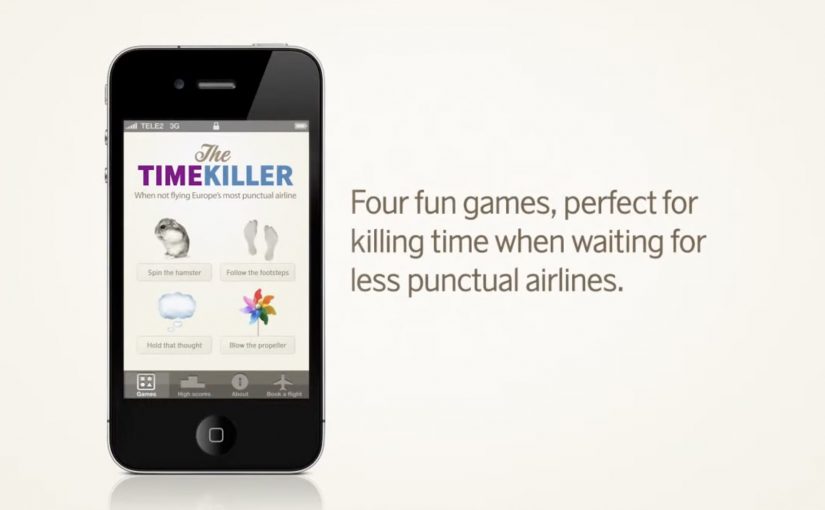
For the last two years in a row, SAS (Scandinavian Airlines) wins recognition as Europe’s most punctual airline. With their ad agency SWE Advertising Stockholm, they create a small time-wasting utility app that is not actually made for loyal SAS customers, but for customers of competitor airlines. Here, a “utility app” means a tiny set of simple time-wasters meant to fill airport waiting time, not a booking tool.
The idea is to poke fun at SAS’ rivals by suggesting their passengers will need this app from SAS because chances are their flight will be delayed and they will need something to kill time with.
Punctuality is a service promise that is easier to demonstrate through playful proof than to claim in a static ad.
Why the joke works as a positioning tool
The app is framed as “help” for the wrong audience. That reversal does two things at once. It flatters SAS’ own performance, and it gives people a sharable punchline that does not require you to know anything about the airline’s route map or pricing.
Extractable takeaway: If you have a provable operational edge, package it as “help” for the people who do not have it. The inversion makes the proof memorable and easy to retell.
What the utility format adds
A utility app earns attention differently than a film. People understand the use case immediately, and the brand is present during the exact moment when “punctuality” becomes emotionally relevant, which is waiting around with nothing to do. Because the brand shows up inside that boredom, the punctuality claim feels like lived experience rather than marketing.
In European travel markets where delays are a shared irritation, proof-based humor like this can travel faster than polished slogans.
The real question is whether your brand can turn a performance claim into something people choose to share.
Competitor teasing like this is worth doing only when your punctuality claim can withstand scrutiny.
Steal the move: playful proof of punctuality
- Target the competitor’s pain point. The message lands because it attaches to a real frustration, delays.
- Make the idea explainable in one line. “An app for when your airline is late” is instantly clear.
- Let the brand voice do the selling. The confidence in the joke is the differentiator.
- Choose a format that matches the claim. If the promise is saving time, build something that lives inside wasted time.
A few fast answers before you act
What is the SAS TimeKiller App?
It is a light utility app positioned as a set of simple time-wasters for passengers who end up waiting because their flight is delayed.
Who is the app really aimed at?
Competitor airline customers. The concept uses them as the audience so SAS can underline its punctuality by contrast.
What is the core message SAS communicates?
If you fly SAS, you should not need a time-killing app at the airport. If you fly someone else, you might.
Why is an app a smart channel for this idea?
Because it places the brand in the exact moment of frustration and boredom, which makes the message feel relevant rather than abstract.
What is the main risk with this kind of competitor jab?
If your own operational performance slips, the joke can backfire. This format works best when your proof point is consistently strong.