Supreme Security is an international company offering security services ranging from personal security to dog squad assignments, as well as access and baggage checks. To deliver that, it continually needs specially trained personnel, but only a small pool of specialists fits this narrow job profile in Switzerland, and many of them work in border patrol or airport police.
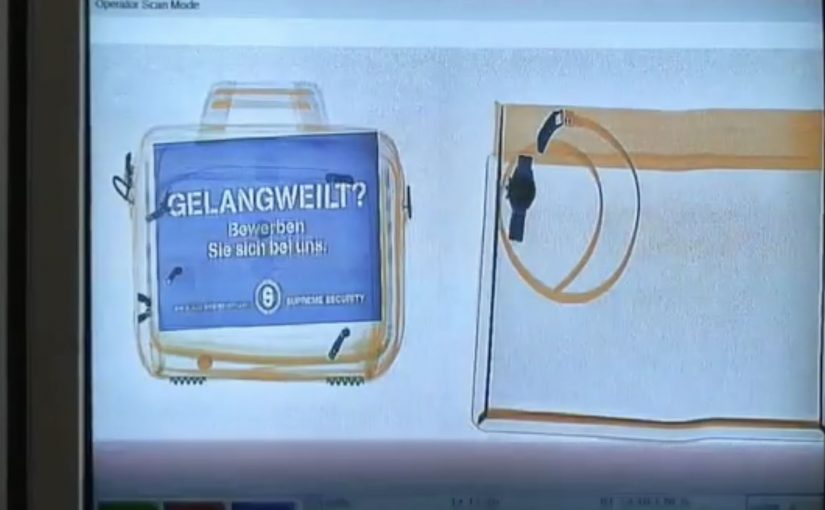
So the company equips its own employees with machined metal bars and sends them on business trips with those bars packed in their hand luggage. When the bags go through security, the X-ray image reveals a clear recruitment message to the people operating the scanner.
The X-ray reveal: a job ad delivered inside the checkpoint
The execution is almost stubbornly physical. No QR codes. No landing pages in the moment. Just a piece of metal engineered so its silhouette becomes readable text on a baggage scanner screen.
That design choice matters because it matches the audience’s reality. These candidates spend their day looking at X-ray images. The campaign puts the job offer exactly where their attention already lives.
In specialist recruitment markets, placing your job offer inside the candidate’s daily workflow can outperform broad awareness media.
Why it lands: it respects expertise and filters for it
This is not a mass recruitment message pretending to be clever. It is a targeted signal aimed at a professional who will immediately understand what they are seeing, and why it was made for them. The real question is whether your recruitment message shows up inside the exact workflow that signals real fit. This is smart recruitment because the medium itself does part of the qualification work.
Extractable takeaway: The fastest way to reach scarce talent is to design a “high-signal artifact”, meaning a message carrier whose form already screens for relevance, so only the right audience will notice and appreciate it. If the medium itself acts like a competency filter, you get fewer leads, but better ones.
The low-budget constraint is part of the story too. The campaign is described as being produced for under 5,000 Swiss francs and as recruiting eight highly qualified employees in two months. That makes the idea feel replicable, not reserved for brands with giant hiring spends.
What to steal for your next hard-to-hire role
- Recruit inside the work context: deliver the message where the target audience already concentrates.
- Make the medium do the targeting: if only the right people “get it”, you reduce noise.
- Keep the message legible in one glance: no one at work wants to decode your campaign.
- Design for retellability: the story should travel as “did you see this” even without a link.
- Use constraints as credibility: low-production realism can read as confidence, not lack of polish.
A few fast answers before you act
What is the core idea here?
A job offer is embedded into a metal object so it becomes readable when scanned by an airport X-ray system, reaching security professionals while they work.
Why is this better than a normal recruitment ad for this audience?
Because it targets scarce specialists in their professional environment and feels like an insider message rather than generic hiring noise.
What makes it “experience-based”?
The candidate does not just see a message. They experience the reveal in a real workflow moment, which makes it memorable and easy to retell.
What’s the biggest risk if you copy this approach?
Operational and reputational risk. If the artifact disrupts operations, causes safety concerns, or feels deceptive, the idea backfires. The execution must be safe, respectful, and clearly non-threatening.
How do you measure success beyond hires?
Track qualified inbound leads, interview-to-offer ratio, time-to-hire for the target profile, and earned mentions within the professional community you are trying to reach.