
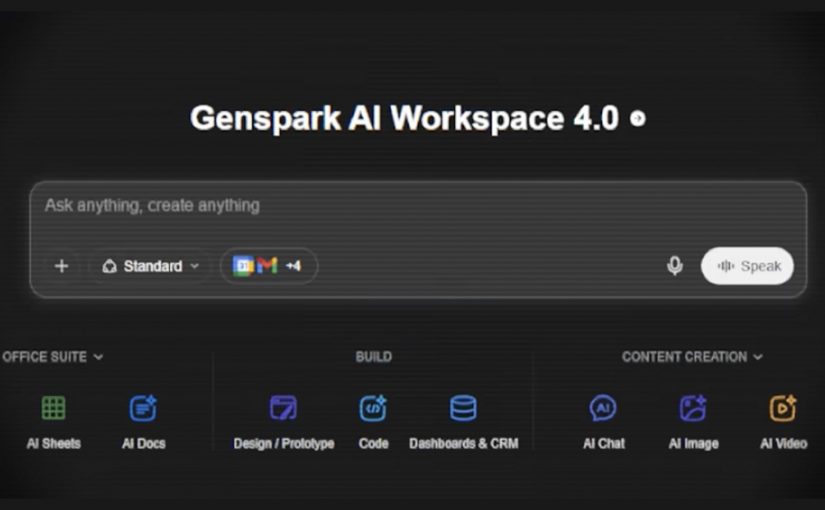
A content workflow is shown using 11 AI logins, 11 separate subscriptions, and 11 different places where files can disappear.
Genspark is presented as the answer: an all-in-one AI workspace. An all-in-one AI workspace is a shared environment that combines models, agents and production tools around one deliverable.
The useful enterprise lesson is not that one product has made 11 subscriptions obsolete. It is that the next productivity gain may come from carrying context across the work, and leaders should test that before adding another specialist AI tool.
The demo: six deliverables, one working context
The demo covers many different outputs: the video reports a week of back-and-forth with the designer to produce a visual identity and a breakdown of raw footage into structured assets completed in minutes. Those are creator-demo claims, not independent performance benchmarks, and the outputs shown still reflect a human-in-the-loop workflow, including review and refinement before final use. They demonstrate breadth of capability, but not repeatable enterprise-grade quality in production environments.
The operating implication is more useful than the spectacle. When the brief, assets and prior decisions remain available to the next task, less work is spent re-explaining intent, moving files and rebuilding context.
The mechanism: context travels with the work
Four days after the video was published, Genspark announced Workspace 6.0 with four layers: SecondBrain as memory; Super Agent as the intelligence engine; a tools layer combining Build Suite for applications, automations and custom tools, Office Suite for slides, documents and spreadsheets, and Content Suite for images, video and campaign assets; and GenTeam for collaboration between people and agents. The mechanism is an orchestration layer. An orchestration layer retains context, selects capabilities and sequences work across models and tools so the user manages the outcome rather than every transfer.
The wider context is a shift from buying isolated AI capabilities to governing a workspace that carries context across a job.
This matters because every handoff creates another opportunity to lose information, introduce a version mismatch or repeat work. Reducing those handoffs can shorten cycle time and lower rework because the next task starts with more of the approved context intact.
The value: fewer handoffs, not magic
The video calls the hidden cost the “tab tax”. The tab tax is the time and attention lost when people switch tools, re-upload assets, restate instructions and reconcile outputs. In an enterprise, that tax also includes access requests, version confusion and approval loops.
The claims that 80% of the work is coordination and that Genspark covers 95% of the production arc are not decision-grade measures. A proper baseline should count elapsed cycle time, active working time, handoffs, rework rounds, accepted outputs and the full cost of the current toolchain.
Consolidation of the baseline creates value only when improvements occur without degrading quality or control.
The enterprise limit: one workspace is not one stack
An AI workspace is not a system of record. A system of record is the authoritative, governed home for a particular class of business data or content. The better enterprise position is clear: use an AI workspace as an orchestration layer around governed systems, not as a replacement for them.
In a MarTech environment, product data, approved assets, consent status, customer profiles and published content still need governed homes such as PIM, DAM, consent, CIAM, CDP and CMS platforms. The workspace may prepare, transform or assemble work, but approved outputs must return to the correct system with source and ownership intact.
Persistent context is also both the attraction and the risk. It means teams don’t have to keep re-uploading the same information, but it also means more data is stored and shared in one place, which increases governance risk. Before scaling, teams need to verify retention, model access, data residency, permissions, auditability, output rights and how integrations work. That makes governance part of the value case, not an afterthought. The real question is whether one governed workspace can remove enough handoffs to improve cycle time and accepted-output quality without weakening control.
Ownership: one workflow still needs many owners
A unified interface does not create unified accountability. The business owner still defines the outcome, platform and IT teams determine integration and security, legal and data-governance teams set usage boundaries, and brand or content operations define the approved inputs and review standard. Procurement only captures savings when redundant tools are actually retired.
Without those decisions, an all-in-one workspace can become one more tab rather than the tab that removes the others. Adoption should focus on specific roles and repeatable workflows, not giving everyone access and hoping a prompt library creates value.
The action: pilot one handoff-heavy workflow
Pick one recurring deliverable that uses several tools and owners. Record the current baseline. Give the workspace controlled access to approved inputs. Run enough repeats to see if results are reliable, not just new. Measure accepted output, not raw output, including the human correction and approval work that remains.
The takeaway: do not buy an all-in-one AI workspace because its feature list is longer. Pilot it where repeated context transfer is already measurable, keep governed systems as the source of truth, and retire specialist tools only when the workflow produces accepted work faster, at lower total cost, without weaker control.
A few fast answers before you act
What is an all-in-one AI workspace?
An all-in-one AI workspace combines multiple AI models, agents and production tools in one environment so work can move from request to deliverable with fewer manual transfers.
Does Genspark replace 11 AI subscriptions?
Genspark does not replace 11 AI subscriptions as a general rule. Eleven was the number in one creator’s workflow; the tools any team can retire depend on output quality, usage, integration, governance and total cost.
How is Genspark different from a chatbot?
Genspark is designed to coordinate models and tools to produce artefacts such as slides, documents, images, video, code and websites, rather than stopping at a conversational answer.
Can an AI workspace replace an enterprise MarTech stack?
An AI workspace cannot replace an enterprise MarTech stack. It may orchestrate work around CMS, DAM, PIM, CRM, CDP, consent and other platforms, but those governed systems should remain the authoritative sources and destinations.
What should an enterprise pilot measure?
An enterprise pilot should compare cycle time, handoffs, rework, accepted-output rate, human review effort, total cost and control failures against the current workflow.
What is the biggest consolidation risk?
The biggest AI-tool consolidation risk is exchanging visible tool fragmentation for hidden dependence on one vendor’s model routing, credits, data handling and integration boundaries.