
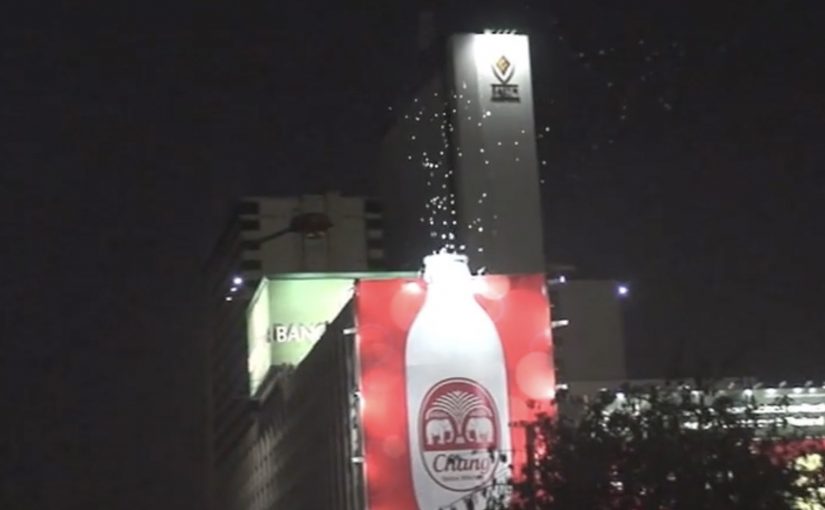
A giant Chang Soda bottle towers over a busy Bangkok shopping area. At the right moment, the cap “pops” and a burst of white balloons shoots out like carbonation escaping from a freshly opened drink.
Seeking new ways to create an impact in today’s sea of daily ad bombardment while taking into account shrinking budgets is quite a challenge. Chang’s Fizzy Billboard did just that, described as a reminder of how effective a great billboard idea can be when it turns a product truth, a single attribute the product can credibly own, into a public spectacle.
This is an outdoor activation that uses a physical effect, balloons released from the bottle, to dramatize “fizz” in a way that can be understood in a single glance.
The mechanism that makes it memorable
The creative leap is not the billboard. It is the “fizz”. Balloons are cheap, visible from far away, and they behave like bubbles in motion. Because of that, the claim becomes tangible even for people who only catch the moment in passing.
In FMCG categories where products are hard to differentiate at shelf, a single unmistakable physical metaphor in public space can outperform a week of polite messaging.
Why it lands as a shareable street moment
The payoff is time-based. People hear that “something happens” and they wait. When the burst comes, it reads instantly and creates a crowd reaction that becomes part of the communication. The effect also photographs well, which helps the idea travel beyond the street.
Extractable takeaway: If you want OOH to earn sharing, build a visible cause-and-effect that people can describe in one sentence, then make the payoff repeatable enough to be worth waiting for.
What the brand is really buying
This is a salience play. The goal is to make “Chang equals fizzy” stick through a short, repeatable spectacle, and to borrow the credibility of a real-world stunt rather than relying on a purely filmed illusion. The real question is whether you can turn one attribute into a repeatable moment people will stop for and retell. If you have to choose, back one literal, repeatable effect instead of spreading budget across polite static placements.
Steal-worthy rules for spectacle OOH
- Make one product truth physical. Choose the one attribute you want remembered and build the effect around it.
- Design for distance. If it does not read from across the street, it will not earn attention.
- Use a predictable moment. A scheduled payoff creates anticipation and word of mouth.
- Keep the metaphor literal. People should get it before they think about it.
A few fast answers before you act
What is Chang’s “Fizzy Billboard”?
An outdoor activation for Chang Soda where a giant bottle billboard appears to “pop” and release balloons like fizz, turning carbonation into a public spectacle.
Why use balloons for a soda message?
Balloons are inexpensive, highly visible, and they move like bubbles. That makes “fizzy” readable in one second from a distance.
What makes this kind of billboard more effective than a standard print-only OOH?
It creates a moment, not just an image. A time-based spectacle earns attention, crowd reaction, and secondary sharing that static posters rarely trigger.
What business outcome is this designed to influence?
Brand salience and attribute ownership. It aims to make the brand strongly associated with “fizz” versus competitors.
What is the biggest execution risk with spectacle billboards?
If the payoff is unclear or inconsistent, people feel tricked. The effect must be obvious, repeatable, and easy to explain in one sentence.