
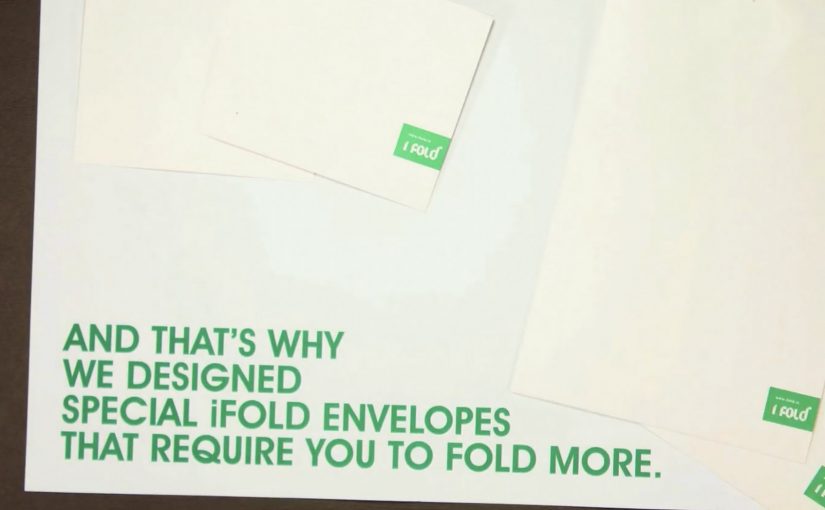
Billions of business envelopes are used every day. Imagine how much paper can be saved if we just halved their size.
So while posting a letter, ask: can it be folded once more. If it can, fold more.
Use a smaller envelope. Save trees. It’s that simple. It’s called iFOLD.
A tiny behavior change, packaged as a system
The mechanism is effort-to-impact math: a simple rule where one extra fold creates a visible downstream saving. One extra fold reduces envelope size. Reduced envelope size reduces paper consumption. That works because the cause and effect are easy to understand immediately, so the behavior feels practical rather than preachy. The campaign frames this as a repeatable rule anyone can apply without new infrastructure or technology.
In high-volume corporate mailrooms and customer communications, small process changes compound into meaningful material savings.
The real question is how to turn a trivial action into a default business habit. The smart move is to build the fold into standard mailing practice, not treat it as a one-off reminder.
Why it lands
This works because it does not ask for a lifestyle shift. It asks for a micro-habit that fits inside existing routines. The instruction is binary, memorable, and immediately testable. You can literally try it with the next letter in your hand.
Extractable takeaway: When you want behavior change at scale, give people a single, repeatable decision rule that requires almost no extra effort, and make the benefit feel cumulative and obvious.
Steal this envelope logic
- Make the rule portable: one sentence people can remember and repeat.
- Target a high-frequency routine: boring, repetitive processes are where scale lives.
- Prefer “do this instead” over “stop doing that”: substitution habits stick better than abstinence messages.
- Connect the micro to the macro: one fold feels trivial. Aggregate savings makes it feel worth doing.
- Design for adoption inside organizations: the best ideas fit procurement, operations, and compliance realities.
A few fast answers before you act
What is iFOLD?
iFOLD is a paper-saving idea that encourages people to fold letters one extra time so they can be mailed in smaller envelopes.
Why focus on envelope size?
Because envelopes are used at massive volume in business and government. Small reductions per unit add up quickly at scale.
What makes this a strong sustainability message?
It is a concrete action, not an abstract appeal. People can do it immediately without buying anything new.
Where does this work best?
In organizations that send large quantities of letters and statements, where a standard change in folding and envelope formats can be implemented consistently.
What could prevent adoption?
Template constraints, inserts that cannot be folded further, window placement, and operational inertia. The idea works best when mail formats are designed with folding flexibility in mind.