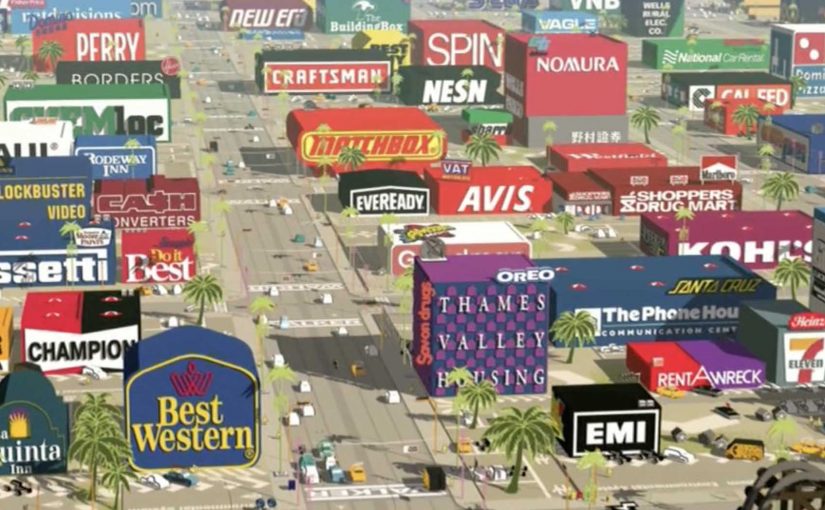
A seventeen-minute Hollywood-style tale where the city, the props, and even the characters are built from brand marks. The film is described as using more than 2,500 logos.
Logorama turns a familiar crime-thriller structure into something stranger. A world that looks like Los Angeles, but everything is signage. Every surface is a trademark. Every background detail is a corporate symbol you already know.
A thriller built out of trademarks
The mechanism is extreme constraint. Here, that means one hard rule: the filmmakers construct the entire environment out of existing brand identities, then animate it with blockbuster pacing, chase energy, and escalating chaos. That constraint works because instant logo recognition lets the film establish character, tone, and hierarchy without slowing down for explanation.
In brand-saturated consumer cultures, the fastest way to make people feel the weight of logos is to stop treating them as background and make them the physical world.
Why it lands, even if it feels wrong
The film works because it makes recognition do the work. You do not need exposition to understand who is powerful, who is ridiculous, and what kind of world you are in. Your brain fills in associations at speed, and the pace keeps you laughing before you have time to get comfortable. The satire lands not through speeches, but through accumulation. If everything is a logo, nothing is neutral.
Extractable takeaway: If your message is about cultural saturation, build a system where the audience cannot escape the stimulus, and let their own pattern-matching create the critique.
What the film is really demonstrating
Logorama is both craft flex and commentary. It shows how deeply brand codes have entered shared visual language, and it proves that you can tell a coherent, high-tempo story while replacing conventional production design with a library of corporate symbols.
This is not a logo stunt. It is a disciplined storytelling system that turns brand recognition into narrative force. The real question is how far a single visual rule can carry both entertainment and critique without collapsing into gimmick.
What to borrow from Logorama
- Use constraint as a headline. One clear rule can make a piece feel instantly different.
- Let recognition drive meaning. Familiar symbols carry narrative shortcuts, use them deliberately.
- Keep the story engine simple. High concept needs a readable spine, chase, pursuit, escalation.
- Make the critique experiential. People remember what they felt while watching, not what they were told.
A few fast answers before you act
What is Logorama?
An animated short that builds a Hollywood-style thriller world entirely out of brand logos and mascots, using recognition as both storytelling fuel and satire.
Why does the “all logos” rule matter?
It turns branding from decoration into environment. That shift makes consumer culture feel unavoidable, which is the point the film is pressing on.
How many logos are in the film?
The film is commonly described as featuring more than 2,500 logos.
What is the main creative risk of this approach?
If the narrative spine is weak, the piece becomes a spot-the-logo gimmick. The story has to keep moving, so the constraint serves meaning rather than replacing it.
What can marketers learn from it?
High constraint plus simple story structure can produce work that is both memorable and interpretable. The audience does the decoding, which increases engagement.