
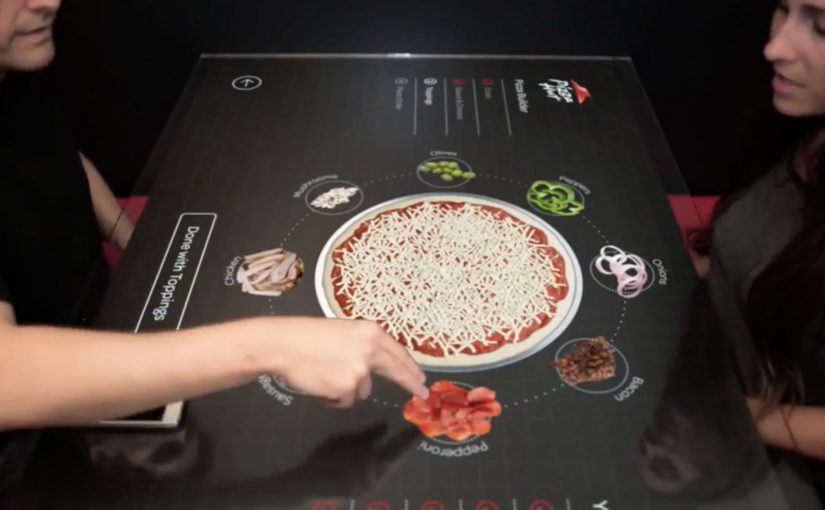
Multi-touch media that uses highly engineered glass and companion technologies feels like the future. So Pizza Hut partners with Chaotic Moon Studios in the USA to create an interactive concept table that lets customers in retail outlets create and customize their pizzas on the spot.
The promise is simple: instead of a static menu, the table becomes the interface, turning ordering into something you can explore, assemble, and adjust with your hands.
A table that turns ordering into a build experience
The mechanism is a multi-touch tabletop UI that walks you through base, sauce, toppings, and sides as a sequence of visual choices. Your pizza is assembled live on-screen, so the product takes shape while you decide.
In quick-service restaurants, the easiest way to increase customization confidence is to make choices visual and immediate.
Why it lands: it reduces friction and adds play
Ordering pizza can be surprisingly error-prone: misheard toppings, unclear sizes, forgotten extras, awkward group decisions. A touch-first interface turns that into a shared, visible process where everyone can see what is being built before it is submitted.
Extractable takeaway: When customization is the product, make the build visible to everyone, so groups converge on one order with fewer misunderstandings.
What Pizza Hut is really trying to prove
Beyond “cool tech,” this kind of table concept signals modernity in the dine-in experience. It frames Pizza Hut as a place where the experience is part of the product, not only the food.
These interfaces are worth doing only when they reduce ordering errors and keep dine-in throughput intact.
The real question is whether turning ordering into a shared build process increases confidence without slowing the line.
Borrowable patterns for touch-first ordering
- Make the product assemble itself. Visual construction beats textual configuration for speed and accuracy.
- Design for groups, not only individuals. Shared screens turn indecision into collaboration.
- Keep the interaction shallow. Limit the flow to a few obvious steps with minimal typing.
- Let the interface do the upsell quietly. Sides and add-ons perform better when they appear as natural next steps.
A few fast answers before you act
What is the Pizza Hut Interactive Concept Table?
It is a multi-touch tabletop ordering concept designed to let dine-in customers build and customize pizzas directly on the table interface.
What problem does a touch-table solve in restaurants?
It reduces ordering friction by making customization visual, shared, and less dependent on staff hearing, memory, or paper menus.
Is this an ordering system or a marketing concept?
It is presented as a concept experience to demonstrate a possible future dine-in flow, with the interface itself acting as the headline.
Why is multi-touch a good fit for pizza customization?
Pizza is modular. When options can be added, removed, and previewed instantly, customers feel more confident and order faster.
What is the main takeaway for experience design?
If you want people to customize, make the choices tangible. Let them see the product changing as they decide.