
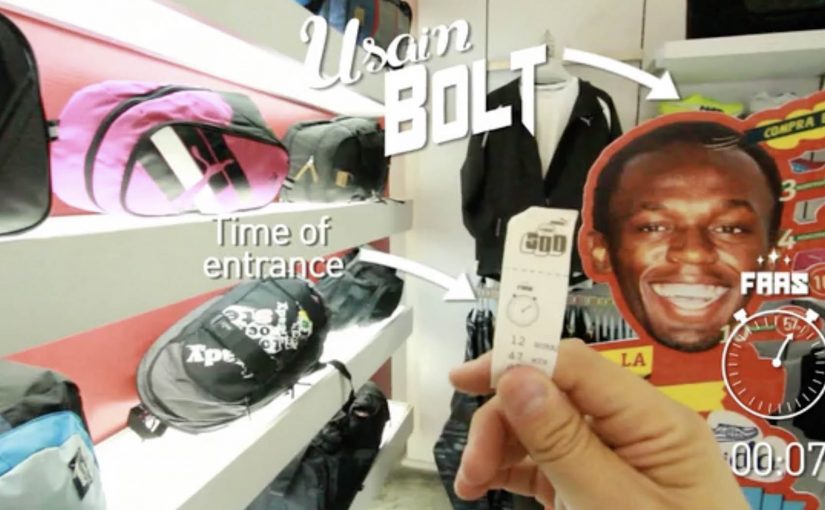
PUMA Faas 500 are positioned as “fast” running shoes, so PUMA Mexico turned that promise into a store rule. The faster you complete the purchase, the bigger your discount.
It is retail gamification with a stopwatch. You take a time-stamped ticket when you enter, then hit the finish at checkout. Your elapsed time maps directly to a percentage off.
Speed, translated into a receipt
The mechanic is intentionally physical. A start button and a finish button. Two timestamps. A discount ladder, meaning predefined discount tiers tied to elapsed time. It converts a product claim into a behavior challenge shoppers can understand in one glance.
In store-based brand marketing, this kind of “simple rule. visible payoff” design is what turns a promotion into something people talk about and demonstrate. This is the right kind of promotion when the product promise is simple and the store can keep the timing fair.
In physical retail environments where staff can control flow and timing, a timed discount rule turns positioning into something customers can prove on the spot.
Why it works: tension, then relief at the till
Most discounts are passive. This one is earned under mild, playful pressure, which changes how the saving feels. Because the discount is calculated from your elapsed time, the saving feels earned rather than handed out. You are not just getting money off. You are winning.
Extractable takeaway: If you can translate a brand claim into a simple rule with a visible measurement, customers will internalize it faster and retell it more convincingly.
The case framing also borrows credibility from sport. The faster you move, the more you deserve, which fits the “fast” positioning without needing extra explanation.
What the brand is really buying
The real question is whether your operation can make the customer’s speed, not the queue, decide the discount.
Yes, it can drive conversion in the moment. More importantly, it makes “fast” measurable. The shoe is no longer described as fast. The shopping experience is fast, and the brand gets to own that feeling.
It is also a neat piece of shopper marketing craft: the discount is the reward, but the real output is attention inside the store and social retell outside it.
Borrowable moves for a speed-to-discount promo
- Turn the product truth into a rule, not a tagline.
- Make the measurement visible, tickets, timers, receipts, anything tangible.
- Use a stepped reward, so “almost” still feels like something.
- Keep the setup frictionless, one instruction. two actions. instant payoff.
A few fast answers before you act
What is the core mechanic here?
A timed in-store challenge. Entry timestamp plus checkout timestamp determines a discount tier.
Why is this stronger than a standard percent-off promotion?
Because shoppers earn the saving through behavior. That creates participation, attention, and a story, not just a transaction.
What kind of products fit this model best?
Anything with a defensible “speed” or “efficiency” claim, plus a purchase journey that can be completed quickly inside a controlled environment.
What is the biggest operational risk?
Queue dynamics. If checkout bottlenecks decide the discount, the game feels unfair. The store needs enough throughput so the customer’s speed is what matters.
How do you measure success beyond sales?
Participation rate, average completion time, discount distribution, and organic sharing that shows people proving their time and reward.