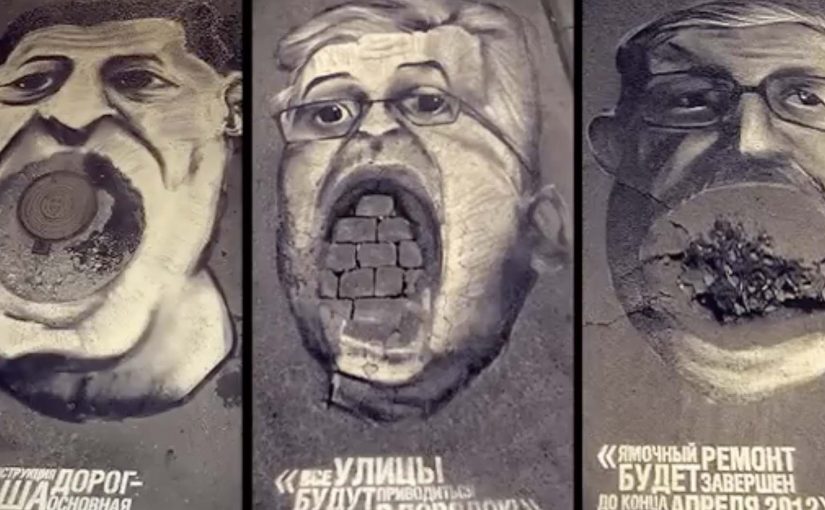
The quality of roads is an eternal problem in Yekaterinburg, described as one of Russia’s largest cities. A local news website, URA.RU, decided to pressure local politicians to do something about it.
One night, with the help of ad agency Voskhod, they drew the faces of the governor, the mayor and the vice-mayor on three potholes in the city center. The next day the caricatures became a sensation, and with the intense PR around them the politicians could no longer sit idle.
Potholes as portraits
This is a brutally simple flip. If a pothole is “nobody’s problem”, make it somebody’s face. The street becomes a front page, and the damage becomes personal, visual, and impossible to ignore once it is photographed and shared.
How the mechanism creates pressure
The mechanism is pure ambient PR. Here, that means using the street itself as the media surface and public attention as the distribution layer. Pick a small number of highly visible road holes. Paint recognizable leaders onto them overnight. Let morning traffic and pedestrians do the distribution by taking photos and talking. Once the story is moving, officials are forced to respond because the issue now has a daily reminder and a public symbol.
In local accountability campaigns, reframing infrastructure neglect as a public symbol is often the fastest way to turn complaints into action.
Why it lands
It lands because it is legible in one glance and sticky in memory. The portraits convert an abstract civic problem into a shareable image with a clear target, without needing a long argument. It also escalates pressure without escalating cost. The “media buy” is the city itself, and the amplification is the public’s instinct to photograph the outrageous.
Extractable takeaway: If you can turn a slow-burn community frustration into a single, repeatable visual metaphor, you give press and citizens an easy story to carry. That story becomes the lever that forces a response.
What URA.RU is really doing
This is not art for art’s sake. It is agenda-setting. The real question is not how to complain louder, but how to give the complaint a symbol the city cannot stop seeing. URA.RU uses a small physical intervention to manufacture a news moment that keeps the road problem in the spotlight until something changes. The painted potholes are the trigger. The sustained coverage is the engine.
How to turn civic neglect into a pressure symbol
- Make the issue visual. If it cannot be photographed, it will not travel.
- Choose a small number of high-impact placements. Concentration beats spread for PR.
- Use a metaphor that explains itself. The best ambient ideas need no captions.
- Design for morning discovery. Overnight installs maximize surprise and coverage.
- Plan the follow-up story. The goal is not attention. The goal is a visible response.
A few fast answers before you act
What is “Make the Politicians Work”?
An ambient PR action where a news site and an agency painted leaders’ faces onto potholes so the road problem became a public symbol and a media story.
Why is this more effective than a petition or complaint thread?
Because it produces a visual headline that spreads fast, keeps pressure on officials, and is difficult to ignore once it becomes widely photographed.
Is this activism or advertising?
It behaves like both. The tactic uses advertising craft to create civic pressure, with PR distribution doing most of the work.
What is the biggest risk with a “shame-based” stunt?
Backlash. If it is perceived as defamatory, unfair, or unsafe, the story can flip against the organizers instead of against the problem.
How can a city issue campaign copy the approach safely?
Keep the metaphor clear, avoid personal attacks beyond what is necessary, and anchor the action to a solvable request so the pressure has a practical endpoint.