Raining Polar Bears: Shock Against Short-Haul

Raining Polar Bears: Shock Against Short-Haul

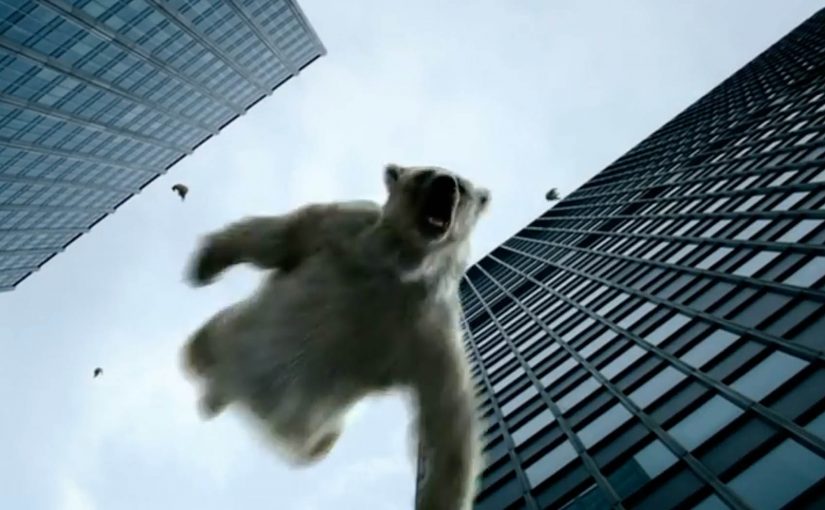
A shocking ad with a brutal message: every short haul flight you take emits four hundred kilogrammes of carbon dioxide. The equivalent weight of an adult polar bear.

This is the promotional film from anti-aviation expansion campaigners Plane Stupid.

It is a hard-hitting piece of communication because it skips the abstract science and goes straight for a physical, imaginable consequence. You cannot “feel” four hundred kilograms of CO₂. But you can picture a polar bear’s mass, and you can picture it falling. The metaphor is deliberately uncomfortable.

A metaphor designed to make emissions feel heavy

The mechanism is simple: translate an invisible output into a visible burden. By mapping a single flight to a single, concrete weight, the campaign turns “carbon” into something that feels measurable and personal. The viewer is pushed to connect a routine choice with an outsized consequence. This works because a weight-based image is easier to remember and retell than an abstract emissions number.

In European organisations where sustainability goals collide with travel habits, this kind of metaphor is used to make the trade-off feel immediate.

In behavior-change communication, metaphors work best when they translate an invisible impact into a concrete, repeatable image people can easily retell.

Why this kind of brutality gets attention

Shock tactics work when they force a moment of interruption. They create a jolt that breaks autopilot. In this case, the jolt is not gore or fear for its own sake. It is moral discomfort. The message implies complicity. It suggests that “small” flights are not small at all when you translate them into a consequence you can carry in your head. Used sparingly and paired with a believable alternative, shock can be a legitimate behaviour-change lever; used without one, it is counterproductive.

Extractable takeaway: If you need to shift norms, convert impact into one vivid unit people can repeat from memory, then make the next step feel doable.

But there is a trade-off. If the audience feels judged or helpless, they can disengage. The campaign therefore depends on whether the viewer sees a plausible alternative, like rail, coach, fewer trips, or simply resisting the idea that every short hop is “normal”. Here, an off-ramp means a clear, doable alternative the viewer can choose instead of flying. Without an off-ramp, shock can become noise.

The real intent: change what feels acceptable

The business intent here is public pressure. Plane Stupid campaigns against aviation expansion. To do that, it needs cultural permission to tighten constraints: fewer runway projects, fewer short-haul routes, and a stronger argument that alternatives should win. The film is a lever to make policy positions feel socially justified.

The real question is whether you can make “short haul” feel unacceptable without making the audience tune out.

What to borrow from this shock metaphor

  • Make the invisible visible. Translate abstract impact into a physical metaphor that is easy to repeat.
  • Anchor to a single action. “One short-haul flight” is specific. It removes debate about averages and totals.
  • Choose a symbol that carries meaning. The polar bear arrives pre-loaded with climate context, for better or worse.
  • Plan the off-ramp. If you want behaviour shift, pair the shock with credible alternatives people can act on.
  • Measure backlash, not just reach. Shock optimizes attention. Track whether it also produces avoidance.

A few fast answers before you act

What is “Raining Polar Bears” trying to say?

It argues that short-haul flights have a disproportionately high carbon cost. It makes that cost feel tangible by equating one flight’s emissions to the weight of an adult polar bear.

Why use a polar bear in a climate campaign?

Because it is an instantly recognized symbol of climate impact. It compresses a complex topic into a single image people remember and retell.

Do shock tactics actually change behaviour?

Sometimes. They can disrupt complacency and create attention. They can also trigger defensiveness if people feel accused or see no realistic alternatives.

How do you make a shock campaign more effective?

Pair the emotional jolt with a clear path to action, and ensure the audience believes the alternative is doable. Without that, the message can be dismissed as moralizing.

What is the practical takeaway for marketers and communicators?

If you want to shift norms, translate impact into something concrete, memorable, and repeatable. Then make the next step obvious so attention converts into action.

Tiger Beer: The Last Tiger

Tiger Beer: The Last Tiger

How far would you go for a bottle of Tiger Beer? That is the question posed by the campaign for the brand by Saatchi & Saatchi.

A last-bottle dare, turned into a brand moment

Reportedly, the film plays the “last bottle” scenario as a competitive, larger-than-life showdown, then punctures the testosterone with a dose of feminine charm. It is a simple tension. One bottle. Too many people who want it. Social rules bend fast when scarcity shows up.

From TV tension to small digital interactions

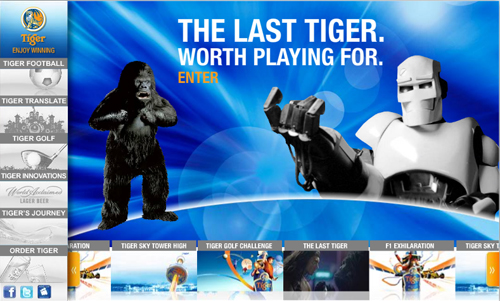
Mechanically, the idea extends beyond the TVC (television commercial) by giving fans lightweight ways to participate: a personality quiz, downloadable avatars, a wallpaper creation function, and a “happy hour” reminder widget that nudges people to take a break after a long day at work.

In Southeast Asian beer marketing, translating a TV story into lightweight, shareable participation is a reliable way to extend reach beyond the media buy.

Tiger Beer Website

A useful pattern here is the conversion of one emotional hook into repeatable touchpoints. Identity (quiz result). Self-expression (avatar). Personalization (wallpaper). Timing cue (the reminder widget). Each interaction is small, but it keeps the campaign’s core question alive in moments when people are actually deciding what to do next.

Brands should resist bolting on unrelated features and instead reuse the same tension across every micro-interaction.

The real question is whether the digital layer keeps the same scarcity tension alive at the moment someone can act on it.

What the “happy hour” widget is really doing

Even if someone watches the film once, a time-based reminder can re-open the narrative at the most relevant moment. End of work. Start of social time. This works because the timing cue re-enters a real routine, so the story resurfaces when choices are being made. It is not about “more content”. It is about putting the same story back in front of the user when it can convert into action or talk value.

Extractable takeaway: A timing mechanic is often the highest-leverage digital element because it returns the same story at decision time, not just at viewing time.

How to reuse a scarcity premise in digital

  • Start with one tension. If the film’s premise can be summarised in one sentence, it is easier to translate into digital actions.
  • Design for replay, not depth. Quizzes and downloads work when they are fast, obvious, and socially legible.
  • Add a timing mechanic. A reminder widget or calendar nudge can outperform another “feature” because it re-enters a real routine.
  • Keep every interaction tied to the same story. If an element does not reinforce the core question, it becomes decoration.

A few fast answers before you act

What is “The Last Tiger” concept?

A scarcity story. One “last bottle” triggers social competition, and the campaign invites viewers to imagine how far they would go for it.

How does the digital layer support the TV film?

It breaks the central tension into quick actions people can complete and share: a quiz, avatar downloads, wallpaper creation, and a time-based “happy hour” reminder.

Why include a “happy hour” reminder widget?

Because it re-surfaces the campaign at a high-intent moment. The end of the workday. The start of social decisions.

What makes the digital interactions feel connected, not gimmicky?

They all reinforce the same premise. One last bottle, and the social scramble it triggers. If an interaction does not echo that tension, it will not travel.

What is the transferable lesson for other brands?

Turn one strong film premise into three to five tiny interactions that reinforce the same story, and add at least one timing cue that re-enters a routine.

Toshiba: Space Chair to the edge of space

Toshiba: Space Chair to the edge of space

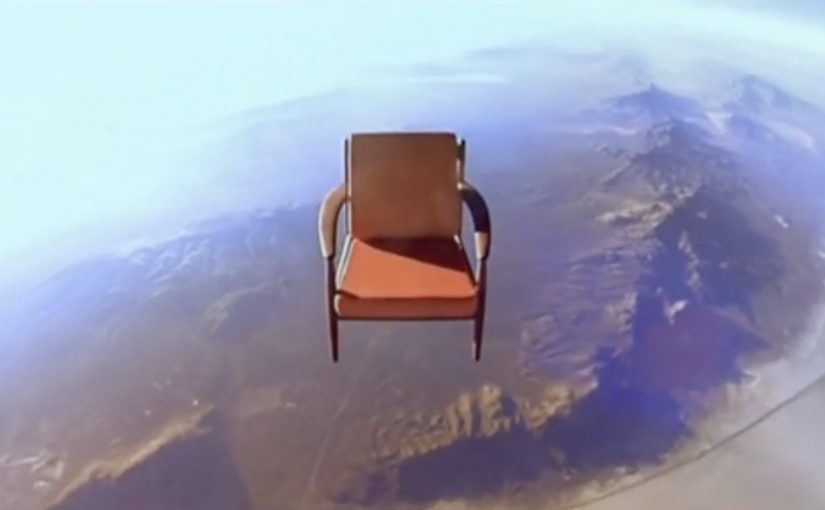
To promote its new line of LCD TVs, Toshiba sends an ultra-lightweight biodegradable chair toward the edge of space using a helium balloon, and films the entire mission in high definition with its IK-HR1S camera system.

The chair rig rises to 98,268 feet. The climb is reported as taking 83 minutes. Once the balloon pops, the fall back to earth is reported as taking 24 minutes.

Armchair viewing, taken literally

The creative move is almost aggressively simple. “Armchair viewing” is a cliché. So Toshiba turns it into a physical event. A chair. A balloon. A horizon line that curves. The resulting footage does the persuasion without needing exposition.

If the product claim is abstract. clarity, detail, realism. put a real object into an extreme, undeniable environment and let the camera do the talking.

Physics as production value

This is not “space” as a metaphor. The production is built around constraints that make it believable. Weight limits. fragile materials. freezing temperatures. low pressure. The rig has to survive long enough to capture usable footage, and the team has to recover it afterwards.

That operational reality becomes part of the brand signal. If you can shoot a commercial in those conditions, “HD” stops sounding like a spec sheet and starts sounding like capability.

In consumer electronics marketing, extreme real-world demonstrations are used to make “picture quality” feel like engineering proof, not advertising promise.

Why it lands as a TV ad, not just a stunt

The footage is the product demo. The shots are what a screen is for. It is scale, texture, contrast, and atmosphere. The chair is simply the reference object that lets the viewer feel distance and altitude.

Extractable takeaway: When the claim is “better quality,” build a proof moment the viewer can judge with their own eyes, and keep the story simple enough that the footage carries the persuasion.

It also avoids the typical trap of “innovation” campaigns. Over-claiming. Instead, the story is modest. Here is what we did. Here is what we captured. Judge the images. For picture-quality claims, a single verifiable proof moment beats layers of copy and metaphor.

The real question is whether your “proof” would still hold attention if the logo were removed.

Steal the Space Chair pattern

  • Make the demo inseparable from the claim. If you sell image quality, build an image that earns attention on its own.
  • Use one hero object. A single recognisable object makes scale and risk instantly legible.
  • Let constraints show. Real limits make real footage feel trustworthy.
  • Design for replay. If viewers rewatch because the visuals are stunning, the brand message repeats without extra media.
  • Keep copy light. When proof is the asset, words should not compete with it.

A few fast answers before you act

What is Toshiba “Space Chair”?

It is a Toshiba commercial built from real high-definition footage of a chair carried toward near space on a helium balloon, created to showcase Toshiba’s LCD TV picture quality.

How high did the chair go?

The flight is described as reaching 98,268 feet before the balloon broke apart and the rig descended.

How long did the ascent and descent take?

The timings are commonly reported as about 83 minutes up and about 24 minutes down.

What makes this feel credible instead of CGI?

It reads as real because it uses “documentary grammar,” meaning small signals like changing light, wind noise, tracking drift, and a rig visibly fighting extreme conditions.

What is the core lesson for brands doing “innovation” stories?

Build a proof moment people can replay and share for its own sake. If the audience wants to watch it again, the product message gets repeated for free.