Nike’s Rip the Script starts with a control problem.
A director wants order. The footballers keep breaking the plan.
That is the useful lesson for brand marketers: campaign systems matter, but they only scale when the creative idea has enough energy to make people participate.
A campaign system is the connected set of assets, channels, behaviours, commerce surfaces, data signals and governance choices that turn one idea into repeated consumer action.
The June pattern – fandom became the operating layer
A lot of the work around World Cup 2026 was not built as a simple sponsorship message.
It was built as a campaign system.
That is the right direction.
A tournament is not just a media moment. It is a sequence of consumer behaviours.
People plan where to watch. They buy food. They wear colours. They argue about players. They collect things. They scroll before the match. They message during the match. They look for highlights after the match. They repeat the ritual for weeks.
This is the mechanism brands are chasing: one tournament trigger becomes repeatable actions across product, retail, social, CRM, creator, commerce and media surfaces.
The context matters because World Cup 2026 marketing has already started before the tournament itself, with brands trying to enter fan rituals before match attention peaks.
McDonald’s is a useful contrast example because its FIFA World Cup 26 Meal and collectible cups turn fandom into a clear purchase and collecting behaviour.
As a June sports-marketing contrast, Uber Eats’ Ding Dong Deals points in a similar direction: make the offer feel like part of the sports reaction cycle, not just a discount sitting outside the moment.
Strategically, that all makes sense.
The real question is not whether the campaign has enough channels, but whether the idea gives those channels something people actually want to repeat.
The problem – participation mechanics are not the same as energy
This is where a lot of modern campaign thinking gets lazy. Teams build the mechanics of participation and then mistake those mechanics for desire. They create the collectible, the offer, the social format, the content calendar, the retail activation and the measurement layer, but the work still does not always feel alive.
The position here is clear: the TVC is not dead, but weak campaign systems are.
Here, TVC means the brand’s hero film asset: the emotionally loaded centrepiece that can still create memory, even when most distribution now happens across social, retail, commerce, CRM and creator surfaces.
The problem is not that brands are building systems. They should be. The problem is that campaign systems can make average ideas look more sophisticated than they are. They add surfaces, decks, journeys, assets, touchpoints and reporting structures, but they do not automatically add tension, humour, memory, emotion or cultural velocity.
That matters because consumers do not participate because the operating model is elegant. They participate because the thing has enough pull to earn the behaviour.
Nike’s advantage – the TVC has enough voltage to feed the system
Nike’s Rip the Script works because it does not feel like a brand politely entering football culture. It feels like football culture losing control in exactly the right way.
Creative voltage is the emotional force that makes an idea memorable enough to be clipped, argued with, reposted, remixed, bought into and carried across channels.
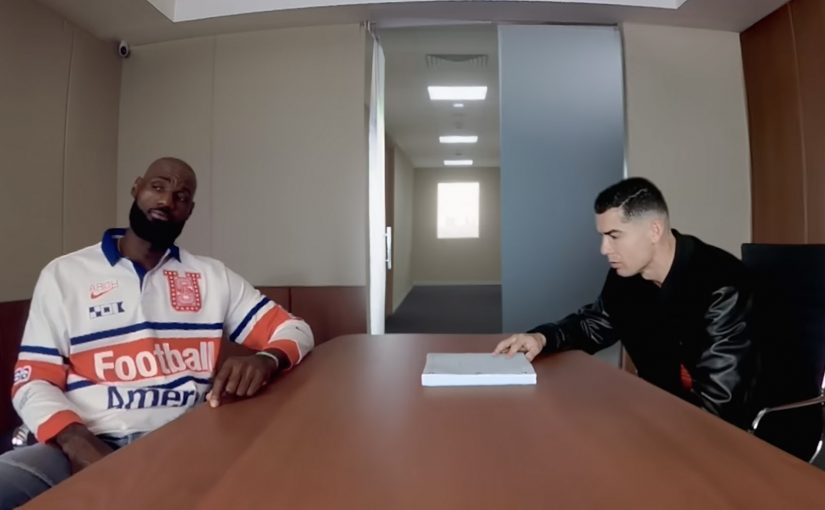
The TVC has that voltage because it turns the basic idea, players breaking away from a controlled script, into the form of the film itself. The director wants order. The players ignore him. The scripted goodbye gives way to instinct, chaos, cameos, jokes, pace and momentum.
That is why the campaign idea becomes legible without being over-explained. The work is not simply saying “ditch the playbook.” It behaves like a control system collapsing under the force of football instinct.
Because it generates distinctive moments that can be cut, debated, reposted and reused, the TVC gives the wider campaign system something worth distributing. That is what many campaign systems miss. They start with the architecture and hope the creative fills it. Nike starts with creative force strong enough to feed the architecture.
The operating lesson – do not build the system before the energy
For brand teams, this is not a nostalgia argument for big films. The answer is not to abandon systems and go back to hero-film thinking.
The answer is to stop treating systems as substitutes for ideas.
A modern campaign still needs the full operating stack: social fragments, commerce surfaces, retail or platform behaviour, creators, athletes, partners, media architecture, CRM logic where relevant, and measurement that separates attention, participation, conversion and repeat behaviour.
But the sequence matters. If the idea is weak, the system becomes an expensive distribution machine for something people did not care about in the first place. If the idea has energy, the system becomes a multiplier.
That is the business difference. One version creates operational complexity. The other creates commercial compounding.
What Nike gets right – the TVC behaves like an operating asset
The lazy conclusion is that Nike won because it made the best film. That is only half true.
Nike won because the TVC behaves like an operating asset.
An operating asset is creative work designed to create reusable value across channels, formats, markets, partners and consumer behaviours.
Rip the Script gives the brand multiple assets inside one idea. It gives scenes for social cuts, faces for fan debate, jokes for football pages, cameos for wider culture, and a Nike Football world that can stretch beyond one upload.
That is why the TVC matters. Not because it is long. Not because it is expensive. Not because it has famous people in it. It matters because it creates memory structures that the rest of the system can use.
The brand test – design for voltage before scale
Large brand organizations are good at building systems. They can build channel matrices, map consumer journeys, create modular content models, localise assets, and connect retail, ecommerce, CRM, social, media and measurement. But the June lesson is uncomfortable: operational maturity does not compensate for creative weakness.
The takeaway: treat campaign systems as distribution architecture, not idea substitutes. Build the emotional idea first, then design the fragments, commerce layers, creator surfaces, data signals, governance and measurement that let that idea travel without becoming operational theatre.
That is the useful operating test. Before asking how many channels the campaign can fill, ask whether the core idea creates enough feeling to deserve those channels.
The future is not TVCs versus systems.
The future is TVCs powerful enough to become systems.
A few fast answers before you act
Is this an argument against campaign systems?
No. Campaign systems are essential when brands need repeatable participation across media, commerce, retail, social and CRM. The argument is that systems should multiply strong ideas, not disguise weak ones.
What does TVC mean in this context?
TVC means the brand’s hero film asset. It does not mean the campaign only lives on television. It means the central piece of creative work that carries the emotional idea and gives the wider system something to distribute.
What did Nike do better than most June campaigns?
Nike created a TVC with enough cultural energy to become a wider operating platform. Rip the Script gives social, retail, creators, football media and fans reusable material instead of forcing channels to carry a thin idea.
Why are participation mechanics not enough?
Participation mechanics only define what people can do. They do not explain why people would care enough to do it, repeat it, share it or attach meaning to it.
Where do McDonald’s and Uber Eats fit in the argument?
They are useful contrast examples because both show the modern move toward behaviour-led campaign design. McDonald’s connects World Cup attention to meals and collectibles, while Uber Eats connects offer value to sports-reaction formats.
What should brand marketing teams change?
They should separate system readiness from idea strength. A campaign can be well-integrated, measurable and operationally mature while still lacking the emotional force needed to travel.