
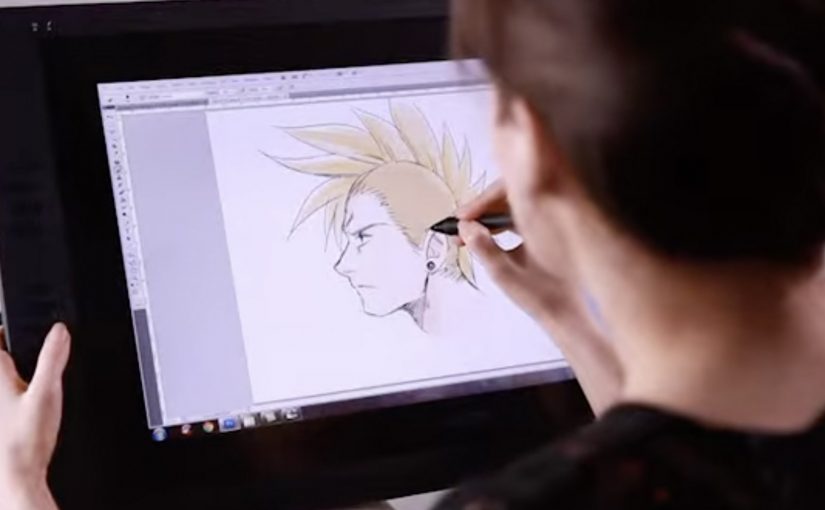
Wacom Inkling: paper sketches, digitized

Wacom Inkling: paper sketches, digitized

Wacom is launching a cool new digital sketch pen for artists called the Inkling. This unique pen allows artists to draw or sketch on a standard piece of paper and then automatically have a digital version created.

The trick is that Inkling pairs a real ink pen with a small receiver that clips to your paper and records your strokes as you draw, so you can plug it into a computer later and bring the sketch into your digital workflow.

What Inkling changes in a familiar habit

Most artists already start with pen and paper because it is fast, portable, and forgiving. Inkling keeps that behaviour intact, but removes the “scan it later” step by capturing the drawing while it happens.

How the capture works in practice

  • Draw normally. You sketch with an actual ballpoint pen on regular paper.
  • Record quietly. The clipped receiver tracks each stroke and stores the sketch.
  • Transfer when ready. You connect the receiver to your computer and import the captured file for editing.
  • Refine digitally. The value shows up when you want to iterate, clean up, or reuse elements without redrawing from scratch.

In creative and design workflows, bridging paper-first sketching to digital editing keeps momentum for artists who think with their hands.

The real question is whether you can keep paper-first speed while still landing in edit-ready digital files.

Why it lands: it removes one of the most annoying handoffs

The friction is never “making the sketch”. The friction is getting that sketch into the tools where it becomes a layout, a storyboard, an illustration draft, or a presentation asset. Inkling makes the handoff feel like part of the act of drawing, not a separate job you do later.

Extractable takeaway: If you remove one ugly handoff between a familiar analog habit and a digital toolchain, you get adoption without asking creators to change how they start.

What Wacom is really selling here

This is not just a new pen. It is a bridge product that expands Wacom’s relevance beyond tablets and into the earliest moment of creation, when ideas are still raw and fast. A bridge product connects a trusted old workflow to a newer one, so users can cross without friction. Wacom is right to focus on the handoff, not on adding more pen features. If the first capture happens with Wacom, the next steps in the workflow are more likely to happen with Wacom-friendly tools too.

Takeaways for marketing creator tools

  • Respect existing habits. Do not force a new behaviour when the old one already works.
  • Remove a single painful step. “No scanning” is a clearer benefit than a long list of features.
  • Sell the workflow, not the gadget. The story is speed from idea to editable file.
  • Show the before and after. Demos work best when viewers can see the exact handoff being eliminated.

A few fast answers before you act

What is Wacom Inkling?

It is a digital sketch pen system that lets you draw on regular paper with real ink while capturing a digital version of the sketch for later transfer to a computer.

Do you need special paper to use Inkling?

No. The idea is that you sketch on standard paper while a clipped receiver records your strokes.

How do you get the sketch onto your computer?

You connect the receiver to your computer and import the stored sketch so it can be edited digitally.

What is the main benefit compared to scanning?

You skip the “capture later” step. The sketch is already recorded as you draw, which makes it faster to move from rough idea to editable file.

Who is this best suited for?

It fits artists and designers who start on paper for speed, then want to refine, iterate, or reuse parts of the sketch digitally without redrawing everything.
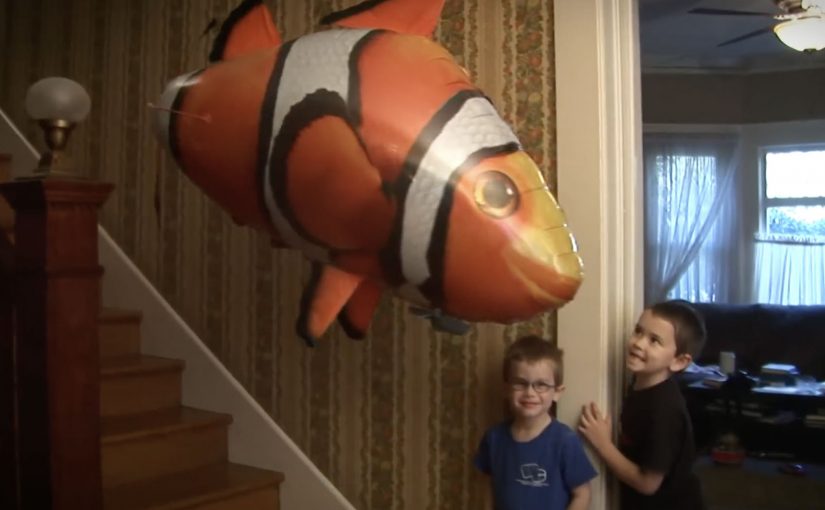
Air Swimmers: Flying Shark and Clownfish

Air Swimmers: Flying Shark and Clownfish

Have you ever seen a fish that can swim in the air with smooth, life-like motion. Air Swimmers is a US-based company that developed these remote controlled, helium-filled flying fish.

They are designed for indoor fun even in small rooms. Air Swimmers describes them as running on four AAA batteries, one in the body and three in the controller, with up, down and 360 degree turning control.

How it works

The mechanism is lighter-than-air buoyancy plus simple steering controls. The helium does the lifting. The controller provides direction and small adjustments that make the movement read as “swimming” rather than “flying”. The technology fades into the background, and the illusion becomes the product.

In consumer retail for playful tech products, the fastest path from curiosity to purchase is a demo that looks impossible at first glance, but becomes obvious after ten seconds of watching it move.

The real question is how quickly your demo turns “that can’t be real” into “I want to try that”.

Lead with the impossible-looking motion first, and let the explanation come second.

Why it lands

It delivers a clean emotional sequence. Surprise first. Then control. The viewer sees it drift like a creature, then realises someone is steering it with precision. Because buoyancy handles the lift, small steering inputs read as effortless, which makes the motion feel alive and shareable. That makes it instantly shareable because the value is visible without narration or specs.

Extractable takeaway: If your product’s value is delight, design a demo that creates a visible illusion, then reveal just enough control to make people want to try it themselves.

Guerrilla activation lessons from Air Swimmers

  • Make the demo the message. If the value is visual, build your marketing around one clip that proves the experience in seconds.
  • Use “living motion” as the hook. Here, “living motion” means movement that reads like a creature rather than a machine, so people treat it as a moment worth filming.
  • Turn everyday space into a stage. Air Swimmers were also used as a guerrilla execution for SEA LIFE Speyer in Germany. Reported coverage describes Leo Burnett Frankfurt sending “flying sharks” through Frankfurt, including public locations and public transport, to turn the city into a temporary “aquarium” and build awareness for the aquarium in the Rhein-Main region.
  • Design for spectators, not only users. The best stunts create a second audience. Passers-by who do not control the object still get the full story.

A few fast answers before you act

What is an Air Swimmer?

A helium-filled balloon “fish” you steer indoors with a handheld controller, designed to move with a swimming-like motion through the air.

Why does it feel more impressive than other RC toys?

Because buoyancy handles the “floating,” so the control inputs translate into smooth, creature-like movement rather than noisy, mechanical flight.

What makes a product like this easy to market?

The demo is the message. One short clip communicates the full value without specs, because the motion is the proof.

Why was this a good fit for a SEA LIFE guerrilla execution?

Because it is thematically aligned with marine life, instantly attention-grabbing in public spaces, and it creates a moving spectacle people want to film and talk about.

What should the first ten seconds of the demo show?

Start with the “impossible” floating motion, then reveal the steering control quickly, so people understand it is real and want to try it.

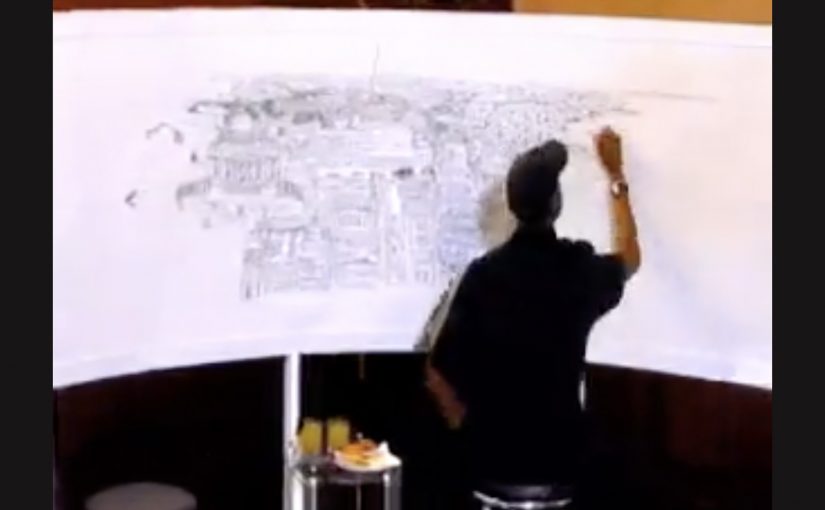
Stephen Wiltshire: Human Camera Over Rome

Stephen Wiltshire: Human Camera Over Rome

Stephen Wiltshire from London has been called the “Human Camera”. Here, “Human Camera” means the ability to retain and reconstruct a complex visual scene from memory with unusual precision. In this short excerpt, he takes a helicopter journey over Rome and then draws a panoramic view of what he saw, entirely from memory.

One flight, then a full panorama

The mechanic is simple and almost unbelievable. A brief aerial look at a city. Then a long, quiet reconstruction on paper, with landmarks, streets, and proportions held in his head rather than referenced from photos.

In global media and creativity culture, clips like this work because they show skill as proof, not as a claim.

The real question is why this setup makes the proof feel so undeniable.

Why it lands

It compresses something we usually outsource to cameras into a single human performance. The helicopter ride sets a hard constraint, and the drawing becomes the payoff. This is a stronger proof format than a simple claim of talent, because the audience can watch the capability being earned under pressure.

Extractable takeaway: When you want an audience to believe a capability, show the constraint first and the proof second. The tighter the constraint, the more convincing the proof feels.

What to steal for creative work

  • Lead with the constraint. The “how” is what makes the “wow” credible.
  • Make the process visible. Progress shots and time-lapse style excerpts turn craft into narrative.
  • Let detail do the selling. Specificity beats hype, especially in talent stories.

A few fast answers before you act

What is the core of this excerpt?

A short flight over Rome followed by a panoramic drawing created from memory, framed as a demonstration of exceptional recall and draftsmanship.

Why is the “Human Camera” label so sticky?

Because it gives people a shortcut for the ability they are seeing. It translates an abstract skill, visual memory, into a familiar metaphor.

What makes proof clips like this shareable?

The setup is instantly explainable, and the payoff is visual. Viewers can share it without adding context and the clip still lands.

How would you apply this structure to a brand story?

Show one clear constraint, then demonstrate the capability under that constraint. Keep the proof concrete and easy to verify on-screen.

What should creative teams borrow from this setup?

Borrow the sequence, not the spectacle. Put the limitation up front, make the process visible, and let the final proof resolve the tension.