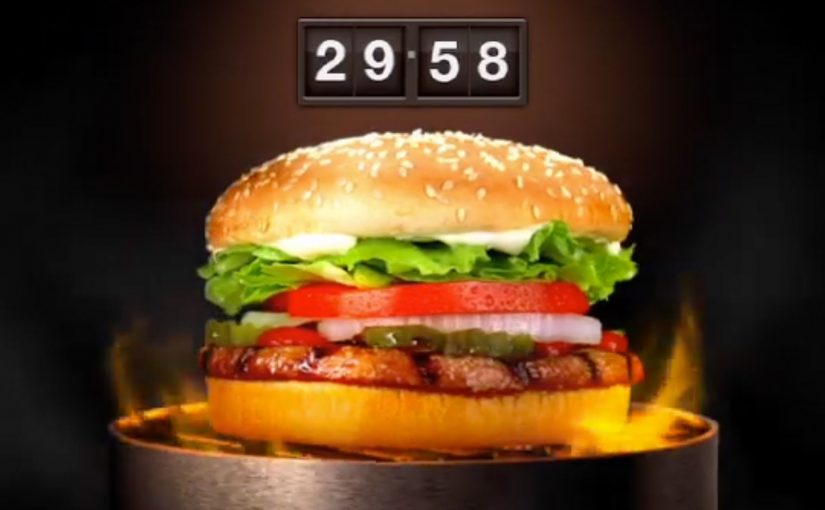
Stare at a picture of a Whopper long enough and you win one. That’s the premise of an interactive TV campaign from Burger King. What looks like a never-ending ad is actually a dedicated TV channel on DirecTV channel 111, built around a spinning flame-grilled burger and a timer.
To win, you tune in and activate the Whopper Lust challenge. A five-minute countdown starts, and you have to keep watching the rotating Whopper for the full duration. Make it to five minutes and you earn one free burger. Keep going for another ten and you earn two. Keep going and the rewards scale. The longer you last, the more you unlock.
The catch is that the channel occasionally prompts you to hit buttons on your remote. Miss one and the clock resets, so you lose the reward you were building toward. Complete the challenge and you can claim the free burger directly on the TV.
How the mechanic turns attention into currency
This is “watch time” treated like a loyalty program. Here, “watch time” means the viewer’s sustained, verified attention, not just a channel left on in the background. The spinning Whopper is deliberately hypnotic, the timer makes the commitment explicit, and the remote prompts prevent passive cheating. It is simple, but it forces real engagement rather than background viewing.
That works because the timer defines the commitment, the remote prompts verify attention, and the visible progress makes the reward feel earned rather than handed out.
In US quick-service marketing, converting a passive channel into a participation loop can buy disproportionate attention without buying proportional media.
Why this lands
It works because it is a dare, not a discount. The reward feels earned, and the friction is oddly satisfying because it creates tension. Will you slip and reset. The interaction also turns a solitary act. Watching TV. Into a game you can talk about immediately.
Extractable takeaway: If you want people to stay with a message, make the “cost” a clear, timed commitment and add periodic interaction checks, so attention becomes an active choice rather than a passive exposure.
What Burger King is really optimizing
This is not just a giveaway. It is a retention play. The real question is how to turn passive media time into a branded challenge people willingly stay with. The channel trains repeat viewing, creates a habit loop, and attaches the brand to a measurable “I lasted” story. Reported campaign figures describe large volumes of burgers given away and large volumes of watch minutes generated over the week.
What to steal from attention-for-reward mechanics
- Make the rule instantly legible. “Watch X minutes. Win Y.” is frictionless to understand.
- Prevent passive participation. Add simple interaction prompts to keep it honest.
- Let rewards compound. Escalation keeps people in the loop longer than a single prize.
- Turn viewing into a game. A timer and resets create stakes without complex tech.
A few fast answers before you act
What is the Whopper Lust Challenge?
It’s an interactive TV activation where viewers watch a dedicated Burger King channel and earn free Whoppers based on how long they stay engaged.
How do you win a free Whopper?
You activate the challenge, watch the spinning Whopper for five minutes, and respond correctly to occasional remote-control prompts so the timer does not reset.
Why add remote button prompts?
To ensure people are actually watching and interacting, not leaving the channel on in the background.
What makes this different from a normal TV ad?
The ad is the channel, and the viewer is part of the mechanic. Time and interaction directly determine the reward.
What’s the main risk with this format?
If the interaction prompts feel unfair, too frequent, or glitchy, frustration overwhelms the fun and people drop out.