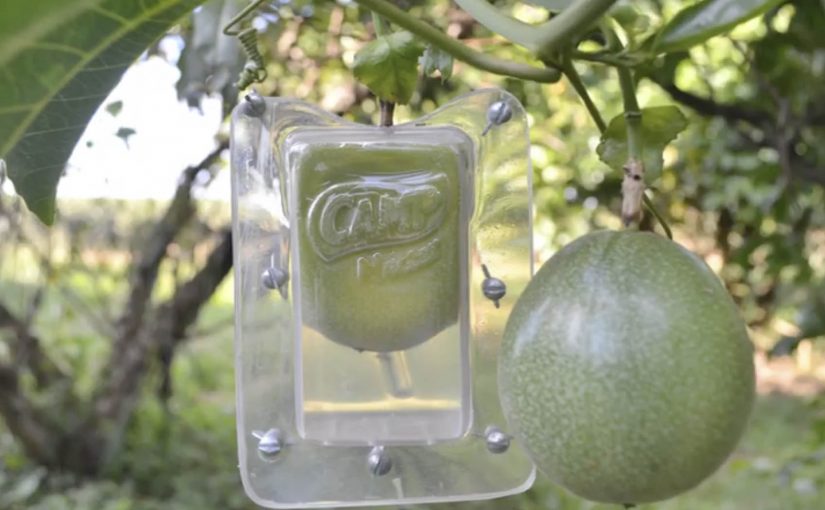
A piece of fruit is hanging from a tree. But it is not round. It is shaped like a juice pack, complete with the unmistakable carton silhouette.
Brazilian agency ageisobar was asked to prove that Camp Nectar juices were all natural. So they created molds in the shape of the brand’s packaging and attached them to fruit as it grew on farms. As the fruit developed and ripened, it took on the exact shape of the juice box, turning “made from real fruit” into something you can see without reading a claim.
The mold-on-tree mechanic
The mechanism is product proof, not persuasion. By product proof, the campaign uses the fruit itself as evidence instead of asking the audience to trust a written claim. Instead of showing ingredients or production steps, the campaign engineers a physical outcome that can only happen if real fruit is involved. The fruit becomes the packaging, and the packaging becomes the argument.
In packaged food and beverage marketing, “natural” claims are often distrusted, so literal demonstrations that collapse the gap between product and source earn attention faster than explanations.
Why the visual is hard to forget
The idea lands because it is a contradiction you can resolve instantly. You see something impossible, then you understand the trick, and the understanding reinforces the claim. It is also inherently shareable because the proof fits in a single frame. A fruit that looks like the pack.
Extractable takeaway: If your claim is routinely doubted, design a one-image demonstration that makes the claim self-evident, then let distribution follow the proof rather than the copy.
What the brand is really doing
Camp Nectar is not just saying “we’re natural”. It is trying to reset the credibility bar in a category full of vague promises. The stronger strategy is to make the claim visible, not louder. The execution borrows the authority of nature itself. Growth, time, and farming become the brand’s endorsement.
The real question is not whether the brand can say “real fruit”, but whether it can make that claim feel self-evident at a glance.
What food and beverage brands can take from this
- Prove, do not promise. Engineer a physical or behavioral outcome that functions as evidence.
- Compress the story into one frame. If the proof reads in a second, it travels further.
- Let the medium match the message. A farm-grown artifact is more persuasive than a studio-made graphic.
- Keep the claim implicit. When the proof is strong, the audience supplies the conclusion for you.
A few fast answers before you act
What is “Real Fruit Boxes”?
A demonstration campaign where real fruit is grown inside juice-box-shaped molds so it ripens into the shape of Camp Nectar’s packaging.
Why does this work better than ingredient messaging?
Because it is evidence-first. The audience sees a physical result that implies real fruit without needing technical explanation.
What is the core creative principle?
Make the proof visual, literal, and instantaneous. One glance should communicate the point.
What is the main execution risk?
If the proof looks fabricated or overly staged, trust collapses. The craft has to feel like a real-world process, not a prop.
When should brands use “literal proof” ideas?
When the category is saturated with claims and skepticism is high, and you can create a demonstration that is simple, safe, and repeatable.