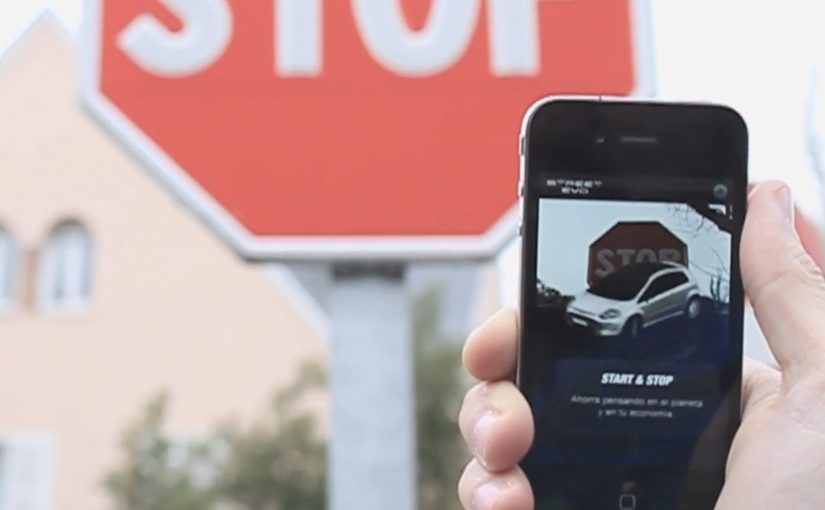
Leo Burnett Iberia has launched a new app called Fiat Street Evo, described as a “not-printed” car catalogue. A catalogue that is virtually on every street in your city.
Fiat Street Evo recognises traffic signs as if they were QR codes and associates each sign with a feature of the new Fiat Punto Evo. For example, a STOP sign points you to braking. A curve-ahead sign points you to intelligent lighting that guides you through bends. The list continues across the everyday signage you pass without noticing.
When street furniture becomes a product demo
The mechanism is a neat inversion of the usual brochure logic. Instead of printing a catalogue and hoping people keep it, the city becomes the index. Your camera becomes the browser, and the sign becomes the trigger. Here, “street furniture” means the signs and fixtures already in public space.
In automotive launch marketing, the strongest mobile ideas turn the real world into media without asking people to change their routine.
Why it lands
It reframes “specs and features” as discovery. You do not read a list. You unlock a feature in context, tied to a symbol you already understand. That makes the catalogue feel lighter, and it makes exploration feel like play rather than research. This pattern is stronger than a brochure-style feature list because it earns attention through context, not interruption.
Extractable takeaway: Product education travels further when it is organised around familiar cues in the environment, not around the brand’s feature taxonomy.
What Fiat is really trying to achieve
The real question is whether you can make the phone the first place curiosity goes by attaching product education to cues people already recognise. This kind of execution is doing two jobs at once. It builds attention for a new model, and it makes the phone the first place curiosity goes. That matters because the intent moment is not always at a dealership. It is often on the street, in motion, and in between other tasks.
Patterns to borrow for mobile launch marketing
- Borrow existing symbols. Traffic signs already carry meaning. Use that meaning as your information architecture.
- Keep the mapping intuitive. The sign-to-feature link should feel obvious, or people will drop the experience.
- Design for quick sessions. One sign. One feature. One payoff. Repeat when you feel like it.
- Make “catalogue” feel like exploration. A sense of discovery beats a long scroll of specifications.
- Use the city as distribution. When the triggers are everywhere, frequency becomes effortless.
A few fast answers before you act
What is Fiat Street Evo in one sentence?
It is a mobile catalogue concept that recognises traffic signs and uses each sign to reveal a related Fiat Punto Evo feature.
Why call it a “not-printed car catalogue”?
Because the “pages” are distributed across the city as street signs. The phone becomes the reader, and the street becomes the catalogue.
What makes the sign-to-feature mapping important?
The mapping is the comprehension layer. If the association feels natural, users keep going. If it feels random, the idea collapses into novelty.
What is the biggest execution risk?
Recognition reliability. If the app struggles to identify signs in real conditions, people will not persist beyond the first attempt.
What should you measure in a pilot?
Successful recognitions per session, repeat usage, time-to-first-payoff, and whether the experience increases search, dealership visits, or brochure requests.