
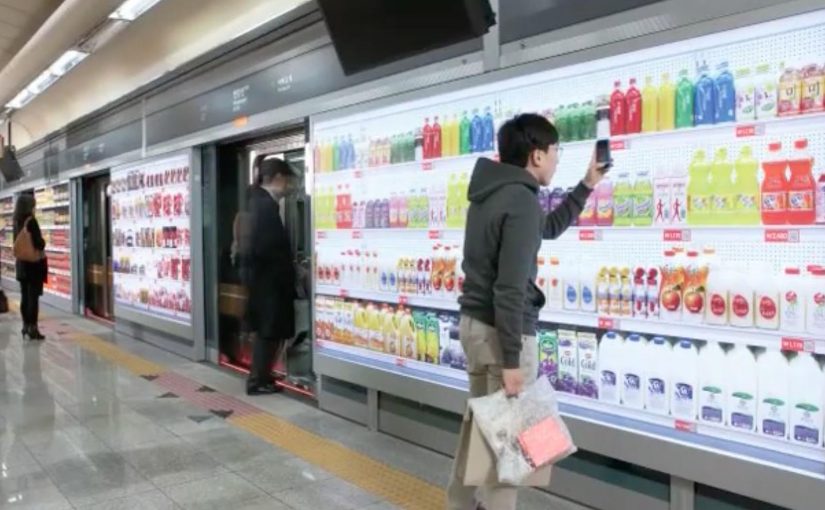
A retail store that lives on a subway wall
Homeplus turns a familiar commuter moment into a shopping moment.
Instead of asking people to visit a store, Homeplus brings the store to where people already wait. In the subway.
The virtual store appears as a life-size shelf display on station walls. Products are shown like a real aisle, complete with packaging visuals and clear selection cues.
The value is not novelty. It is time leverage. Shopping happens in minutes that normally get wasted.
How it works
The experience is deliberately simple.
A commuter scans product codes with a smartphone, adds items to a basket, and completes the order digitally. Delivery then happens to the home address.
That flow changes the meaning of convenience. The store is no longer a destination. It becomes an interface layer that can be placed anywhere footfall exists.
In high-density urban retail, the strongest convenience plays capture existing dwell time instead of trying to create new store visits.
Why this idea matters more than the technology
It is tempting to frame this as a QR-code story. That misses the point.
The strategic innovation is contextual retail design.
Homeplus places the catalog where time is available, reduces friction to scan, pay, and deliver, and treats the physical environment as media and distribution at once.
The subway becomes a high-intent moment. People have time, they are idle, and they are already in a routine. Retail becomes a habit stitched into commuting.
What this signals for retail experience design
This concept highlights a shift that becomes increasingly important.
Retail experiences are not confined to stores or screens. They can be embedded into everyday environments where attention is naturally available.
For leaders, the question becomes where the best micro-windows of time exist in customers’ lives, and what a purchase flow looks like when it fits perfectly into those windows.
The real lesson. The aisle is a format, not a place
Homeplus shows that an aisle is a navigational model. It does not have to live inside a store.
Once that is accepted, the design space expands. Aisles can be printed. Aisles can be projected. Aisles can appear in transit, at events, or in high-dwell environments.
The pattern is consistent. Retail becomes more modular. Distribution becomes more creative. Convenience becomes a design discipline.
A few fast answers before you act
What is the Homeplus subway virtual store?
It is a life-size “aisle” display in a transit environment where commuters scan products with a phone and order delivery to home.
What is the core mechanic that makes it work?
A fast scan-to-basket flow that turns waiting time into a purchase moment, with fulfillment doing the heavy lifting after the scan.
What is the main prerequisite for repeating this model?
Operational reliability in fulfillment. If delivery fails, the experience collapses because the shopper has no store fallback.
Why is this more than a QR-code story?
The strategic innovation is placing a commerce interface inside a high-dwell routine, using the physical environment as both media and distribution.