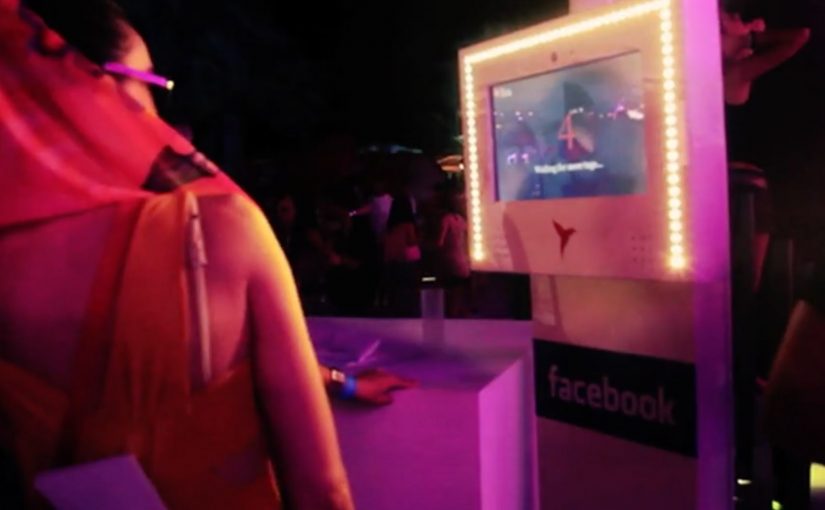
You arrive at Ushuaïa Beach Hotel in Ibiza wearing an RFID-enabled bracelet. Around the venue, pillars invite you to check in, take photos, or post a status update. You step up, scan your bracelet, and your moment is shared straight to Facebook from the beach, the pool, or the dance floor. The objective is simple. “Make all your Facebook friends jealous.”
What Ushuaïa builds with RFID and Facebook
RFID technology and its integration with social APIs is becoming more mainstream. Here, RFID means a radio-frequency identification chip in the guest wristband that lets the hotel recognize the wearer with a quick scan. In this example, Ushuaïa Beach Hotel becomes the world’s first hotel to use RFID to engage guests through social sharing. The installation is created by Dorst & Lesser, who also create the Renault RFID installation at the Amsterdam Auto Show. The business intent is clear. Turn guest activity into social distribution for the venue.
How the pillars drive sharing across the hotel
The hotel is outfitted with pillars that read RFID-enabled bracelets. Depending on where you are and what the pillar offers, you can check in, take pictures, or post a status update. The pillars are placed at the beach, the pool, and on the dance floor, so sharing becomes a physical action you repeat throughout the experience.
In hospitality, nightlife, and live-experience marketing, the scalable advantage is not more content tools but lower-friction moments that guests want to publish in public.
Why this pattern matters beyond Ibiza
This is a smart hospitality activation because it turns guest presence into guest-generated distribution. The real question is how to make sharing feel native to the venue instead of like extra work on a phone. Because the bracelet carries identity and each pillar offers a predefined action, the system removes login and typing friction, which is why guests can repeat the behavior in the middle of the experience.
Extractable takeaway: When identity, action, and location are already built into the environment, social sharing stops feeling like a separate task and starts behaving like a byproduct of the experience.
This RFID and Facebook integration is also used at the Coca-Cola Village in Israel.
What to steal for RFID-powered social sharing
- Make the environment the interface. Pillars in specific zones turn “sharing” into a physical, location-based action.
- Offer one clear action per touchpoint. Check-in, photo, or status is easier to adopt than a menu of options.
- Keep the identity token effortless. A wearable wristband reduces friction compared to phones, logins, or QR codes.
- Design for social proof in public. When others can see the interaction, participation becomes contagious.
A few fast answers before you act
What is the Ushuaïa RFID Facebook sharing concept?
Guests wear RFID-enabled bracelets and use scanning pillars placed around the hotel to trigger Facebook check-ins, photos, and status updates from different locations.
Why place pillars at the beach, pool, and dance floor?
Because those are the high-emotion moments guests want to share. Putting the tech at the peak moments increases usage and makes sharing feel like part of the experience.
Why use a wearable instead of a phone workflow?
A wearable reduces friction. Guests do not have to unlock a phone, open an app, log in, and type in the middle of the moment.
What is the key design lesson for brands?
Make sharing an outcome of participation, not a separate workflow. When the action is physical, fast, and obvious, publishing scales without instruction.
What should you measure if you run something similar?
Scan volume by location, repeat scans per guest, social reach and engagement of generated posts, and any lift in on-site dwell time around the activation points.