
The Beauty Machine by Dove

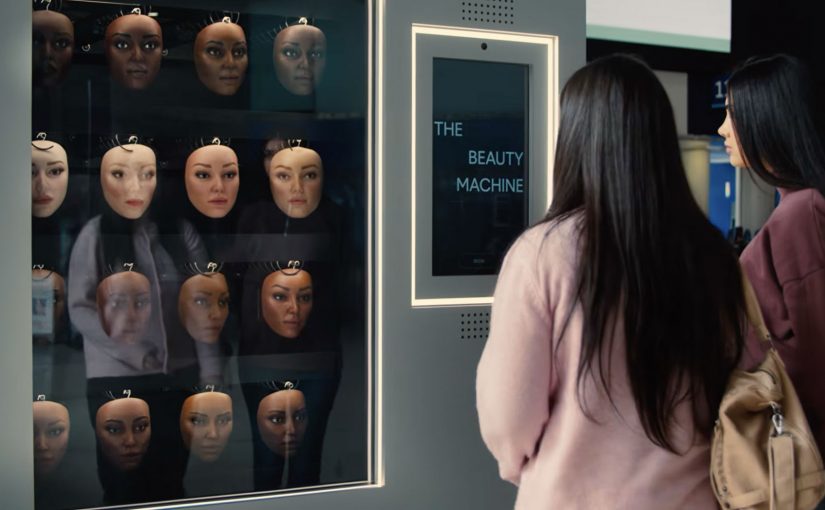
At London’s Waterloo Station, Dove placed rows of different faces inside a vending machine. It invited passers-by to “choose your face” and “pay with your face”, yet every choice produced the same perfect face.

I have featured dozens of unique vending machines over the years. Most use convenience, novelty or personalisation to create a brand experience. Dove uses the format to expose the opposite: the illusion of choice.

That reversal makes The Beauty Machine useful beyond its creative novelty: it shows how to turn invisible system behavior into a physical experience, connect that experience to consumer participation, and quickly feed the response back into the idea.

The mechanism – false choice made physical

At Waterloo station, masks with different skin tones and features appeared to offer a variety of faces. The screen prompted people to select a face and pay with their own, but the machine kept delivering the same ideal face, mimicking a social feed that keeps showing the same beauty ideals now in the form of a vending machine.

This campaign is part of Dove’s long-running “Real Beauty” platform, which began in 2004. The idea started with a simple challenge to traditional beauty advertising: instead of showing only professional models and heavily edited images, Dove began featuring real women of different ages, body types and ethnicities to broaden what “beauty” looks like in media.

Over time, the platform has evolved alongside changes in how beauty is shaped and distributed. In the 2000s, that meant challenging magazine retouching and TV advertising standards. Today, it focuses on newer pressures like social media filters, AI-generated faces and algorithm-driven feeds that repeatedly promote narrow, idealised versions of beauty.

So when this campaign references the Real Beauty platform, it connects the same long-term idea of questioning unrealistic beauty standards to today’s digital systems that now influence what people see and compare themselves against every day.

Because people experience the false choice instead of hearing an explanation about how social media algorithms decide what we see, the campaign turns an invisible loop into something visible and uncomfortable within seconds.

Dove reports that almost one in two women and girls in the UK feels pressured to change their appearance even when they know an image is fake. The machine gives that statistic a behaviour people can see: apparent abundance at the front, narrowing selection behind it.

Why it lands – the format carries the argument

A vending machine is a familiar symbol of convenient choice. You see different options, press a button and receive the one you selected. Dove keeps that familiar interface but removes the expected result: many visible choices lead to one standardised output.

The instruction to “pay with your face” pulls the observer into the contradiction. The issue is no longer happening somewhere inside an inaccessible technology platform. It becomes a personal transaction.

Developed with Ogilvy UK and Emmy-winning documentary filmmaker and photographer Lauren Greenfield, the execution needs very little explanation because the object carries the argument.

The strongest experiential work does not decorate a message; it lets people enact the problem.

Participation at speed – the audience changes the output

The activation then became a participation loop. A participation loop is the process that takes a consumer submission, moves it through approval, and returns it into public distribution.

Through #DoveOpenCall, women were invited to submit unfiltered photographs representing their individual beauty. Dove says participant images began appearing on digital billboards across Waterloo within 48 hours, replacing the machine’s repeated face with real differences.

The strongest part of The Beauty Machine is therefore not the machine itself; it is the response system that allows the audience to change what appears next.

The real question is whether the organisation behind the idea can move consumer participation through consent, usage rights, moderation, brand approval, production and media deployment quickly enough to keep the response culturally live. That only works if there is a connected submission-to-publishing system in place i.e. from consent and usage-rights capture through moderation, DAM intake, legal and brand approval, templated production, digital-out-of-home deployment, social publishing and measurement. Without that end-to-end chain, an open call simply accumulates content instead of becoming a live campaign.

Brand platform – one conviction, a new opponent

The business value comes from keeping the same belief over time. Dove still stands for women defining beauty, but it continually updates what it challenges as beauty is now shaped by algorithms and social feeds.

The installation later appeared in Hamburg and Cannes. That turns one creative object into a repeatable activation format that can travel while retaining the same central argument.

This is a useful model for long-running brand platforms. Instead of inventing a new purpose for each campaign, keep the conviction stable, identify how the surrounding system has changed, and build the next activation around that change.

At enterprise scale, repeatability still needs central narrative control, local activation ownership, media coordination, content governance and a reusable response process. The creative platform and the operating model have to travel together.

The limit – what it does and doesn’t change

The Beauty Machine does not change how social media recommendation algorithms work.

Its impact sits in representation: what Dove chooses to surface publicly and how it invites women to contribute to that output.

It should therefore be measured through participation, published representation, speed of publication, audience response and brand perception, not as evidence of platform-level algorithm change.

From open call to billboard – design the path before launch

For marketing teams, the 48-hour billboard payoff is a design constraint, not a final media flourish. Creative, consumer experience, legal, content operations, data, technology and media teams need to align behind the scenes before a contribution is published.

The takeaway: if a campaign asks people to help change the story, design the complete response path before launch, including consent, moderation, asset handling, approvals, production, distribution and measurement; otherwise participation becomes a promise the operating model cannot keep.


A few fast answers before you act

What is Dove’s Beauty Machine?

Dove’s Beauty Machine is a vending-machine-style installation first shown at London’s Waterloo Station. Although the masks appeared different, they repeatedly produced the same composite face, dramatising how algorithmic repetition can narrow the range of beauty people see online.

Why does the vending-machine format work?

A vending machine normally promises visible choice and a predictable result. Dove reverses that familiar logic by making many apparent options produce the same face, turning the illusion of online variety into an immediately understandable physical experience.

What is #DoveOpenCall?

#DoveOpenCall is Dove’s open casting call inviting women to share unfiltered photographs of their individual beauty. Participant images were distributed through out-of-home and social media, with images beginning to appear on Waterloo billboards within 48 hours.

What makes the campaign operationally interesting?

The Beauty Machine connects a physical activation to consumer submissions and rapid public distribution. A repeatable version of that model requires consent, moderation, asset management, approvals, templated production, media publishing and measurement to operate as one response system.

Does The Beauty Machine change social media algorithms?

No. The Beauty Machine does not alter platform recommendation systems. It broadens representation through Dove’s campaign output, so its impact should be assessed through participation, distribution and brand measures rather than claims of algorithmic reform.

What should marketers learn from Dove’s approach?

Marketers should design the consumer experience and the response infrastructure as one system. If participation is central to the creative promise, ownership, governance, technology and publishing speed must be designed before launch.
Pomelli Photoshoot: Fast studio-quality assets

Start with one approved product image, then generate channel-ready variants fast enough to reduce reshoot demand, review churn, and asset bottlenecks.

A jar in your hand. A whole shoot in your CMS

Start with the most ordinary thing in e-commerce. A single product photo, shot on a desk, held in a hand, good enough for internal approval but nowhere near “campaign-ready”. Then imagine turning that one image into a set of studio and lifestyle shots that look like you planned the lighting, the surface, the props, and the framing.

That is the pitch behind Photoshoot, a feature inside Pomelli from Google Labs: take a basic product image and generate professional-grade marketing imagery fast, without booking a studio for every new variant. “Studio-grade” here means assets that can sit on a PDP or paid social without instantly looking like “placeholder content”.

How Photoshoot turns one product photo into usable marketing imagery

Photoshoot is not just “generate me a nicer background”. It is a guided flow designed to keep output consistent.

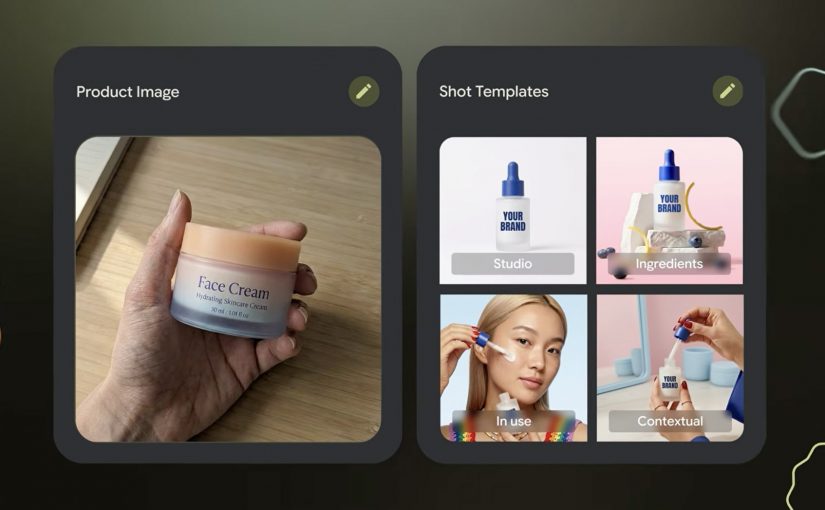
  1. Pick a product photo. The input can be imperfect. The tool is explicitly designed to handle “don’t worry about polish”.
  2. Choose a template. Templates are pre-built shot styles (for example studio or lifestyle) that constrain composition so results do not drift into random aesthetics.
  3. Generate. Pomelli applies your brand aesthetic via its Business DNA, then generates new shots. Business DNA is Pomelli’s saved brand profile derived from your website (voice, fonts, imagery, color palette).
  4. Refine. You iterate with finishing touches, then download assets or store them back into Business DNA for reuse in later campaigns.

Under the hood, Google describes this as combining business context (Business DNA) with Nano Banana image generation to produce the final scenes.

In high-velocity retail and FMCG e-commerce teams shipping new SKUs (Stock Keeping Units) and promos weekly across many markets, this is the shortest path from “we have a product” to “we have compliant, channel-ready variants”.

The real question is whether one approved product shot can produce enough on-brand variants to increase throughput without increasing review drag.

Why it lands. Because it cuts the real friction, not the fun part

Most teams are not blocked on “having ideas”. They are blocked on throughput with consistency: getting enough variants, in enough formats, that still look on-brand, pass review, and do not trigger rework across design, legal, and local markets.

This is why the mechanism matters. Because Photoshoot grounds outputs in Business DNA and constrains composition via templates, the results tend to feel brand-consistent faster, which reduces review churn and makes variant production scalable.

Extractable takeaway: If you want generative creative to survive enterprise review, do not start with infinite freedom. Start with constraints that encode your brand (a reusable brand profile) and your channel rules (shot templates), then let the model fill in the pixels inside that box.

The business intent is blunt. Production leverage for asset variants

“Production leverage” is the multiplier you get when one person-hour produces many more usable assets without multiplying headcount or agency spend. For e-commerce teams, Photoshoot is essentially a variant engine.

Its real enterprise value appears when it fits between PIM, DAM, CMS, and channel publishing as part of the asset supply chain, rather than sitting as a standalone creative tool.

  • More PDP (Product Detail Pages) imagery coverage without re-shooting every pack change.
  • More paid social iterations without waiting on design queues.
  • Faster seasonal refreshes when the same SKU needs a new context (spring, gifting, back-to-work).
  • A tighter loop between merchandising and creative because the cost of “try another angle” collapses.

Important reality check: you still need governance. Treat outputs like any other marketing asset. Rights, claims, pack accuracy, and local compliance do not disappear just because generation is fast.

Without asset lineage, approval states, and pack-level control, faster generation just pushes bottlenecks downstream into legal review, localization, and channel operations.

Where it fits, if available in your region

For enterprise teams, the more important question is not where to access the tool, but who owns the workflow, approval model, and publishing controls around it.

The Pomelli app on Google Labs is where you can access the experience.

However availability is currently limited. Pomelli has been launched as a public beta experiment in the United States, Canada, Australia, and New Zealand (English).

What to steal for your next asset sprint if the app is available in your region

  • Codify brand constraints first. Build a reusable “brand profile” (fonts, tone, visual rules) before you chase more generations.
  • Template your shots like you template layouts. Decide the 6 to 10 shot types you actually need (hero studio, detail crop, lifestyle context, ingredient cue) and standardize them.
  • Design for review speed. Define what “acceptable” means (pack legibility, logo integrity, claims, background rules), then generate inside those rails.
  • Run a SKU ladder test. Start with 10 SKUs across easy and hard surfaces (glass, reflective, metallic). If it fails there, it will fail at scale.
  • Instrument the pipeline. Track time-to-first-usable, approval rate, and rework causes. That is how you prove leverage, not by “wow, looks nice”.

A few fast answers before you act

What is Pomelli Photoshoot, in one sentence?

Pomelli Photoshoot is a feature inside Google Labs’ Pomelli that turns a single product photo into professional-style studio and lifestyle marketing images using brand context and image generation.

What is the mechanic marketers should care about?

You choose a product image, select a curated template (studio or lifestyle), generate variants grounded in your Business DNA, then refine and download or reuse those assets in future campaigns.

What does “Business DNA” actually mean here?

Business DNA is Pomelli’s saved brand profile derived from your website, such as tone of voice, fonts, imagery, and color palette, which Pomelli uses to keep generated outputs consistent.

Where is Pomelli available right now?

Pomelli is in public beta in English in the United States, Canada, Australia, and New Zealand. It is not currently available in Germany.

What is the first safe way to pilot this in an enterprise team?

Pilot it on a small SKU set with strict shot templates and review criteria, then measure approval rate and rework reasons before scaling variant production.

Viral Content: Clone Winning Ads in Minutes

Viral video creation is shifting from a production task to an operating-model question, and Topview AI is a useful example.

For years, short-form performance video lived in two modes. Manual production that is slow and expensive. Or template-based generators that are faster, but still force you into lots of manual re-work.

Now a third mode is emerging: AI Video Agents, meaning systems that take a short brief plus a few inputs and generate a complete multi-shot draft you can iterate on.

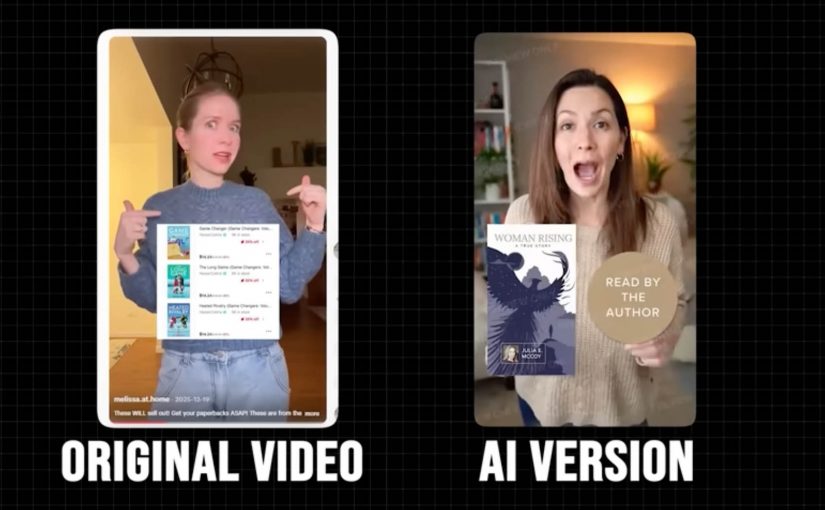
The shift is simple. Instead of editing frame-by-frame, you brief the outcome. Optionally provide a reference viral video. The agent then recreates the concept, pacing, and structure for your product in minutes. Your job becomes direction, constraints, and iteration. Not timelines.

Meet the AI Video Agent “three inputs” workflow

Topview’s core promise is “clone what works” for short-form marketing.

Upload your product image and/or URL so the system extracts what it needs. Share a reference viral video so it learns the shots and pacing. Get a complete multi-shot video that matches the reference style, rebuilt for your product.

That is the operational unlock. You stop asking a team to invent from scratch every time. You start generating variants of formats that already perform, then iterate based on outcomes.

In enterprise teams, that makes this less a content toy and more a new layer in the performance-creative operating model, where briefing quality, asset governance, and measurement discipline matter more than raw production capacity.

That changes what teams need to get right. Faster generation only creates value when the workflow improves how quickly the team learns what to scale.

What “cloning winning ads” really means

This is not about copying someone’s assets. It is about cloning a repeatable pattern.

Extractable takeaway: When a workflow can reliably regenerate a proven creative structure, the bottleneck shifts from making assets to choosing angles, proof, and guardrails that improve one test at a time.

High-performing short-form ads tend to share the same backbone. A strong opening. A clear value moment. Proof. A simple call-to-action. The variable is the angle and execution. Not the structure.

AI video agents are optimized to reproduce that backbone at speed, then let you steer the angle. Because the agent reuses a proven structure, you can spend your time on angles and proof, which increases iteration velocity. That is why they matter for performance teams. The advantage is iteration velocity. The risk is sameness if you do not bring differentiation in offer, proof, and brand voice.

What to evaluate beyond the AI Video Agent headline

I would not judge any platform by a single review video. I would judge it by whether it covers the tasks that constantly slow teams down.

From the “creative tools” surface, Topview positions a broader toolbox around the agent, including: AI Avatar and Product Avatar workflows, plus “Design my Avatar”. LipSync. Text-to-Image and AI Image Edit. Product Photography. Face Swap and character swap workflows. Image-to-Video and Text-to-Video. AI Video Edit.

This matters because real creative operations are never “one tool.” They are a chain. The more of that chain you can keep inside one workflow, the faster your test-and-learn loop becomes.

The practical question is whether that workflow plugs cleanly into your brand-asset flow, approval model, paid-social activation, and testing cadence without creating new review debt.

Topview alternatives. Choose by workflow role, not by hype.

If you are building an enterprise creative stack, choose these tools by workflow role, asset control, and measurement fit, not by demo quality.

HeyGen

HeyGen positions itself around highly realistic avatars, voice cloning, and strong lip-syncing, plus broad language support and AI video translation. It also supports uploading brand elements to keep outputs consistent across projects. Compared to Topview’s short-form ad focus and beginner-friendly “quick publish” style workflow, HeyGen is often the stronger fit when avatar-led and multilingual presenter content is your primary format.

Synthesia

Synthesia is typically strongest for presenter-led videos, especially training, internal communications, and more corporate-grade marketing explainers. Compared to Topview’s short product ad focus, Synthesia is often the cleaner fit when a human-style presenter is the core format.

Fliki

Fliki stands out when your workflow starts from existing assets and needs scale. Blogs, slides, product inputs, and team updates converted into videos with avatars and voiceovers, plus a large set of voice and translation options. Use Fliki when you want breadth and flexibility in avatar and voiceover production. Otherwise, use Topview AI when your priority is easily creating short videos from links, images, or footage with minimal workflow friction.

Operating moves for AI video agents

The real question is whether your team can turn minutes-long production into a disciplined iteration system without losing distinctiveness.

My take is that viral content is no longer mainly a production problem. It is an operating-model problem, because speed only compounds value when briefs, proof, guardrails, and learning loops are already in place.

  • Brief for outcomes, not assets. Define the hook, value moment, proof, and CTA before you generate variants.
  • Constrain sameness early. Put brand voice, offer boundaries, and “do not do” rules into the brief so speed does not turn into remix culture.
  • Run a ruthless learning loop. Test fewer, better variants. Kill quickly. Scale only what proves incremental lift.

Which viral video would you recreate first. And what would you change so it is unmistakably yours, not just a remix.


A few fast answers before you act

What does “clone winning ads” actually mean?

It usually means generating new variants that reuse the structure of high-performing creatives. The goal is to speed up iteration, not to copy a single ad one-to-one.

Is this ethical?

It depends on what is being “cloned.” Reusing your own learnings is normal. Copying another brand’s distinctive IP, characters, or protected assets crosses a line. Governance and review matter.

What will still differentiate brands if everyone can produce fast?

Strategy, customer insight, and taste. If production becomes cheap, the competitive edge moves to positioning clarity, creative direction, and the quality of testing and learning loops.

How should teams use this without flooding channels with slop?

Use strict briefs, clear brand guardrails, and a limited hypothesis set. Test fewer, better variants. Kill quickly. Scale only what proves incremental lift.

What is the biggest risk?

Over-optimizing for short-term clicks at the expense of brand meaning, trust, and distinctiveness. High-volume iteration can become noise if the work stops saying something specific.