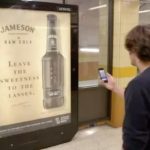
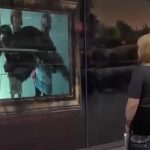
“Are you talking to me?” becomes a real question when a wall talks back. This month, people in high foot-traffic areas across New York and Los Angeles react to Jameson Irish Whiskey as if the city itself has started a conversation.
The idea defies the downturn mood by shifting from broadcast to banter. The wall does not just show a message. It performs a social moment with whoever walks past.
How the talking wall works
The mechanism is described as a projected interactive ad. A large-scale wall projection delivers conversational prompts and responses that feel directed at individuals in the crowd, turning a static surface into something closer to a street-level character than an ad unit. That works because the projection frames the encounter as a social exchange people instinctively want to resolve.
In urban brand marketing, interactive out-of-home can behave like a social channel when it turns passersby into participants rather than impressions.
Why it lands
It flips the usual power dynamic of outdoor media. Instead of you watching an ad, the environment appears to notice you. That creates a tiny moment of surprise and self-conscious humor, which is exactly what people share with friends standing next to them.
Extractable takeaway: If you want out-of-home to travel beyond the street, give it a social script, meaning a prompt people naturally know how to answer or perform. When the medium feels conversational, people perform it, and performance becomes distribution.
What Jameson is really buying
The business intent is to make the brand feel present in the city’s social fabric, not just visible on its surfaces. A “talking” installation creates memory through interaction, which can outperform pure reach when budgets are tight and attention is scarce.
The real question is whether the interaction makes Jameson feel socially present enough to be retold after the moment ends. Jameson is right to use interactivity here as a behavior engine, not a decorative layer.
What to steal from conversational out-of-home
- Write for interruption. A short line that sounds like it belongs in real life earns the first glance.
- Design for group reactions. Outdoor works best when it creates a moment that strangers can share in real time.
- Make the medium feel alive. Interactivity is not a feature. It is the reason people stop.
- Keep the proof simple. A single video that shows the reaction is often the most scalable artifact.
A few fast answers before you act
What is the core idea here?
Turn a wall into a conversational brand moment, using a projected interactive execution that feels like it is speaking directly to people on the street.
Why does “talking” out-of-home get attention?
Because it breaks expectation. Outdoor is usually passive. When it behaves like a person, people pause to resolve the surprise.
What makes this more than a stunt?
The interaction itself is the brand experience. The wall creates a repeatable feeling, and that feeling is what people remember, record, and retell.
What should a brand copy from this?
Start with a line that sounds native to the street, then make the interaction readable from a distance. If the setup triggers a shared reaction, the format can extend beyond the physical site.
What is the main pitfall to avoid?
If the interaction is unclear from a distance, people will not stop. The hook must read instantly, even before someone understands the tech behind it.