
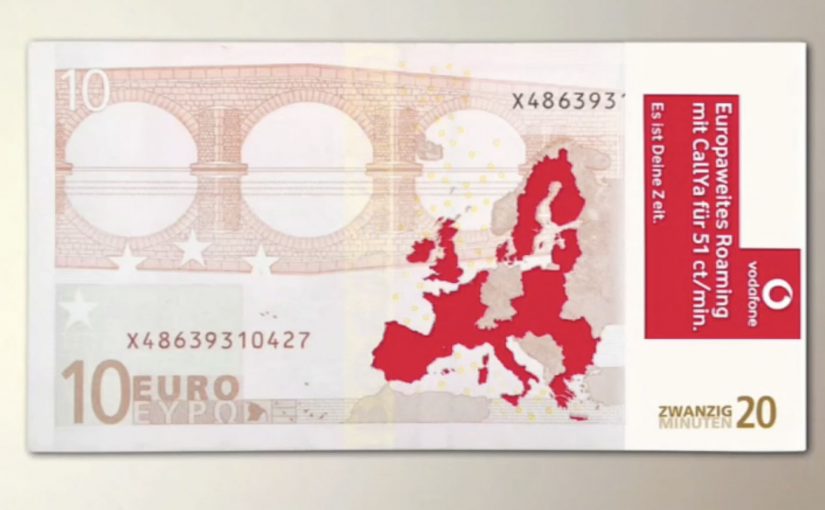
To promote Vodafone’s cheap roaming tariff for Europe, Scholz & Friends chose a medium that does not compete for attention. They modified banknotes with stickers, so the message reaches people in a very specific place, their wallet.
The idea is as low-tech as it is disruptive. Instead of asking travellers to notice another poster, banner, or leaflet, the campaign piggybacks on something they already handle repeatedly while travelling.
In European travel contexts, roaming costs are a practical irritation. Wallet-level touchpoints can cut through because they appear at the exact moment people are thinking about money and movement.
Why a sticker on cash beats a billboard
Most media fights for a glance. A banknote already has “permission” to be looked at, checked, counted, and passed along. Adding a sticker turns that routine behavior into repeated exposure, without needing a second of extra attention budget.
It is also inherently portable. Cash moves through hands, venues, and neighborhoods, which gives the idea a built-in distribution logic that feels organic rather than broadcast.
What the mechanic is really doing
- Context targeting: travellers touch cash, exchange cash, and pay in unfamiliar places.
- Frequency: one note can generate dozens of impressions across multiple days.
- Zero clutter: the message lives where ads rarely live, inside the payment ritual.
That is the core “clutter breaking” move. It replaces interruption with insertion.
Business intent under the simplicity
The immediate goal is recall for “cheap EU roaming” at the moment a traveller is likely to make a connectivity decision. The deeper goal is brand association with practical travel confidence, meaning Vodafone as the network that makes cross-border usage feel less stressful.
What to steal for your next campaign
- Choose a touchpoint people already trust, then add a light layer of message.
- Exploit repeated rituals, paying, checking, stamping, validating, not one-off exposure.
- Keep the promise instantly legible, one benefit, one reading, no decoding.
- Design for pass-along, so distribution is a property of the medium, not a separate plan.
A few fast answers before you act
What makes this “ambient” instead of traditional advertising?
The message is placed inside an everyday object people already use, rather than in a dedicated ad space that competes for attention.
Why is the wallet a powerful media channel for travel offers?
Because it is handled frequently during travel, and it naturally frames the offer around cost and practicality.
What is the main risk with banknote-based ideas?
Control and coverage. You cannot fully control who receives the notes, and scale depends on distribution logistics and how widely the notes circulate.
How do you measure impact when the medium is not digital?
Use proxies like search lift for the tariff term, store inquiries, roaming plan activations, and time-boxed correlation against the distribution window.
What is the transferable lesson beyond telecom roaming?
If your promise is about saving money or reducing travel friction, placing it inside a payment or travel ritual can outperform louder media because it arrives in-context.


